

Football matches are no longer decided only by talent or formations.
They are decided by where and how teams defend.
Two defensive approaches dominate modern football:
- the high press
- the mid-block
Understanding the difference between these two systems explains why some teams suffocate opponents, while others stay compact and wait for mistakes.
This guide breaks down high press vs mid-block (This is part of our complete series on Football Tactics.) in clear, practical terms — so you can recognize them instantly during matches and understand why managers choose one over the other.
Table of Contents
What Is a High Press?
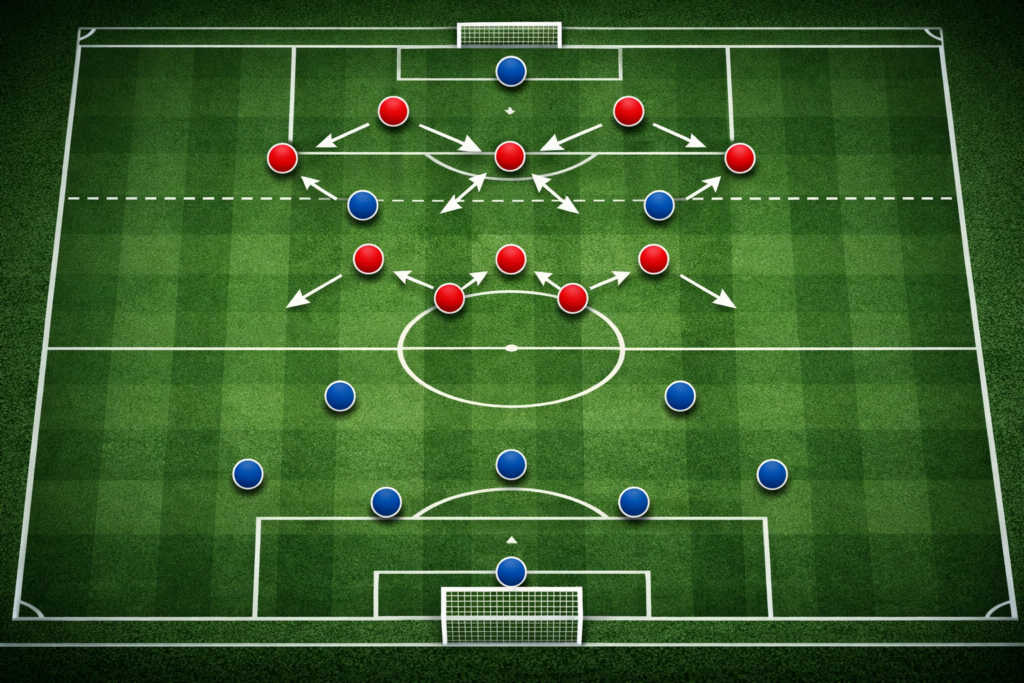
A high press is a defensive strategy where a team applies pressure high up the pitch, close to the opponent’s goal.
The objective is simple:
- force mistakes during build-up
- win the ball in advanced areas
- create immediate scoring chances
High pressing is aggressive, coordinated, and physically demanding.
Key characteristics of a high press
- Defensive line positioned near midfield
- Forwards initiate pressure
- Passing lanes to central midfield are blocked
- Traps are set near the sidelines
A high press only works when multiple players move together. One player pressing alone is not a system — it’s a gamble.
Enjoying the analysis?
Don’t Just Watch Football. Understand It.
Join KharaSportsDaily and receive occasional deep tactical insights most fans miss.
Occasional analysis. No match reports. No noise.
What Is a Mid-Block?
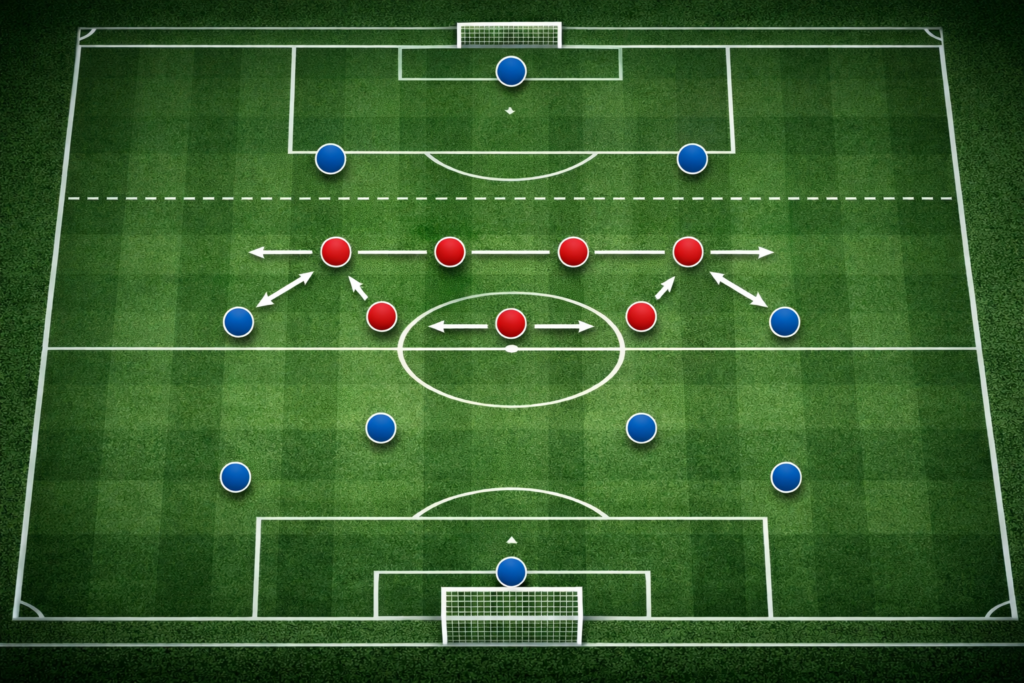
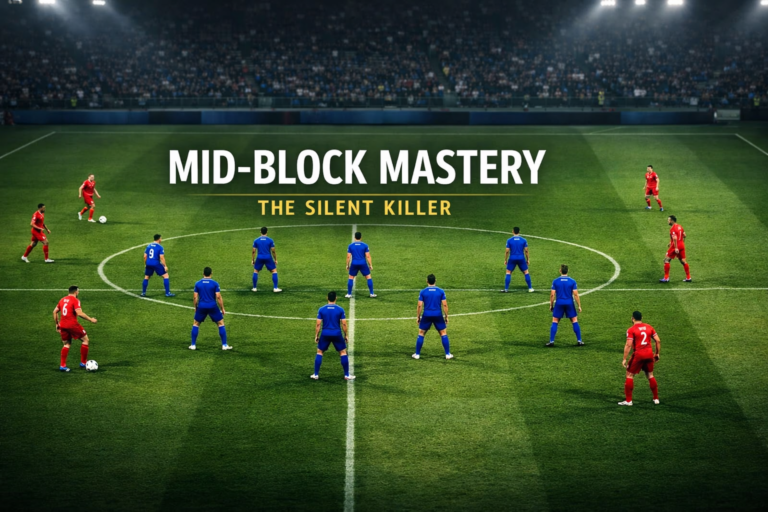
A mid-block is a more balanced defensive structure where a team defends around the middle third of the pitch.
Instead of pressing immediately, the team:
- stays compact
- protects central spaces
- waits for pressing triggers
Mid-blocks prioritize control over chaos.
Key characteristics of a mid-block
- Defensive line positioned closer to midfield
- Compact shape between defense and midfield
- Pressing begins after specific triggers
- Lower physical risk than a high press
Mid-blocks are especially effective against teams that rely on structured build-up.
| Aspect | High Press | Mid-Block |
|---|---|---|
| Defensive Height | Very high | Medium |
| Risk Level | High | Moderate |
| Physical Demand | Very high | Balanced |
| Ball Recoveries | Near opponent’s box | In midfield |
| Best Against | Weak build-up teams | Possession teams |
| Main Strength | Forces mistakes | Controls space |
| Main Weakness | Vulnerable if beaten | Allows controlled possession |
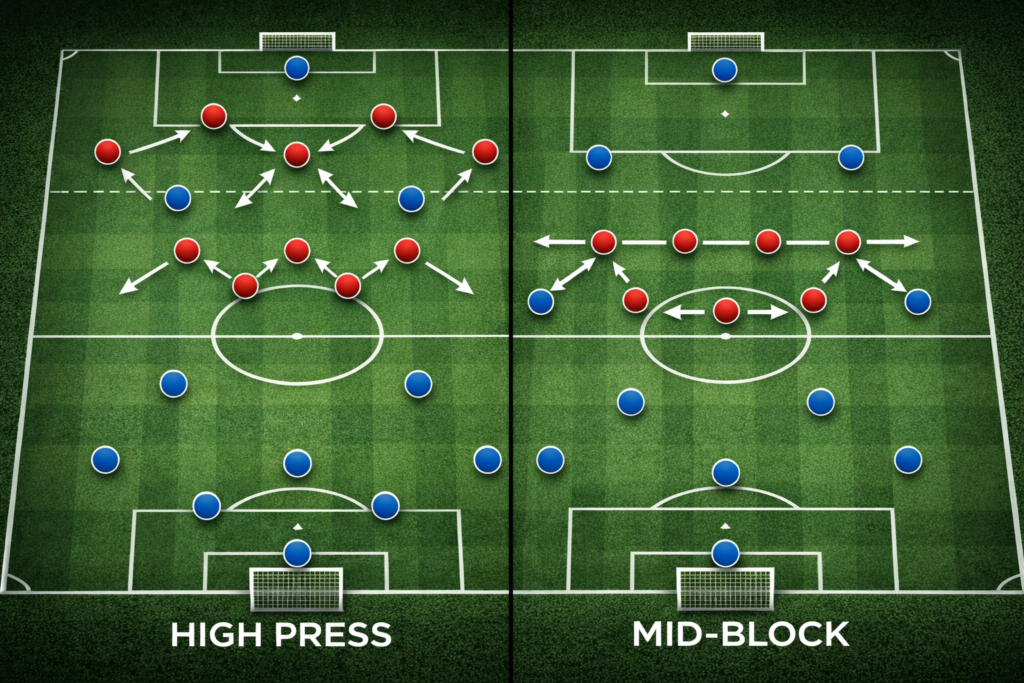
High Press vs Mid Block comparison explains why managers switch between these systems depending on opponents, scoreline, and squad profile.
Pressing Triggers: The Hidden Detail That Matters
Neither system works without pressing triggers.
Common pressing triggers include:
- a backward pass
- a poor first touch
- a pass to a full-back near the sideline
- a defender receiving the ball with back to play
In a high press, triggers lead to immediate collective pressure.
In a mid-block, triggers signal when to step out without breaking shape.
This is why pressing is about timing, not speed.
For readers who want to explore pressing concepts in more depth, these resources provide additional tactical context:
- For deeper tactical context, see FIFA’s technical football insights.
- Additional tactical analysis is available via UEFA’s technical development resources.
Why Teams Choose a High Press or a Mid-Block
Why Teams Choose a High Press
Managers choose a high press when:
- they want to dominate territory
- they trust their defenders in space
- they have athletic forwards
- they want fast goals, not long possession spells
High pressing is often used:
- early in matches
- after conceding
- against teams uncomfortable on the ball
However, high presses are fragile. One clean pass can break the system that mid-block might not be able to.
Why Teams Choose a Mid-Block
Managers prefer a mid-block when:
- protecting a lead
- facing elite build-up teams
- managing player fatigue
- prioritizing defensive stability
Mid-blocks reduce:
- space between lines
- exposure to counter-attacks
- physical overload over 90 minutes
This makes mid-blocks extremely popular in knockout tournaments.
High Press vs Mid-Block in Real Match Scenarios
A key misconception is that teams use only one system.
In reality:
- teams often start in a mid-block
- shift into a high press during key moments
- drop back again after losing energy
Modern football is about fluid defensive behavior, not rigid systems.
Common Mistakes Fans Make When Watching Pressing
Mistake 1: Judging by one player
Pressing is collective. One forward sprinting means nothing without support.
Mistake 2: Confusing intensity with effectiveness
A team can run a lot and still press poorly.
Mistake 3: Thinking pressing is constant
Even high-pressing teams rest in mid-blocks during matches.
Which System Is Better?
There is no universally “better” system when it comes to High Press vs Mid-Block
- High presses create chaos and quick chances
- Mid-blocks create control and stability
The best teams master both — and know when to switch.
That decision separates elite managers from average ones.
How This Fits Into Modern Football Tactics
High press vs mid block is the foundation of modern tactics.
It influences:
- build-up structures
- counter-pressing
- defensive transitions
- attacking spacing
Next tactical layer:
If pressing is about winning the ball, build-up play is about keeping it. Our in-depth guide on build-up play explained breaks down the structures teams use to progress the ball under pressure. Once you understand this comparison, everything else — from build-up play to low blocks — becomes easier to read.
Final Thoughts
High pressing and mid-block defending are not opposing philosophies but contextual tools used to manage space, risk, and control. A high press prioritizes immediate pressure and territorial dominance, while a mid-block focuses on compactness, stability, and selective engagement.
The effectiveness of either approach depends less on aggression and more on collective timing, spacing, and role clarity. Teams that press high without structure expose themselves; teams that sit too passively in a mid-block surrender initiative. The balance lies in understanding when to step forward and when to protect space.
Modern football rarely commits to a single defensive height. Instead, teams shift between high press, mid-block, and recovery phases depending on game state and opponent behavior. Understanding the principles behind both systems is essential for reading how teams defend—and why they choose one approach over another.
Enjoyed this breakdown?
Don’t Just Watch Football. Understand It.
Join KharaSportsDaily and receive occasional deep tactical insights most fans miss.
Occasional analysis. No match reports. No noise.
Frequently Asked Questions (FAQs)
Is high pressing risky?
Yes. High presses expose space behind the defense. If the press is broken, teams can concede quickly.
Is a mid-block defensive football?
Not necessarily. Mid-blocks can be proactive, intelligent, and aggressive when triggers are used correctly.
Do top teams still use mid-blocks?
Absolutely. Even elite possession teams defend in mid-blocks depending on game state.
Can a team switch between both in one match?
Yes. Most modern teams alternate between systems multiple times per game.
Part of the Football Tactics Framework
This article is part of KharaSportsDaily’s Football Tactics framework, where we break down how modern teams press, build attacks, and defend space across different phases of play.
High pressing and mid-block defending form the foundation of modern defensive organization. To see how these ideas connect with build-up play, counter-pressing, and transition control, start with the complete Football Tactics Explained guide.
About The Author
Football Tactician & Analyst. breaking down elite systems for coaches and fans.

[…] seconds after possession loss. It’s not “running at the ball” and it’s not a permanent high press (Learn about High Press in this guide). It’s a short, aggressive window where your team uses […]
[…] mid-block seeks balance between pressing and protection. A low block prioritizes protection above all […]
[…] coaches spend their training sessions teaching players how to avoid the press. Alonso teaches his players how to invite […]
[…] Pressing: Teams will switch between high-pressing and low-blocks to conserve energy in the summer […]
[…] looking for a deep Arsenal tactical breakdown, this match was a live demonstration of the “Mid-Block” concepts we discuss in our Tactical Guides. Here is how it […]
[…] we discussed High Press vs Mid-Block earlier in our blueprint, we talked about the intent of the defense. PPDA is the measurement of […]
[…] studs into the goal line, are you even trying? That’s the narrative fed to us by the high-pressing revolution of the last decade. But I’m here to tell you that the obsession with the high press is often a […]
[…] break pressure. Clipped passes punish overcommitment. One calm touch from the keeper can turn a high press into instant territorial […]
[…] and conserving energy for the transition. We have already explored the aggressive mechanics of the High Press vs Mid-Block and the resilient structure of the Low Block Defense Explained. Now, we must stitch these concepts […]
[…] often hugging the touchline. They are waiting for the overload to do its job. As discussed in our High Press vs Mid-Block article, moving a defensive block requires coordination. Guardiola exploits the split second it […]