
Last updated: September 19, 2026
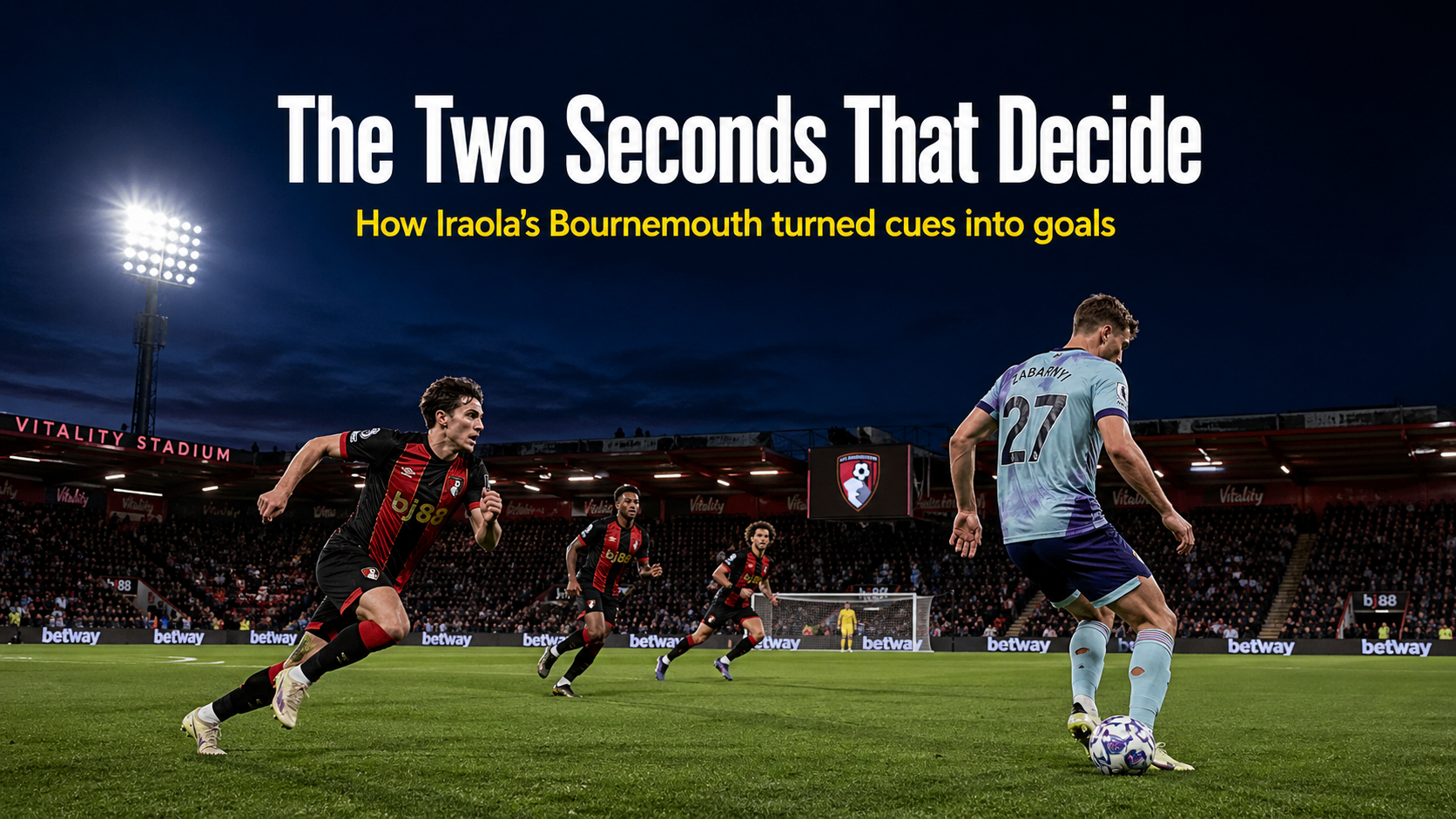
When Bournemouth lost the ball to Manchester City inside their own half last season, Antoine Semenyo did not chase the receiver. He waited.
He watched the City defender’s first touch, and the moment the ball rolled half a yard too far, three Bournemouth players sprinted on the same beat. That synchronised burst is what coaches call a pressing trigger, and Andoni Iraola’s side built a defensive identity around recognising them better than almost anyone in the Premier League.
A press without pressing triggers is just running, and our Football Tactics hub frames the broader defensive cluster this article belongs to.
In simple terms: A pressing trigger is a specific cue, such as a backward pass or a heavy touch, that signals every defender to engage at full intensity at the same moment.
This piece breaks down what pressing triggers are, the four cues elite coaches drill, how Iraola’s Bournemouth weaponised the system, and where the trigger logic breaks against intelligent build-up sides.
Key Takeaways
- Pressing triggers are decisions, not cues: A pressing trigger is a pre-agreed signal that converts a defending team from passive to aggressive in one beat.
- Bournemouth’s intensity is measurable: Under Andoni Iraola, Bournemouth averaged 9 high turnovers per game in 2024-25, with 20.8% ending in a shot, per Opta.
- The backward pass is the cleanest trigger: A receiver facing his own goal cannot play forward, and the press gains a free yard before he can turn.
- Pressing triggers can be manufactured: Pressing traps bait opponents into specific zones before the cue fires.
- Mistime the cue, concede a goal: A misread pressing trigger opens the line behind the press for one vertical pass into a 4-on-3.
Table of Contents
What Are Pressing Triggers?
A pressing trigger is the moment a defending team collectively decides to abandon its shape and attack the ball. It is not a player’s instinct; it is a coached, rehearsed signal that every player on the pitch reads at the same time.
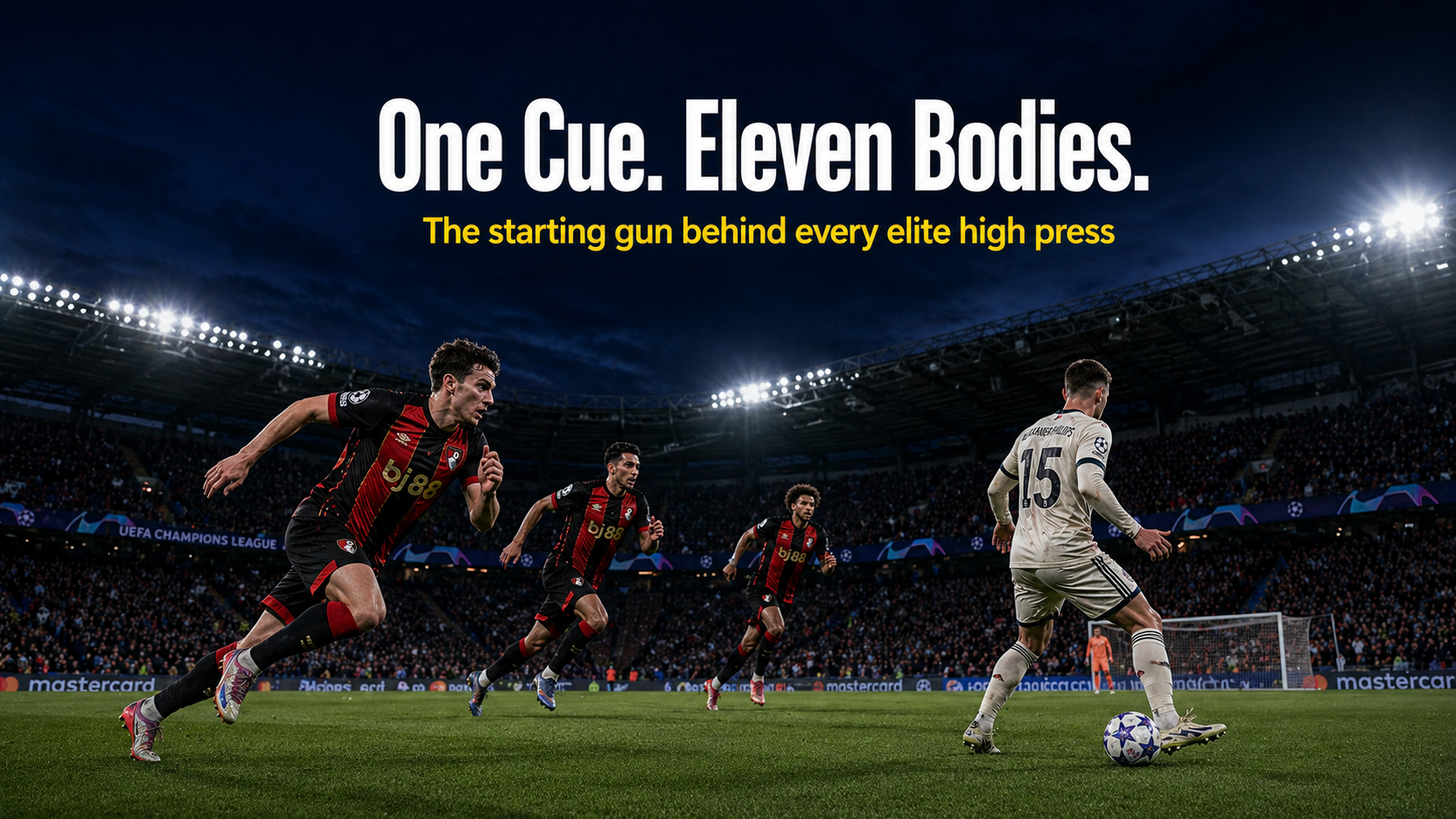
Think of it as the football equivalent of a starting gun. Until the trigger fires, defenders hold their shape, screen passing lanes, and wait. The instant it fires, the nearest forward sprints at the ball, the second forward cuts the back-pass option, and the midfielders step up to lock the receiving zones.
If even one player misreads the moment, the press fails and a passing lane opens behind the line. The collective nature of the trigger is the entire point; eight defenders running on their own instincts is not a press.
Pressing triggers are not about pressing more. They are about knowing when to press in football, and saving the legs for the other 88 minutes.
The Four Most Common Pressing Triggers
Elite coaches collapse pressing triggers into four reliable cues, and most of the world’s pressing systems are built around recognising at least one of them.
The backward pass is the canonical pressing trigger. The receiver is facing his own goal, cannot play forward without turning, and has fewer passing options than usual. This is the cue Bournemouth, Liverpool under Jürgen Klopp, and Thomas Tuchel’s Chelsea all coached as the default.
A heavy first touch is the second cue. The receiver is briefly out of control; the defender knows it, the rest of the press knows it, and the three nearest players sprint within half a second. Per The Analyst, heavy-touch sequences account for the highest share of high-turnover possessions in the 2024-25 Premier League season.
The pass into a wide channel is the third. The touchline acts as a second defender, the receiver’s playable area shrinks by half, and the press uses that geometry to compress the space against the line.
The high ball into a static target is the fourth. The receiver needs three seconds to settle the ball, and during those three seconds the press arrives at full sprint. Each of the four pressing triggers creates a window of roughly two seconds where the attacker has fewer options than usual, which is the only window the press is hunting.
How Iraola’s Bournemouth Built a Pressing Triggers System
When Andoni Iraola arrived at Bournemouth in 2023, the squad had just finished a season as one of the most passive pressing sides in the Premier League. Under Gary O’Neil, no team attempted fewer shots from high turnovers, and the average open-play possession started 39.4 metres from their own goal line.
By the end of his first season, those numbers had been rebuilt around a small, specific set of pressing triggers. The shift was not about asking players to run more; it was about teaching them to wait, then explode.
Iraola’s signature pressing trigger is the back-pass to a centre-back when the goalkeeper has stayed in his box. The moment the centre-back receives, Bournemouth’s lead striker sprints across the passing lane to the keeper, the second striker attacks the ball, and the wide players lock the fullbacks. The trap is set before the pass is even played.
Iraola’s system is the cleanest modern example of pressing triggers built into the team structure rather than left to player instinct, an idea our counter-pressing breakdown tracks from its Klopp-era origins.
The Data Signature of a Pressing Triggers System
A trigger-based press shows up in four columns of public match data before it shows up on the pitch. The table below contrasts Bournemouth’s 2022-23 and 2024-25 numbers, drawn from FBref’s Premier League season tables, to isolate the impact of Iraola’s pressing triggers system.
| Metric (Premier League) | Bournemouth 2022-23 (O’Neil) | Bournemouth 2024-25 (Iraola) | Tactical Implication |
|---|---|---|---|
| High turnovers per game | 7.0 | 9.0 | Two extra possession resets in the opposition half |
| Open-play start distance from own goal | 39.4 m | 42.4 m | Attacks start three metres higher, compressing the opponent |
| Shots from high turnovers (% of total) | 12.1% | 20.8% | Recoveries are nearly twice as likely to become a shot |
| Pressures in the final third per game | 56.6 | 63.8 | Sustained final-third aggression, not isolated bursts |
Data reflects Opta-published Premier League metrics for the 2022-23 (Gary O’Neil) and 2024-25 (Andoni Iraola) seasons. Match and opposition variance applies.
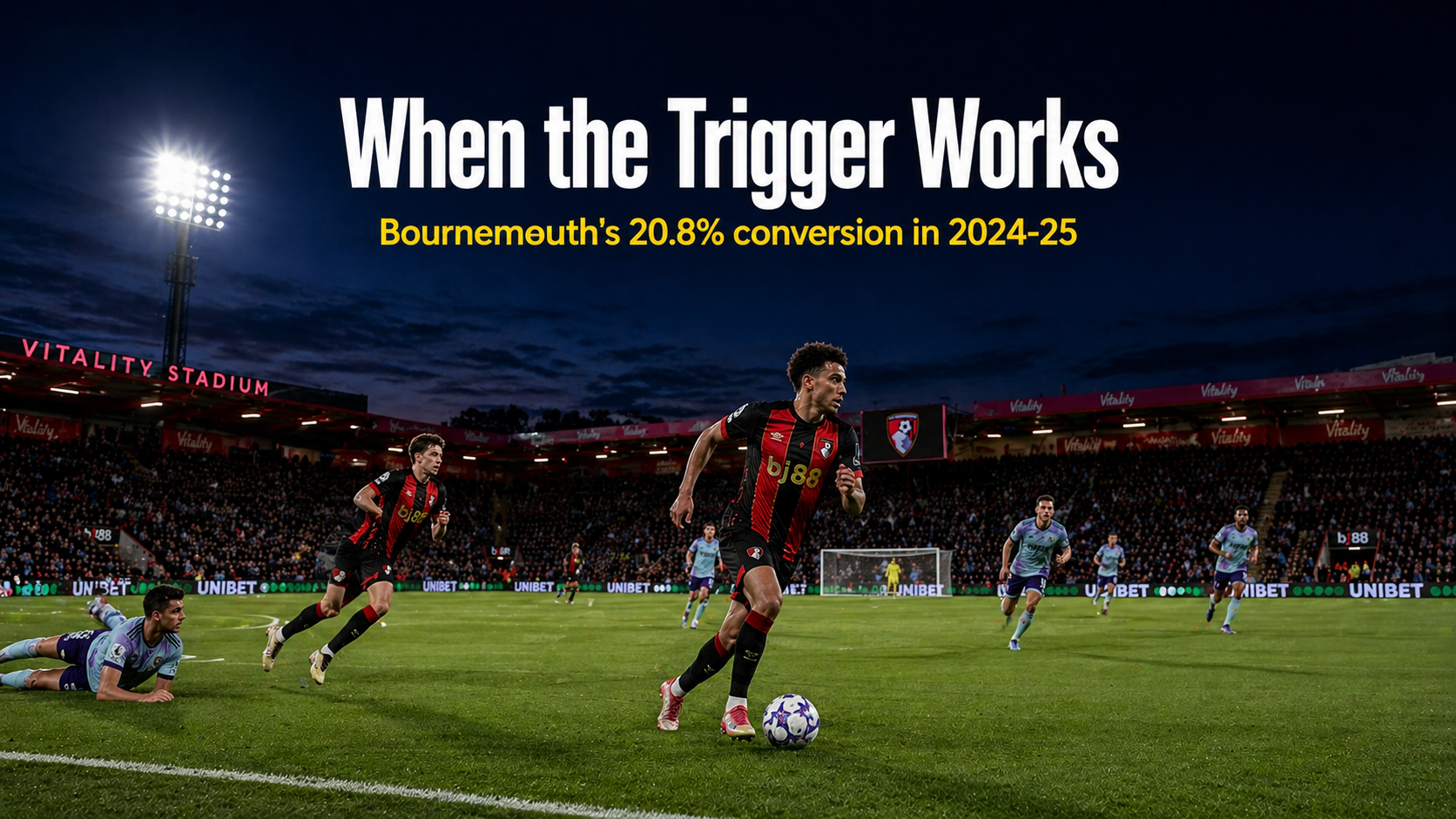
The most important number is the shot-conversion ratio. A pressing trigger system that recovers possession nine times a game but generates a shot from only one in ten recoveries is doing the running without the reward. Iraola’s 20.8% means one in five recoveries becomes a shot, the band that separates triggered pressing from speculative chasing.
The pressures-in-the-final-third number is the second most revealing. A team can record high turnover counts and still be a low-pressing side if recoveries come from defensive blocks. Final-third pressure totals strip out that noise and show genuine pressing volume.
From Solanke to Evanilson: Pressing Triggers Outlive Players
Dominic Solanke, before his move to Tottenham, was the linchpin of Iraola’s first season of pressing triggers. Per Opta, Solanke led the entire Premier League for pressures in the final third resulting in a turnover, with 142 in the 2023-24 season.
When Solanke jumped, the rest jumped. The trigger fired off his read of the centre-back’s body shape, and the rest of the press inherited the cue.
After his transfer in 2024, Iraola distributed the pressing load across Evanilson, Antoine Semenyo, Justin Kluivert, and Marcus Tavernier. All four finished inside the top 20 for final-third turnovers the following season, and the team’s high-turnover-per-game number actually rose.
The pressing triggers survived the loss of the best executor because the cue was built into the structure, not the individual. A coached pressing trigger is a system asset that does not depreciate with a transfer.
Why Most Teams Get Pressing Triggers Wrong
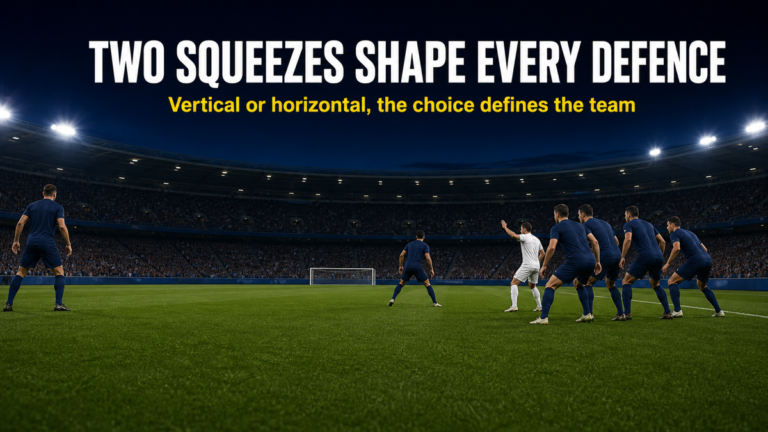
Most Premier League sides attempt some form of high pressing, but only a handful coach the pressing triggers to the level Iraola or Pep Guardiola demand. The shortfall almost always comes from one of three coaching gaps.
The first gap is asking the trigger to fire on too many cues. When a coach lists five pressing triggers across a 90-minute match, players hesitate at every cue and the press loses its synchronisation. The most effective systems coach two or three pressing triggers and rehearse them to the point of automatic response.
The second gap is rehearsing the cue without rehearsing the recovery. A press that fires on a trigger and fails to win the ball needs an immediate counter-press or a structured retreat. Teams that drill the press but not the second wave concede a transition every time the first action misses.
The third gap is misjudging the line of engagement. A trigger that fires when the opposition’s centre-back is 60 metres from his own goal is a different press from one that fires at 35 metres. Our high press vs mid-block breakdown details how the engagement height changes which pressing triggers are even available.
The Weakness: Where the Trigger System Breaks
A pressing trigger is a decision rule, and every decision rule can be exploited by an opponent who learns to manipulate it. From Klopp’s gegenpressing to Iraola’s structured back-pass trap, every elite system inherits the same vulnerabilities, and even the most coached pressing triggers can be turned against the team that uses them.
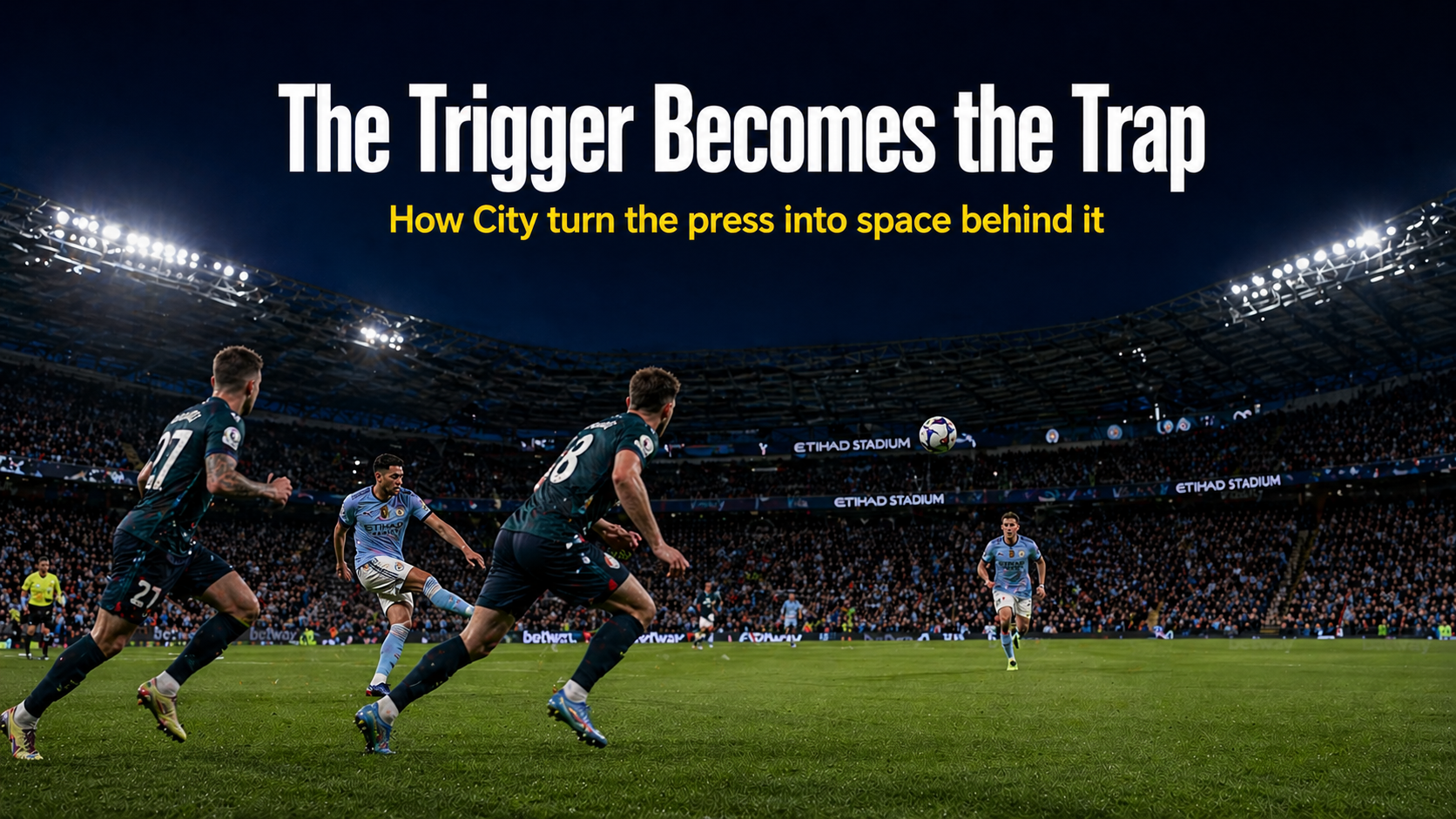
The first weakness is the false trigger. If a team is coached to press on a backward pass, an intelligent build-up side will play deliberate backward passes designed to lure the press, then hit a single vertical ball over the advancing midfield. Pep Guardiola’s Manchester City do this constantly with Rodri (when fit), who receives a pass from Rúben Dias, hesitates, draws the press, and releases a 30-metre line-breaker into the half-space.
The second weakness is fatigue. Per Opta Analyst’s review of the 2025-26 Premier League season, high turnovers have dropped to 11.5 per game across the league, the fewest in 10 seasons, partly because more teams are now kicking long from the back to bypass the trigger. A press with nothing to bite on is a press wasting energy.
The third weakness is the empty-target problem. Diego Simeone’s Atlético Madrid have built a career out of refusing to engage when the pressing trigger fires; the team absorbs and waits for the opposition’s mistake to come to them. When an aggressive pressing system meets a side that will not engage, the structural cost (high line, abandoned half-spaces) becomes the liability.
What This Means on the Pitch
The pressing trigger is one of the most elegant ideas in modern coaching: a single shared cue that turns 11 individual defenders into one synchronised unit for two seconds at a time. The longer you watch elite football, however, the clearer it becomes that the trigger is also one of the most fragile structures on the pitch.
Get the cue right and you are Bournemouth in 2024-25, manufacturing 21% of your shots from recovered possession. Get it wrong and you are one vertical pass from a 4-on-3 against your own centre-backs.
The teams worth studying are not the ones that press the most. They are the ones that have learned which pressing triggers to ignore, and which two seconds in the match are worth the legs.
What Do You Think?
Iraola’s Bournemouth converted 20.8% of their high turnovers into shots in 2024-25, the third-best efficiency in the Premier League, but pressing-heavy systems have a habit of fading in the second half of long seasons. Is a trigger-based high press sustainable across a Champions League campaign, or does it trade quality for intensity once squad fatigue sets in? Drop your take below.
Want to read any match like this?
The framework behind these breakdowns, in one place. The four phases, a 15-minute method for diagnosing both teams before the drinks break, a printable match-watching worksheet, and 51 terms defined. 40 pages.
Get the pack$9, instant downloadRelated Tactical Breakdowns
What Is Counter-Pressing? 7 Principles That Win the Ball Back
Why it connects: Counter-pressing is the highest-stakes form of triggered pressing, where the loss of possession itself is the cue, and reading this piece sharpens the difference between a structured trigger and a reactive five-second press.
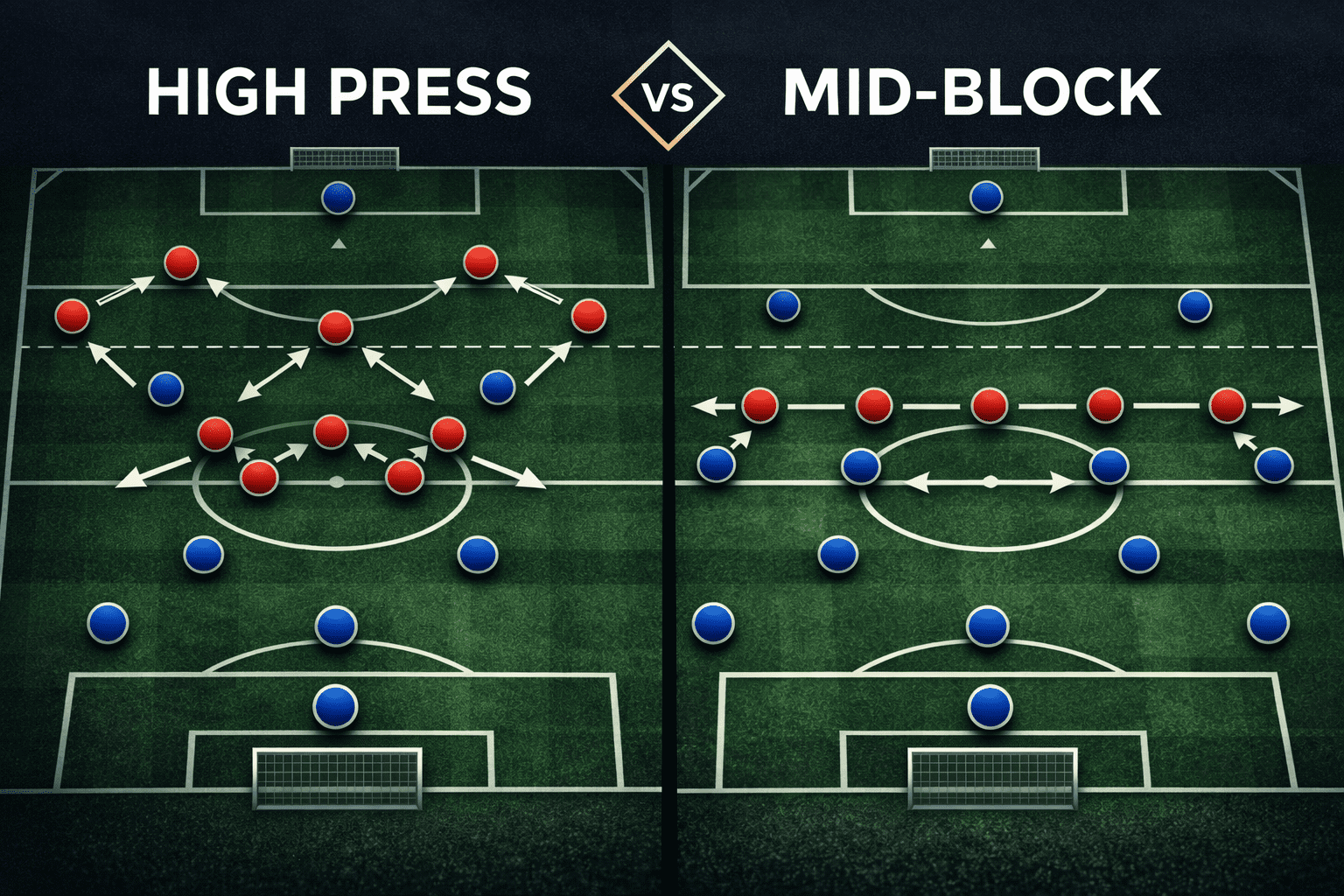
High Press vs Mid-Block: 7 Tactical Differences That Define Modern Football
Why it connects: Pressing triggers operate inside both systems, but the cue, the line of engagement, and the trap all change between them.
What Is PPDA in Football? Meaning, Formula & Pressing Intensity
Why it connects: PPDA is the public-facing metric that captures pressing intent and is the cleanest single number for spotting which sides genuinely trigger their press in the opposition half.
Speak the language of the game
Get the free 47-term tactical glossary. Gegenpress, half-space, xT, low block, each defined in plain language and linked to a full breakdown. It is yours for an email.
Frequently Asked Questions
What are pressing triggers in football?
A pressing trigger is a pre-agreed cue, such as a backward pass, a heavy first touch, or a pass to the touchline, that signals an entire defending team to switch from passive shape-holding to aggressive collective pressure on the ball at the same instant. Without a shared cue, individual chasing replaces structured pressing. The cue is rehearsed in training until players read it without hesitation.
What is the most common pressing trigger?
The backward pass is the most coached pressing trigger across elite football because the receiver is facing his own goal, cannot play forward without turning, and has fewer passing options than usual. Heavy first touches and passes into wide channels are the next two most common cues used by high-pressing sides. Most pressing systems coach two or three pressing triggers, not five, to keep player decisions sharp.
Which teams are most effective at pressing triggers and why?
Andoni Iraola’s Bournemouth and Pep Guardiola’s Manchester City rank among the most effective pressing sides in the Premier League because they treat pressing triggers as collective decisions, not individual instincts. Iraola’s Bournemouth averaged nine high turnovers per game in 2024-25 with one in five resulting in a shot, per Opta. The cue fires on the entire press at once, not on the nearest player.
Can a pressing triggers system be sustained across a long season?
A trigger-based high press is sustainable across a long season only when the squad has the depth to rotate pressing roles and the coach disciplines the team to ignore non-cues. Pressing intensity tends to fade in the second half of long seasons because the physical cost compounds, and 2025-26 Premier League data shows a league-wide drop in high turnovers, per Opta Analyst. Squad rotation, structural pressing rather than personality-driven pressing, and tactical patience are what separate sustainable trigger systems from collapsing ones.