

On a damp February night in Madrid, Manuel Akanji played the wide centre-back role to its purest definition. He stepped twenty yards wide of his centre-back partner, planted a foot inside the touchline, and stopped a Real Madrid counter before it crossed halfway. Vinicius Junior had picked the ball up with thirty yards of grass in front of him; Akanji slid across, angled his body inside, and forced a pass that Manchester City’s midfield mopped up in seconds.
That was not improvisation. The wide centre-back exists because the traditional back four was never built to defend the strip between fullback and centre-half properly. In a growing list of elite football tactics systems, the channel now belongs to a centre-back who lives there by design.
In simple terms: A wide centre-back is a defender stationed in the wide third of the pitch, tasked with controlling the channel between fullback and central defender.
This article unpacks why the role broke the back four, who plays it best, and where it is starting to fail.
Key Takeaways
- The Channel Is the Hardest Zone to Defend: The strip between fullback and centre-back generates the highest expected-threat values in elite attacks, per The Analyst’s positional data. Wide centre-backs exist to claim it.
- Two Profiles Dominate: The sweeper-wide reads the pass before it lands, like Manuel Akanji and William Saliba. The aggressor-wide engages the winger on first touch, like Cristian Romero.
- Manchester City Sets the Standard: Akanji’s positioning shifts City’s defensive shape ten metres wider on the right, compressing the channel that Vinicius Junior and Kylian Mbappe attack.
- Pace Is Non-Negotiable: A wide centre-back without recovery speed gets isolated against fast wingers in ways a narrow centre-back never would.
- The Role Reshapes the Fullback Job: Wing-backs and inverted fullbacks both become viable only because a wide centre-back covers the space they vacate.
Table of Contents
What Is a Wide Centre-Back?
A wide centre-back is a defender stationed in the wide third of the pitch whose primary job is to control the channel between fullback and central defender. The role exists because elite forwards have spent the last decade learning to attack the seam where the back four naturally breaks. Pace, angle of approach, and one-v-one judgement matter more for this defender than for any other defensive position.
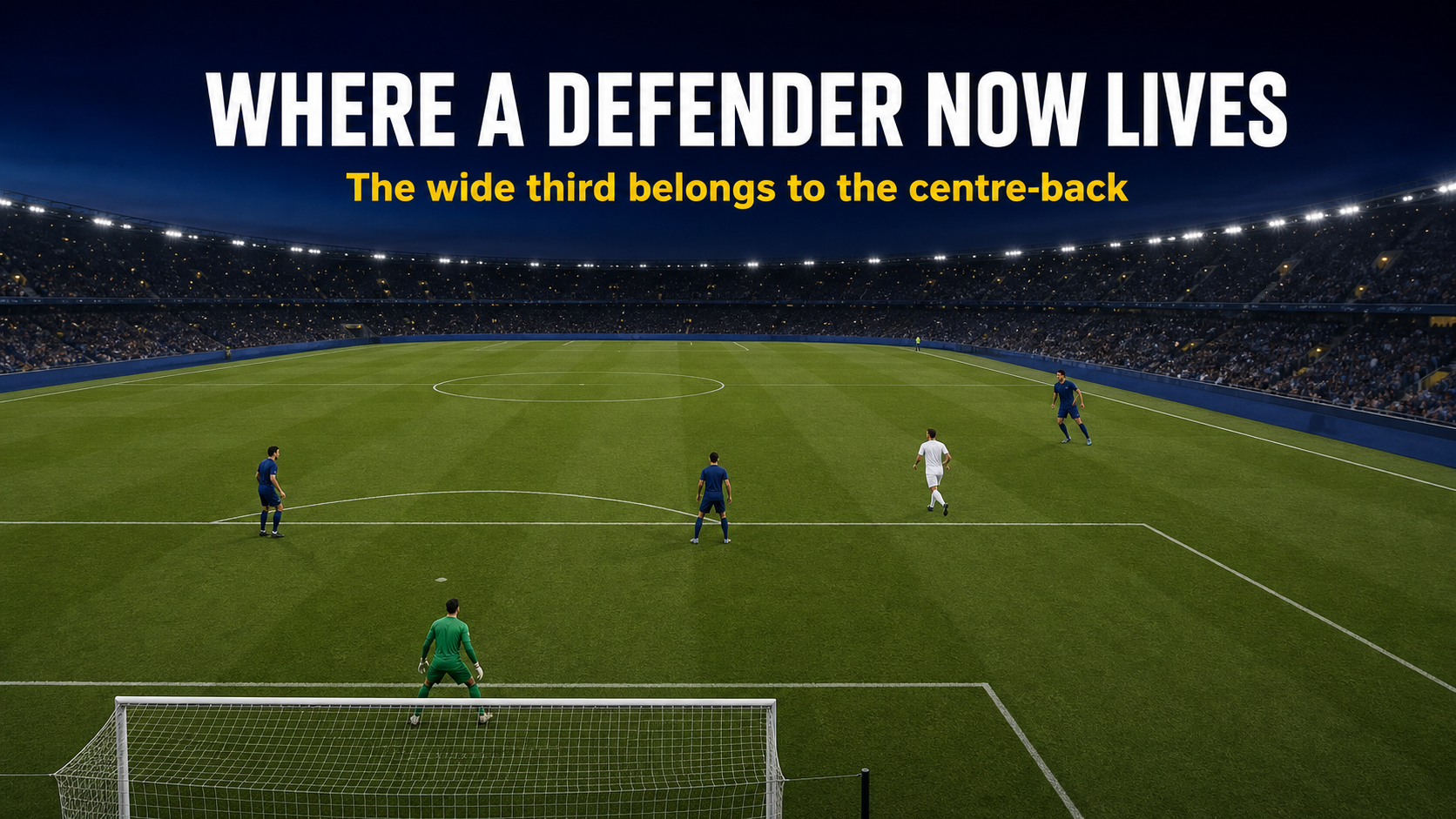
The role lives in two shapes. The first is the back three, where one of the outside centre-backs handles the right or left channel. The second is the hybrid back four that spreads on the touchline rather than narrowing on a goal-side line.
In both, the defender operates higher and wider than a traditional centre-back. Antonio Conte’s title-winning Napoli pushed Amir Rrahmani twelve metres further right than a conventional Italian centre-back would ever defend. Mikel Arteta’s Arsenal asks William Saliba to do the same on the right channel without a wing-back outside him for support.
The crucial distinction is positional. A traditional centre-back defends a goal-side line near the penalty area. A wide centre-back defends a diagonal that runs from the touchline back toward the near post.
Why Channel Defending Broke the Traditional Back Four
The traditional back four assumed a defensive crisis could be solved by a fullback and a wide midfielder doubling up. That assumption stopped holding when wingers started arriving in the channel before the wide midfielder could track back. Fullbacks attempting to defend one-v-ones in the channel succeed at the lowest contested-duel rate in elite open-play defending, per FBref’s Premier League defensive stats.
The crisis sharpened because forwards stopped running at fullbacks. They started running through the channel itself.
Vinicius Junior, Bukayo Saka, and Khvicha Kvaratskhelia all spend more of their open-play time attacking the channel than the touchline, per StatsBomb’s positional tracking. A back four with a narrow centre-back leaves that channel under the responsibility of a fullback who is half a yard slower than the winger he is supposed to contain.
The solution coaches arrived at was simple in concept and difficult in execution. Move one of the centre-backs into the channel itself. That defender becomes the wide centre-back, and the fullback either inverts inside to support the midfield or pushes higher as a wing-back, freed from defending a duel he was losing anyway.
The Two Wide Centre-Back Profiles
The role splits cleanly into two profiles that elite teams pick between based on the rest of their shape. The sweeper-wide reads the pass before it arrives. The aggressor-wide engages the receiving winger the instant the ball lands.
Manuel Akanji at Manchester City is the cleanest sweeper-wide in elite football. He covers thirty metres in the time the ball travels twenty, intercepts the diagonal pass into the channel before the winger can turn, and rarely needs a one-v-one.
William Saliba plays the same way for Mikel Arteta’s Arsenal on the right side, except Arsenal’s shape forces him to make more recovery sprints because they invert their right fullback inside more aggressively than City do. Saliba’s value is therefore as much in his recovery speed as in his interception read.
Cristian Romero is the aggressor-wide template. When Tottenham used a back three under previous regimes, Romero engaged the channel-arriving winger on first touch and forced the duel before the supporting fullback could arrive. The risk of the aggressor profile is foul concession in dangerous areas; the reward is that wingers feel pressure on every reception, which compresses the time and angle they have to pick the next pass.
Akanji’s Role: The Wide Centre-Back Who Doesn’t Step Inside
The popular framing of the modern Manchester City centre-back is the hybrid centre-back who steps into midfield as a sixth in possession. Akanji does not do that job. His brief is to occupy the right channel out of possession and push a narrow line into the right half-space in possession, where he supports the build-up without leaving his defensive zone.
The numbers show how distinct the two roles are. Per FBref’s player profile for Manuel Akanji, he ranks in the 88th percentile for tackles in the attacking half and the 92nd percentile for blocks per ninety among Premier League centre-backs. John Stones’ inverted role ranks lower on both because Stones progresses the ball, while Akanji defends the channel.
The table below compares the two roles on the metrics that separate channel-defending from midfield-progression.
| Metric | Akanji (Wide CB) | Stones (Hybrid CB) | Tactical Implication |
|---|---|---|---|
| Avg defensive action distance from goal | 41 metres | 33 metres | Akanji defends higher and wider |
| Aerial duels won percent | 71% | 58% | Channel role demands more aerial recovery |
| Pass receptions in opp half (per 90) | 12.4 | 24.7 | Stones operates as a midfielder; Akanji does not |
| Recovery sprints (per 90) | 18.2 | 9.4 | Channel defending generates double the sprint load |
Data reflects average metrics across the 2025-26 Premier League season through May. Individual match variance applies.
The takeaway is that the wide centre-back and the hybrid centre-back are not two names for the same job. They sit on opposite sides of the same defensive shape and do different work. Pep Guardiola plays both at once.
How a Wide Centre-Back Coordinates with the Wing-Back
The wide centre-back only works because the player ahead of him knows when to leave the channel uncovered. In a back-three system, the wing-back pushes high knowing the centre-back will slide across to the touchline if the ball is lost. In a hybrid four, the fullback inverts inside knowing he will absorb the wing duel the fullback would have lost anyway.
The coordination breaks when the wing-back times his press wrong. If he engages the receiving midfielder a half-second too late, the channel opens behind him before the defender can rotate across.
Marseille under Roberto De Zerbi suffered this repeatedly in early 2025-26, when their right wing-back over-pressed and the defender found himself in a two-v-one against the opposition winger and an arriving full-back. The fix elite sides use is communication-based, not tactical. The defender calls the wing-back’s press early, telling him whether to engage or hold based on his own positioning.
When the system works, the wing-back trusts him to cover. When it does not, the back three looks porous in transition even when individual players are doing the right thing.
When Saliba Defends the Right Channel for Arsenal
Mikel Arteta’s Arsenal play a hybrid four that turns into a back three the moment possession is lost. William Saliba is the right-side channel defender inside that transition, and the way he times his channel slides is part of why Arsenal conceded fewer counter-attack goals than any club in the Premier League across 2024-25 and 2025-26.
Saliba’s specific instruction is to slide wide the instant Bukayo Saka loses the ball higher up. The right back inverts; the holding midfielder covers Saliba’s vacated central zone; Saliba himself drops onto the touchline and forces the opposing winger inside, where Arsenal’s recovering midfielders are running back to.
The compression that creates is the whole reason Saka can press so high without the team paying for it. This is not the cleanest version of the role because Saliba still has to handle aerial responsibility in the box on set-pieces. But it is the most replicable version in Premier League football right now.
Thomas Tuchel’s England setup is studying the same mechanism, with inverted fullbacks inside and a channel defender outside, ahead of the 2026 World Cup.
The Weakness: What Breaks a Wide Centre-Back
The role’s primary failure mode is pace mismatch in transition. A defender who has stepped twenty yards higher than a traditional centre-back has further to recover, and the fastest wingers in elite football now run that gap in under three seconds. When Lamine Yamal turned Saliba in the 2025-26 Champions League quarter-final, the recovery distance was already too long.

The second failure mode is the second striker. When opposing teams pair a fast winger with a poaching forward who drifts wide, the defender has two players to read. He must decide whether to follow the drifting striker into the channel or stay narrow on the original duel, and there is no good answer in real time.
The third failure mode is the goal kick. A wide centre-back caught high during a goal kick is the player the opposing press targets first, because forcing him to play under pressure with his back to a sprinting forward is the easiest way to manufacture a turnover in a dangerous zone.
Diego Simeone’s Atletico Madrid spent 2025-26 exploiting exactly this, and the pattern shows up in how the rest defense structure collapses against a vertical first pass.
Pulling It All Together
The wide centre-back is the most important defensive role addition of the last five years, and most viewers still do not know it exists. The football coverage industry talks about inverted fullbacks and hybrid centre-backs because those roles are visible in the build-up phase, where television cameras frame the pitch. The channel defender does his work in transition and out of possession, where the camera is rarely on him.
That invisibility is doing him a disservice. Akanji’s positioning in Madrid in February was not Manchester City’s best build-up moment; it was their best defensive moment.
The role that prevents a counter rarely gets the credit a role that scores a goal does. It is the position elite coaches now build their defensive identity around, and the next generation of centre-backs will be drafted to play it from age fifteen onward.
What Do You Think?
If Manchester City’s wide centre-back role is the future of channel defending, why has nobody outside the very top of European football built a back four that mirrors it? Is it because the academy pipeline for pace-and-judgement centre-backs is still empty, or because mid-table coaches do not trust their wing-backs to vacate the channel? Drop your take below.
Want to read any match like this?
The framework behind these breakdowns, in one place. The four phases, a 15-minute method for diagnosing both teams before the drinks break, a printable match-watching worksheet, and 51 terms defined. 40 pages.
Get the pack$9, instant downloadRelated Tactical Breakdowns

Hybrid Centre-Back Explained: How the John Stones Role Redefined Modern Defense
Why it connects: The hybrid centre-back is the channel-defending role’s inverted twin, same defensive shape but opposite job description.
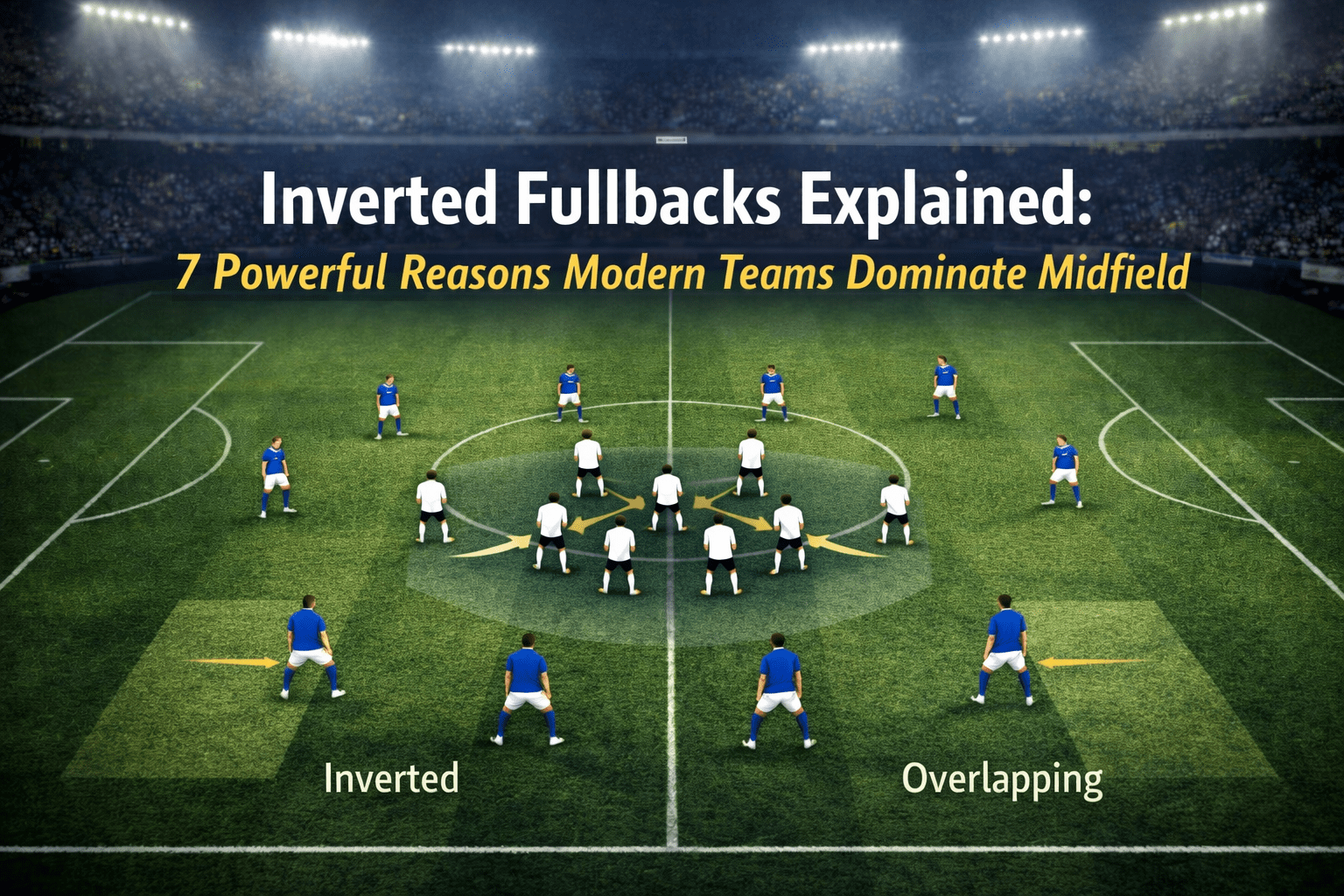
Inverted Fullbacks Explained: How Modern Teams Control the Center
Why it connects: The inverted fullback only works because a wide centre-back is covering the channel he just vacated.
Defending the Half-Space: How Elite Teams Kill the Most Dangerous Zone on the Pitch
Why it connects: The half-space is exactly where the wide centre-back lives when the opposition has the ball.
Speak the language of the game
Get the free 47-term tactical glossary. Gegenpress, half-space, xT, low block, each defined in plain language and linked to a full breakdown. It is yours for an email.
Frequently Asked Questions
What is a wide centre-back in football?
A wide centre-back is a defender stationed in the wide third of the pitch whose primary job is controlling the channel between fullback and central defender. The role exists in back-three systems and hybrid back-four shapes. Antonio Conte and Pep Guardiola both rely on it to lift the channel-defending burden off the fullback.
Why do teams use a wide centre-back instead of a fullback in the channel?
Teams use a wide centre-back because elite wingers now win the majority of one-v-one channel duels against fullbacks in elite leagues, per FBref’s 2025-26 metrics. A centre-back is taller, better in the air, and stronger in the duel itself. The fullback then either inverts inside or pushes higher as a wing-back, freed from a duel he was losing anyway.
Which players are the best wide centre-backs in 2025-26?
The clearest wide centre-back templates in 2025-26 are Manuel Akanji at Manchester City, William Saliba at Arsenal, and Cristian Romero at Tottenham. Akanji defines the sweeper-wide profile, Saliba executes the same role inside a hybrid back four, and Romero plays the aggressor-wide profile. Each fits a different defensive shape and pressing system.
How does a wide centre-back differ from a hybrid centre-back?
A wide centre-back defends the wide channel; a hybrid centre-back steps into midfield as a sixth during build-up. They sit on opposite sides of the same defensive shape and do different jobs. Manchester City use both at once, with Akanji wide and John Stones inverted, which is why conflating the two roles misreads what elite defensive structures actually do.