
Last updated: September 18, 2026
In the 2011 Champions League final at Wembley, Xavi Hernandez received the ball between Manchester United’s lines and did nothing for almost two seconds. United’s midfield froze. Pedro slowed his run, accelerated, and Xavi slid the ball through a gap that did not exist a heartbeat earlier. Barcelona scored. The pass was unremarkable. The pause was the goal, and it is the cleanest illustration of la pausa football we have on film.
That moment exposes a misunderstood idea in football tactics: elite midfielders do not dominate matches by playing faster. They dominate by deciding when the game accelerates.
In simple terms: la pausa football is the act of slowing the ball to draw defenders out of position before releasing the pass that unbalances them.
The technique gets romanticised as Spanish charm, but it is closer to a precise exploitation of how defenders are coached to react, and the modern game keeps producing new examples and new counters worth dissecting.
Key Takeaways
- La pausa football is midfield tempo manipulation, not a trick: Players are not “doing” a skill. They are reading defender weight-distribution and waiting for the moment of imbalance before releasing the ball.
- Origin matters: The concept was codified through Argentine playmaker Ricardo Bochini at Independiente in the 1970s and 1980s, before being absorbed into Spanish positional play through Cruyff, Guardiola, and the Barcelona school.
- Three modern templates exist: Pedri’s high-line Pausa in front of the box, Rodri’s deep-build Pausa in the first phase, and the wide-Pausa cutback played from the half-space. Same principle, three completely different zones.
- Modern pressing is the natural counter: Teams like Atalanta and Bologna under aggressive man-marking systems shrink the time window the pause requires, forcing the press-resistant playmaker into early decisions.
- Pausa is invisible in basic data: It rarely shows up in pass count or completion rate. Its fingerprint is in shot-creating actions, line-breaking passes, and the tempo drop that precedes them.
What Is La Pausa Football?
La pausa football is the deliberate slowing of the ball during attacking possession, used to manipulate the position and weight of defenders before releasing a decisive pass. The phrase translates literally from Spanish as “the pause,” and the concept is most closely associated with Argentine and Spanish football. Its purpose is universal: buy a fraction of a second so that the next action is unopposed instead of contested.
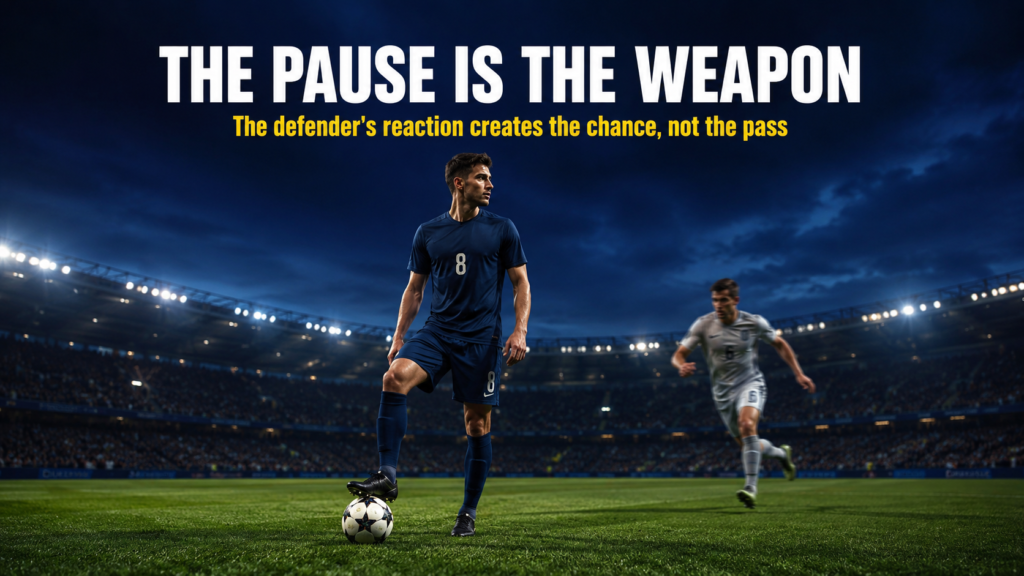
The skill is most often credited to Ricardo Bochini, the Independiente number 10 who built his career on predicting how defenders would shift the moment he stopped on the ball. Diego Maradona called Bochini his idol, and the line of Ricardo Bochini playmaking that runs from Independiente through Juan Roman Riquelme into Spain’s possession era is direct.
What looks like Spanish charm in a Xavi Hernandez pass is actually an Argentine craft delivered through a positional-play frame. The history of la pausa football is therefore a transatlantic one, and that is why the technique looks slightly different in Catalonia than it does in Buenos Aires. The idea sounds paradoxical until you watch a Xavi ball arrive into a runner who has not yet started moving when it is released.
The Mechanical Anatomy of La Pausa
La pausa football works through three biomechanical events firing in sequence inside a one-second window. The player on the ball stops or markedly decelerates. A nearby defender, conditioned to engage the ball-carrier, shifts their weight forward to press.
That forward weight shift is the entire mechanism. The defender’s centre of gravity commits in one direction, and any change of direction now costs them a full yard. The Pausa player reads the committed angle and releases the pass into the space the defender has just vacated.
La pausa football is therefore not a movement skill, it is a perception skill disguised as a movement. The hardest part is not stopping the ball, it is judging the exact half-second when stopping converts a static defender into an unbalanced one. Coaches who teach the technique as a drill almost always fail, because the pause is meaningless without the press it manipulates.
Pedri’s Final-Third Pausa
Pedri’s version of la pausa football happens between the lines around the edge of the box, and it turns Barcelona’s overload pressure into a one-pass kill. He receives with his back half-turned, takes a touch, and then stops. Defenders who have been chasing Hansi Flick’s overload step toward him expecting to win possession back.
The freeze lasts a fraction over a second. Then he plays a slipped pass into a runner from deep, or releases Lamine Yamal one-on-one in the half-space.
The Spaniard finished the 2024-25 La Liga season ranked first in progressive passes per FBref, and a meaningful proportion of those followed a deliberate stop on the ball rather than a first-touch release. The tactical payoff is asymmetric: a Pedri Pausa rarely produces the assist on the next pass, but it produces the action that produces the assist.
Rodri’s First-Phase Pausa
Rodri runs the same mechanism 50 metres deeper, and his version weaponises the opposition’s first pressing trigger. Receiving between the centre-backs while Pep Guardiola’s Manchester City build from the back, he faces the opposition press and waits. The first opposition striker steps, the second curves a run.
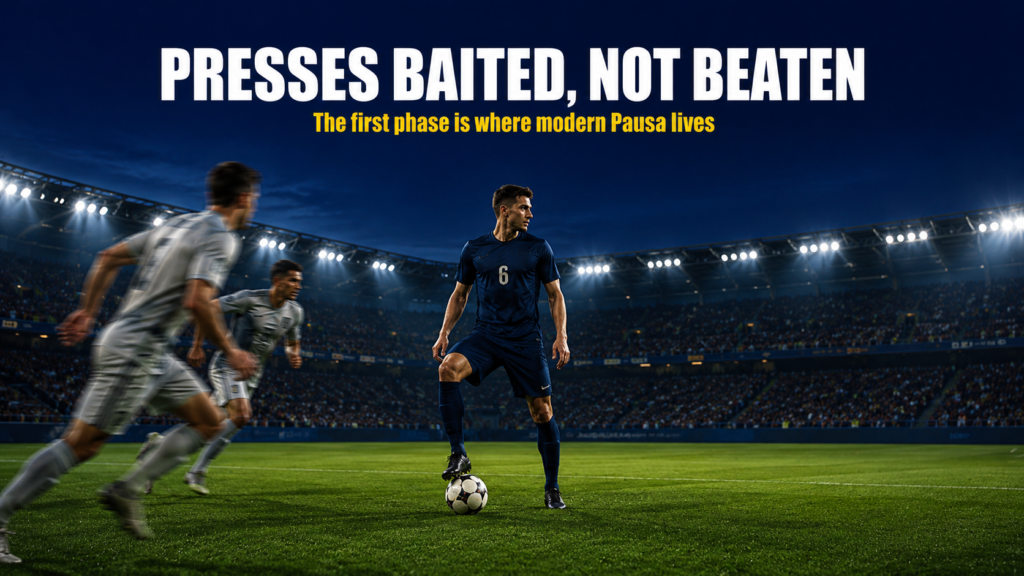
Rodri’s pause forces both pressers into a committed angle, and at the moment they commit, he plays the line-breaker into Bernardo Silva or shifts the ball to the free fullback. The 2024 Ballon d’Or winner per FBref does this so consistently that opposition pressing structures often abandon their first trigger against City entirely, because the trigger has become a liability.
This is the version of la pausa football Pep Guardiola has spoken about for years. The Guardiola pause quote inherited from his Argentine mentor Angel Cappa frames the principle precisely: “Pausa in football is speed. Football without pausa is slow, because it is chaos.”
The Wide Pausa: Half-Space Delay
The wide version of la pausa football lives in the half-space and inverts the overlap into a waiting game. An overlapping fullback or inverted winger carries the ball into the half-space and then stops, daring the opposing fullback to commit.
The moment that defender steps, the ball-carrier slides a cutback inside or releases a third-man runner behind the recovery. Hansi Flick’s Barcelona uses Lamine Yamal in this role on the right, and Trent Alexander-Arnold built his Liverpool career on the same delay-then-deliver pattern from deeper positions.
This wide-zone application of la pausa football is the least-publicised of the three templates because the data captures it as a cross or a deep entry rather than as a tempo event. Its fingerprint shows up in passes into the box from carries, not in shot-creating actions from passes.
The Data Fingerprint of La Pausa
La pausa football rarely shows up in pass count or completion rate, because the technique adds nothing to either metric. Its fingerprint lives in three derivative numbers: shot-creating actions, progressive passes, and pass completion under pressure.
Final-third la pausa football drives shot-creating actions because the pass that follows the pause is by definition a line-breaker. First-phase la pausa football drives progressive passes because the line being broken is the opposition’s press. Wide la pausa football drives passes into the box because the cutback after the pause arrives into a runner the defender has not adjusted to.
| Pausa Type | Zone of Use | Primary Outcome | Indicative Metric Signal |
|---|---|---|---|
| Final-third Pausa (Pedri template) | Between lines, 18-30m from goal | Through ball, isolation, shot-creating action | High shot-creating actions, high progressive passes received by forwards |
| First-phase Pausa (Rodri template) | Defensive third, 70-90m from goal | Press break, line-breaking pass, switch | High progressive passes, high pass completion under pressure |
| Wide Pausa (overlapping fullback) | Half-space and flank | Cutback creation, third-man run | High passes into the box, high carries before delay |
Data reflects descriptive metric patterns associated with these tactical applications across Europe’s top five leagues. Individual team and season variance applies.
The implication for analysts is that tempo control football already lives inside any model that weighs shot-creating actions and progressive passes, but it deserves its own column when scouting press-resistant midfielders. Guardiola’s preference for the technique is not aesthetic. His teams are built to give one player on the ball enough time to use it.
Where La Pausa Breaks Down: The Pressing Counter
The weakness of la pausa football is the time it requires. The pause needs roughly one to two seconds of operating room, and a generation of high-pressing teams has spent the last decade engineering systems that refuse to give it. Where the pause fails, modern pressing triggers are usually the reason.
The clearest counter is collective man-orientation. Diego Simeone’s Atletico Madrid has been doing this for over a decade, attaching defenders to passing options rather than to ball-zones, so that when a midfielder stops on the ball there is no advantage to earn because no defender steps forward to bite. Gian Piero Gasperini’s Atalanta took the principle further, with attackers also man-marking up the pitch into the opposition’s first phase.
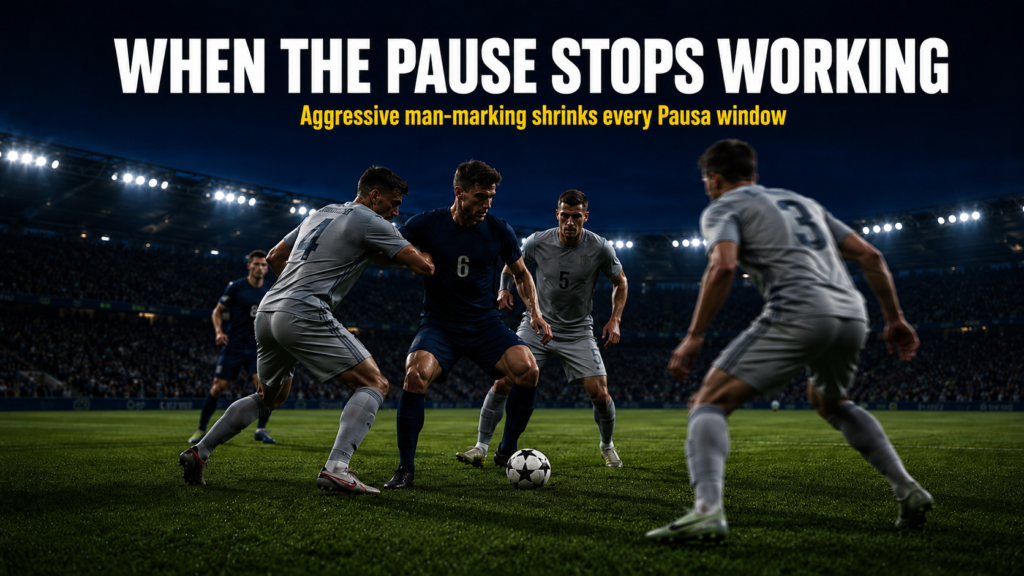
The second counter is pressing-trigger discipline. Roberto De Zerbi’s possession-baiting work, and the wider trend of teams pressing the moment a midfielder receives with their back to goal, removes the half-turn that La Pausa typically begins from. If the ball-carrier never gets the half-second to stop and assess, the pause never happens.
The third counter is positional crowding around Zone 14. Hansi Flick’s Barcelona repeatedly stretch opposition midfields wide so that Pedri’s pause has space to work. Against opponents who refuse to be pulled wide, who instead compact the central channel, even an elite Pausa loses its release angle.
Where This Leaves Us
La pausa football is one of those concepts that sounds romantic and turns out to be ruthless. It is not Spanish charm, it is a calculated exploitation of the press-and-react reflex defenders are coached to use. It is also the most economical way a player can manufacture an advantage out of nothing.
The idea that football is getting faster every year is real. The idea that this makes the technique obsolete is not. If anything, the higher the league’s average tempo, the more valuable the player who can momentarily refuse to play at it.
Pedri, Rodri, and a small group of others remain disproportionately decisive because they carry the rarest commodity in a sport designed around urgency: the willingness to wait. That willingness is what keeps la pausa football alive as the defining mark of a press-resistant playmaker.
What Do You Think?
Pedri’s Pausa works because Barcelona’s wide overloads pull defenders out of central compactness, while Rodri’s Pausa works because Manchester City’s positional structure isolates pressers in 1v1 angles. So which template would survive better in a Premier League where most top-six teams now use aggressive man-orientation? Drop your take below.
Want to read any match like this?
The framework behind these breakdowns, in one place. The four phases, a 15-minute method for diagnosing both teams before the drinks break, a printable match-watching worksheet, and 51 terms defined. 40 pages.
Get the pack$9, instant downloadRelated Tactical Breakdowns
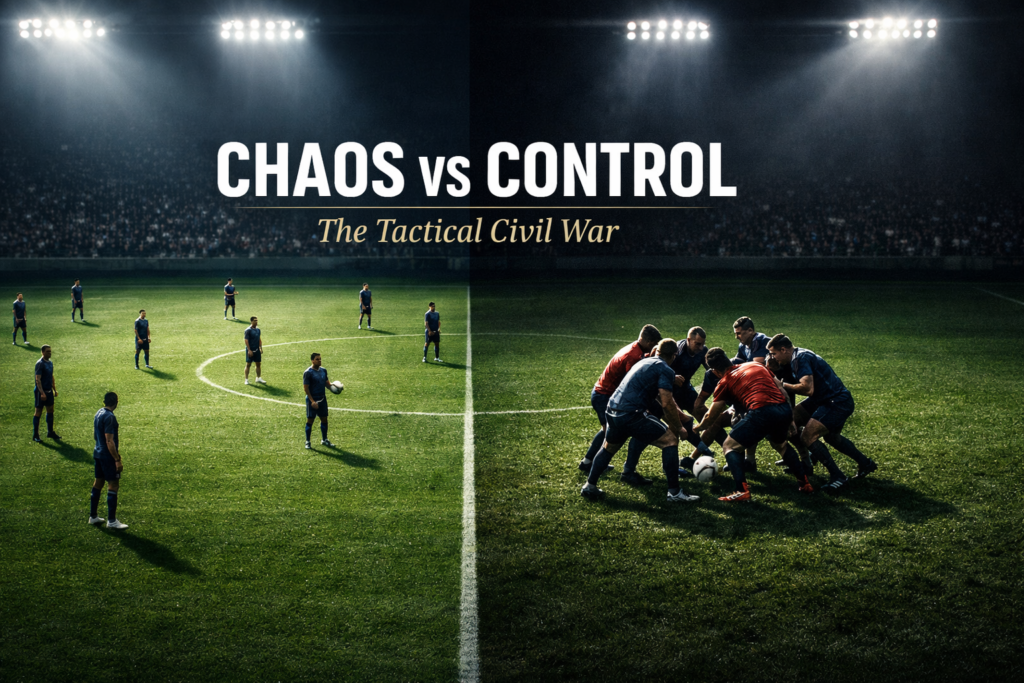
Relationism vs Positionism: The New Tactical Divide
Why it connects: La Pausa lives at the intersection of both schools, and understanding the divide explains why the technique looks different in Buenos Aires than in Catalonia.
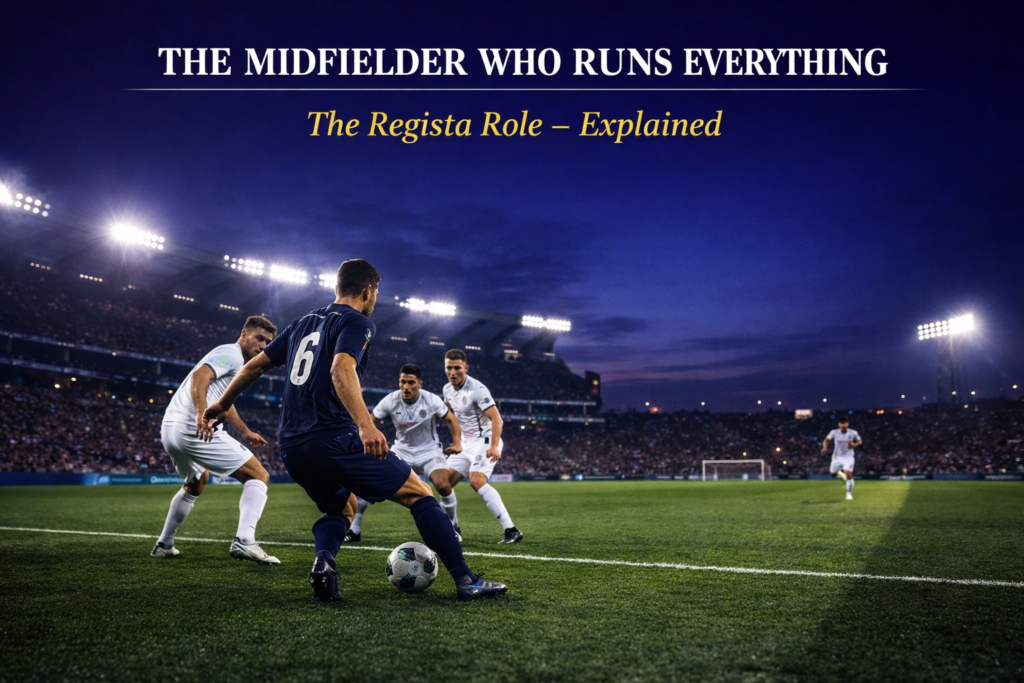
The “Regista” in Modern Football
Why it connects: The deep-lying playmaker role is the natural home of first-phase La Pausa, and Rodri’s template is essentially a modern Regista executing pause as press resistance.
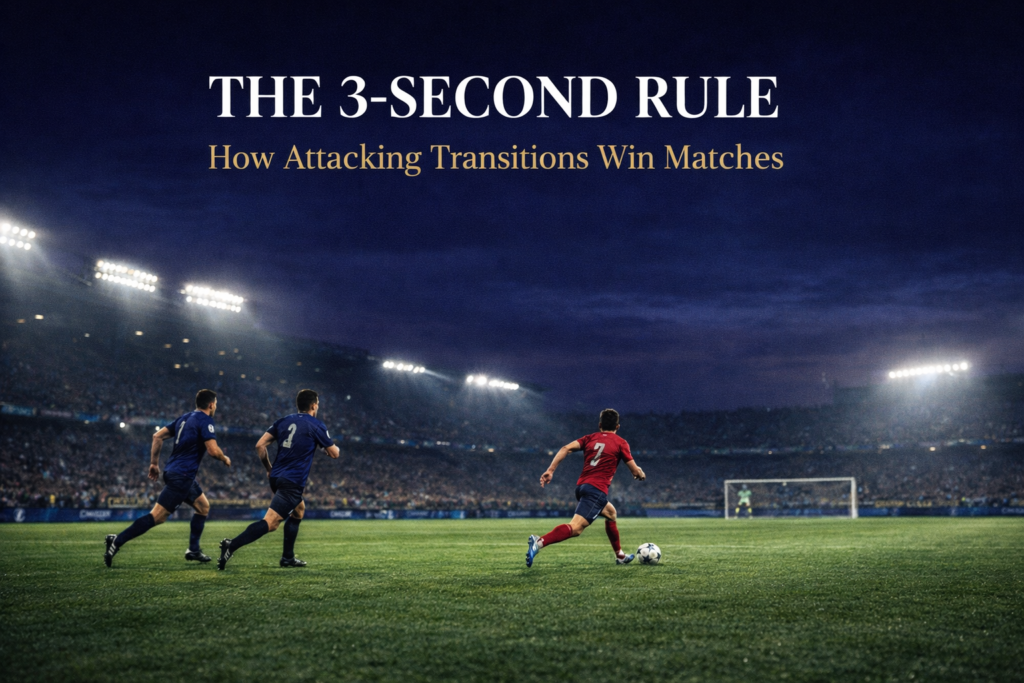
Attacking Transitions: The 3-Second Rule
Why it connects: La Pausa is the conceptual opposite of transition speed, and the contrast between the two reveals when each is the correct tool.
Speak the language of the game
Get the free 47-term tactical glossary. Gegenpress, half-space, xT, low block, each defined in plain language and linked to a full breakdown. It is yours for an email.
Frequently Asked Questions
What does La Pausa mean in football?
La pausa football describes the deliberate slowing of the ball during possession to draw defenders out of position. The phrase is Spanish for “the pause,” and the technique is most associated with playmakers in the Argentine and Spanish traditions. The purpose of la pausa football is to manipulate defender movement before releasing a decisive pass.
Who originated La Pausa in football?
Ricardo Bochini, the Independiente number 10 of the 1970s and 1980s, is most often credited with originating la pausa football. He built his career on reading defender body shape and delaying his passes by a fraction of a second to exploit the reaction. Diego Maradona has publicly named Bochini as his footballing idol, which secured the technique’s place in Argentine playmaking culture.
Which modern players are best at La Pausa?
Pedri at Barcelona and Rodri at Manchester City are the clearest current masters of la pausa football. Pedri uses it between the lines in the final third, Rodri uses it in the first phase of build-up. Historically, Xavi Hernandez, Andres Iniesta, Sergio Busquets, David Silva, Juan Roman Riquelme, and Lionel Messi are considered masters of la pausa football technique.
Why does Pep Guardiola call La Pausa speed?
Pep Guardiola calls la pausa football speed because it converts chaos into structured opportunity. His mentor Angel Cappa originally framed the idea, arguing that football without pausa is chaos because every player reacts at maximum tempo with no decision space. The pause manufactures the decision space that lets the next action be calculated rather than reactive.
How is La Pausa different from simply slowing the game down?
La pausa football differs from slowing down because it targets a specific defender’s reaction, not the team’s overall tempo. Slowing down recycles possession laterally to manage a scoreline. La pausa football freezes the ball for a fraction of a second on a specific receive to force one defender into a committed weight shift, then releases the pass at the moment that defender is unrecoverable.