

Last updated: August 17, 2026
Andrés Iniesta scored the 2010 World Cup final goal four seconds after his previous touch. The TV cameras missed the moment that mattered. In the half-second before Cesc Fàbregas slid him the pass, Iniesta scanned the box twice. By the time the ball reached his right foot, the angle for his finish was already chosen.
This is the part of elite football the broadcast never shows. The vision arrives before the touch.
Scanning in football is the cognitive engine behind every clean first touch at the top level. It is a measurable, trainable habit, and the data has been rewriting how academies select midfielders for two decades.
In simple terms: Scanning is the head movement a player uses to gather pitch information in the seconds before the ball reaches them.
This is the tactical theory breakdown of why the best decisions in elite football are made before the ball arrives.
Key Takeaways
- Scanning in football is measurable: Xavi Hernández clocked 0.83 scans per second before receiving the ball, against a Premier League average near 0.6.
- The head start is the asset: Pre-scan information buys 0.8 to 1.2 seconds, the gap between progression and dispossession under elite pressing.
- It travels across roles: Frank Lampard 0.62, Cesc Fàbregas 0.76, Kevin De Bruyne exceptional. The skill is role-agnostic.
- It is teachable: Targeted cues produced a 27% jump in scanning frequency for elite youth in a 2025 intervention study.
- It is not universally useful: Even elite scanners drop the rate in their own defensive third, where the cost-benefit flips.
Table of Contents
What Is Scanning in Football?
Scanning in football is the deliberate head movement a player makes to gather information about teammates, opponents, and space before the ball reaches them. The term comes from Geir Jordet of the Norwegian School of Sport Sciences, who defined it as head movement where the player’s face is temporarily directed away from the ball to gather information in preparation for engaging with it.
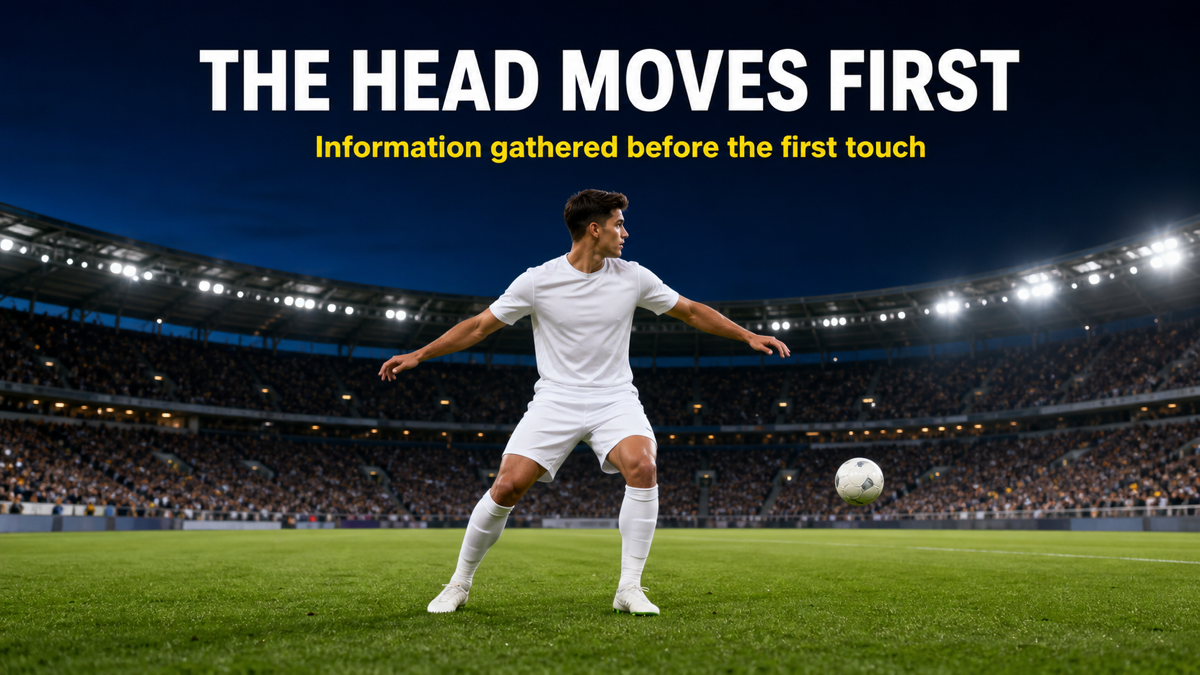
The act is small. The cognitive load is enormous. In the seconds before a pass arrives, the scanner is building a live mental map of where to play, where to move, and which option the defender has already discounted.
That map dictates the first touch. This is why coaches at every level shout “check your shoulder” or “head up” from the touchline. They are not asking for posture; they are asking for a tactical decision before the ball forces it.
The reason scanning in football has become a focus of elite academies is simple. It is one of the few cognitive performance variables quantified at scale, and the data shows it predicts pass success more reliably than physical attributes do. It is also closely linked to peripheral vision in football, the second perceptual track that builds the full picture between head turns.
The Numbers Behind Elite Scanning
Elite scanning in football happens roughly twice as often as the Premier League average, and the numbers behind that gap come from a decade of work by Geir Jordet. His team coded the head movements of 118 Premier League midfielders and forwards across 64 games, focusing on the 10-second window before each player received a pass that advanced the ball.
The dataset, published in Frontiers in Psychology in 2020, found that players in the highest scanning-frequency group completed 17% more passes and 33% more forward passes than the lowest group. Scanning volume predicted on-the-ball outcomes in a way physical metrics did not come close to matching.
The individual numbers are stark. Xavi Hernández, the benchmark, scanned 0.83 times per second in the windows studied, while Cesc Fàbregas hit 0.76. İlkay Gündoğan averaged 0.66, Frank Lampard 0.62, and Steven Gerrard 0.61.
| Player | Scans per second | Approx. scans in 10s window |
|---|---|---|
| Xavi Hernández | 0.83 | 8+ |
| Cesc Fàbregas | 0.76 | 7-8 |
| İlkay Gündoğan | 0.66 | 6-7 |
| Frank Lampard | 0.62 | 6 |
| Premier League average | ~0.60 | 6 |
| Bottom group | ~0.40 | 4 |
Data reflects Jordet’s published research on visual exploratory behavior in elite English Premier League midfielders, sampled across 64 matches and 118 players. Individual variance by match state and opposition applies.
The Premier League average sat around 0.6, and the bottom group fell closer to 0.4. The gap is not a fraction of a percent; it is a doubling of the rate at which information enters the player’s brain before the ball arrives.
These are not glances. Each is a discrete head turn under match pressure in the seconds before contact. Multiply that across 90 minutes and the picture is of a player carrying a live map of the pitch while everyone else reacts when the ball arrives.
Why Pre-Scan Information Beats Reaction Time
The reason scanning in football predicts outcomes is that it converts a reactive decision into a pre-loaded one. A player who has already seen the press shape, the runner behind them, and the lane between two defenders only needs to confirm with the touch. A player who has not seen those things starts cognitive processing from scratch the moment the ball arrives.
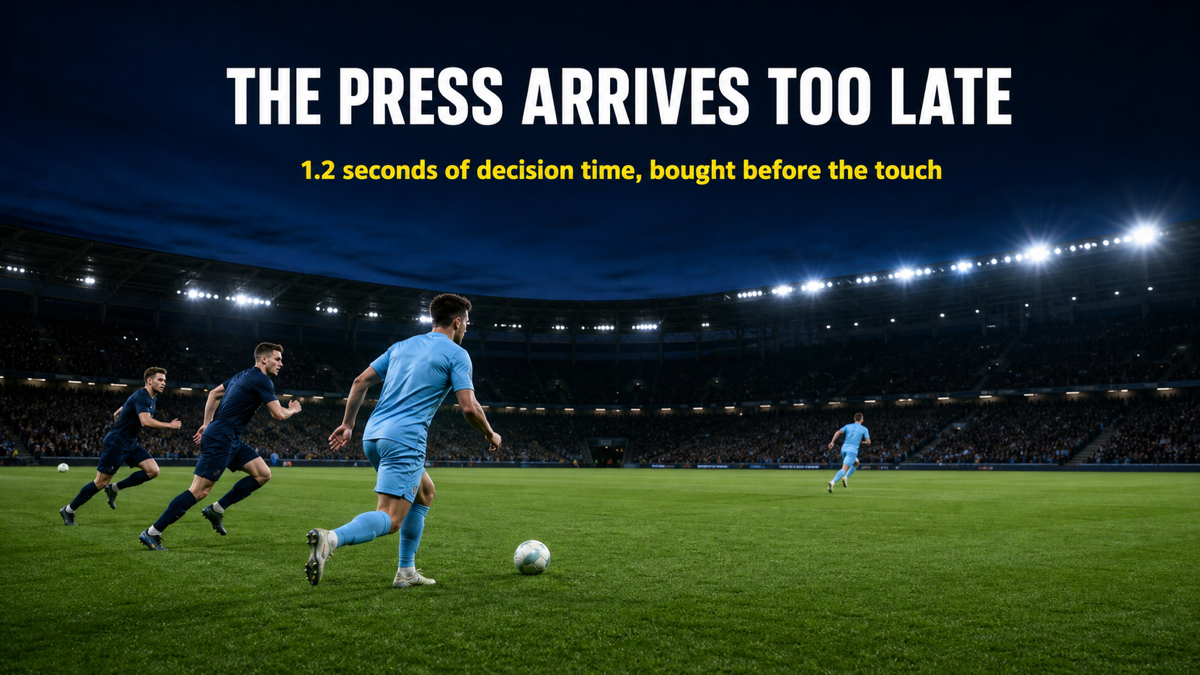
The time difference is measurable. Pre-scan decisions execute 0.8 to 1.2 seconds faster than post-touch decisions, per performance research at top academies. In elite football, where pressing triggers fire within one to two seconds of a ball arriving in the receiver’s zone, that gap is the difference between a clean turn into space and a forced pass back to the centre-back.
The Liverpool sides under Jürgen Klopp built a pressing identity around exploiting this gap. The counter-press triggers the moment a midfielder commits to a touch with a defender in their blind side. A receiver who scanned plays one-touch out; one who did not loses the ball in a dangerous area, often inside five seconds.
Possession football works the same way in reverse. Pep Guardiola’s Manchester City sides drill scanning behaviours into every rondo and positional game, because a player who has seen the next pass before they receive it can complete a third-man combination at speed. The ball moves through three players in under two seconds, and the defence never recovers shape.
How Pep Guardiola Industrialised Scanning at Manchester City
Manchester City under Pep Guardiola turned scanning in football from an individual trait into a team-level standard. Every training session opens with positional games that punish the player who does not look before the ball arrives. The cue is constant, the consequence immediate loss of possession in the rondo.
The reason is structural, not coaching philosophy. City’s possession model relies on third-man combinations, half-space underlaps, and overload-to-isolate sequences that only work if every receiver already knows where the next pass is going. If even one player in the chain has to look up after the touch, the rhythm collapses and the defence reorganises.
This is why İlkay Gündoğan, with a scanning rate of 0.66 per second in Jordet’s dataset, was central to the system for so long. He was the most pre-loaded passer in the squad, not the fastest. His decision was made before the touch in nearly every sequence, and the speed of the ball through midfield depended on it.
The visible signal is in the body language. City midfielders open their stance toward the press before receiving, and the head turn is the one movement the broadcast camera rarely catches. The first touch then takes the ball into the space the opposition has just vacated, and the move continues at the same tempo.
Bellingham vs De Bruyne: Two Templates of Elite Scanning
Two of the modern game’s most quoted examples of elite scanning in football come from very different positions. Kevin De Bruyne, now at Napoli after his summer 2025 free transfer from Manchester City, scans at a rate Jordet himself has singled out as exceptional. Jude Bellingham, the Real Madrid number eight, was named by Jordet alongside Phil Foden and Kylian Mbappé as one of the most accomplished young scanners in elite football.
The two arrive at the same outcome from opposite ends of the pitch. De Bruyne’s scanning is wide-angled and forward-focused. He uses the pre-receive window to map the defensive line and the goalkeeper position, which is why so many of his through balls land in a yard of space that did not exist when the pass left his foot.
Bellingham scans for context, not for the next pass. His head turns before receiving track the defender on his shoulder, the late runner from midfield, and the location of the second-ball zone if the touch goes loose. The output is a Real Madrid number eight who arrives in the box at the right tempo with the right knowledge of who is around him, even when he started the move 40 yards deep.
Both players show the principle Jordet’s research identifies. The cognitive head start makes the technical action look effortless, but the work is being done before the camera follows the ball.
Coaching Scanning: Why “Check Your Shoulder” Is Not Enough
The coaching shorthand for scanning in football is “check your shoulder,” and on its own it is one of the least effective cues in modern coaching. A player who turns their head without knowing what to look for has scanned in posture only. Research from the Norwegian School of Sport Sciences shows the act has to be paired with a perceptual task to translate into better decisions.
The fix is context-led training. A 2025 intervention study on elite youth players using targeted verbal cues like “where is your spare runner?” or “who is open in the half-space?” produced a 27% immediate jump in scanning frequency, with measurable improvements in pass success in the same session. The instruction changed the goal of the scan, not just the action.
This is where Karl Aksum at FIFA’s training centre has reframed academy coaching. Scanning in football is not a drill outcome; it is a habit built through repeated decision-making practice, in which the player chooses between live options after each head turn. Constraint-led games with pressing triggers force the cognitive work to become automatic.
The clubs furthest ahead on this are those that integrate scanning into a regista-style midfielder development pathway, because the player profile and the perceptual skill develop together. The cue, the practice, and the role become a single training package.
The Weakness: When Scanning Becomes the Wrong Habit
Scanning in football is not a universal good. Jordet’s own research shows that elite scanners drop their rate sharply in their own defensive third. A centre-back receiving a pass inside his own penalty area gains little from scanning the pitch and a lot from playing immediately to the closest safe option.
The same principle applies under heavy press. Late-arriving pressing units, like the high-line traps used by Unai Emery’s Aston Villa, are designed to make scanning a liability. The receiver who looks up is given two yards of inviting space, and by the time the eyes return to the ball, the press is on top of the touch.
There is also a player-level failure mode. A young midfielder who scans without the tactical vocabulary to interpret what they see is collecting information they cannot use. This is why intervention studies pair the cue with explicit perceptual training, so the skill matches the cognitive map before data translates into decisions.
Closing Analysis
Scanning in football is the quiet skill that decides who plays at the top level. It is invisible to the broadcast, absent from highlight reels, and almost never named when a midfielder is called elite. But Geir Jordet’s two-decade research project is clear: players who scan more complete more passes, progress the ball more often, and stay calmer under pressing.
The implication for academies is the harder part. Selecting for scanning means valuing a cognitive trait invisible at first sight, over the visible technical actions scouting still anchors to. The clubs that get this right will own the next decade of midfield development.
What Do You Think?
If scanning in football is measurable and predictive, should academies rank 14-year-olds on scans per second the way they rank them on sprint times? Or does formalising a cognitive trait into a scouting metric risk producing a generation of midfielders who look without seeing? Drop your take below.
Want to read any match like this?
The framework behind these breakdowns, in one place. The four phases, a 15-minute method for diagnosing both teams before the drinks break, a printable match-watching worksheet, and 51 terms defined. 40 pages.
Get the pack$9, instant downloadRelated Tactical Breakdowns
The Third Man Run: 3 Secrets Elite Teams Use to Shatter Defensive Lines
Why it connects: The third-man combination only fires at speed because every receiver in the chain has already scanned for the next option.
The Regista: Football’s Most Misunderstood – and Most Essential – Midfielder
Why it connects: The regista role is built on the same pre-receive perceptual habit, applied to a deep-lying playmaker’s tempo control.
The 3-Second Rule: Why Attacking Transitions Win Elite Football Matches
Why it connects: The 3-second rule on attacking transitions depends on the receiver knowing where the runner is before the ball wins the second.
Speak the language of the game
Get the free 47-term tactical glossary. Gegenpress, half-space, xT, low block, each defined in plain language and linked to a full breakdown. It is yours for an email.
Frequently Asked Questions
What is scanning in football?
Scanning in football is the head movement a player makes to gather pitch information before the ball reaches them. The term, coined by sports-science researcher Geir Jordet, refers specifically to deliberate visual exploration during the 10-second window before a pass arrives. Scanning in football is the cognitive engine behind the clean first touch and the pre-loaded decision.
Why is scanning important for midfielders?
Scanning in football matters for midfielders because it converts a reactive decision into a pre-loaded one, the difference between progression and dispossession under pressing. Jordet’s Premier League research found that high-frequency scanners completed 17% more passes and 33% more forward passes than low-frequency scanners. The skill buys a midfielder up to 1.2 seconds of decision time.
How often do elite players scan before receiving the ball?
Elite scanning in football happens between 0.6 and 0.83 times per second in the 10-second window before receiving a pass, per Geir Jordet’s research. Xavi Hernández leads the dataset at 0.83 scans per second, with Cesc Fàbregas at 0.76 and the Premier League average near 0.6. The bottom group falls near 0.4 scans per second.
Can scanning be coached and trained?
Yes, scanning in football can be coached and trained, and intervention studies show measurable improvements within a single session. A 2025 study on elite youth players using targeted verbal cues produced a 27% immediate jump in scanning frequency. The most effective coaching pairs the head-turn cue with a perceptual question, such as identifying spare runners or open half-spaces.
Which players are considered the best scanners in modern football?
Kevin De Bruyne, Jude Bellingham, Phil Foden, and Kylian Mbappé are named by Geir Jordet among the most accomplished examples of scanning in football today. De Bruyne’s frequency has been singled out as exceptional, while Bellingham was identified as an elite young scanner before joining Real Madrid in 2023. Historical benchmarks include Xavi Hernández, Cesc Fàbregas, and Andrés Iniesta.