

Last updated: October 14, 2026
Stuart Dallas tracked Kevin De Bruyne into the corner flag at the Etihad in 2020, forty yards from where a full-back is meant to stand. That chase, a defender abandoning his zone to shadow one man to the touchline, is Bielsa man marking in its purest form.
Marcelo Bielsa did not invent following your opponent, but no modern coach has trusted it across the entire pitch the way he has. It sits at the aggressive extreme of the ideas mapped across our football tactics library. Where most elite teams defend space, Bielsa defends people.
In simple terms: Bielsa man marking assigns every outfield player one opponent to follow anywhere on the pitch, with a single spare defender behind.
This breakdown covers how the system is built, the rule that keeps it standing, the running data that proves what it costs, and the one weakness that undoes it.
Key Takeaways
- One man, one marker: Bielsa man marking gives every outfield player a single opponent to track anywhere, turning defence into eleven individual duels.
- The +1 rule: One central defender stays free as a libero, so the back line always holds a spare man behind the markers.
- The press is the point: Marks double as pressing triggers, squeezing the pitch every time the opponent plays a slow or backward pass.
- It runs on legs: Leeds covered a league-high 113.1km per game in 2020-21, per Opta, the physical cost of marking the man instead of the space.
- One slip ends it: Beat your direct marker and the whole chain breaks, which is exactly how opponents counter Bielsa ball.
Table of Contents
What Is Bielsa Man Marking?
Bielsa man marking is a defensive system in which every outfield player marks a specific opponent across the whole pitch, supported by one spare defender. It swaps the zonal logic most teams use, guarding areas, for a personal logic, guarding people.
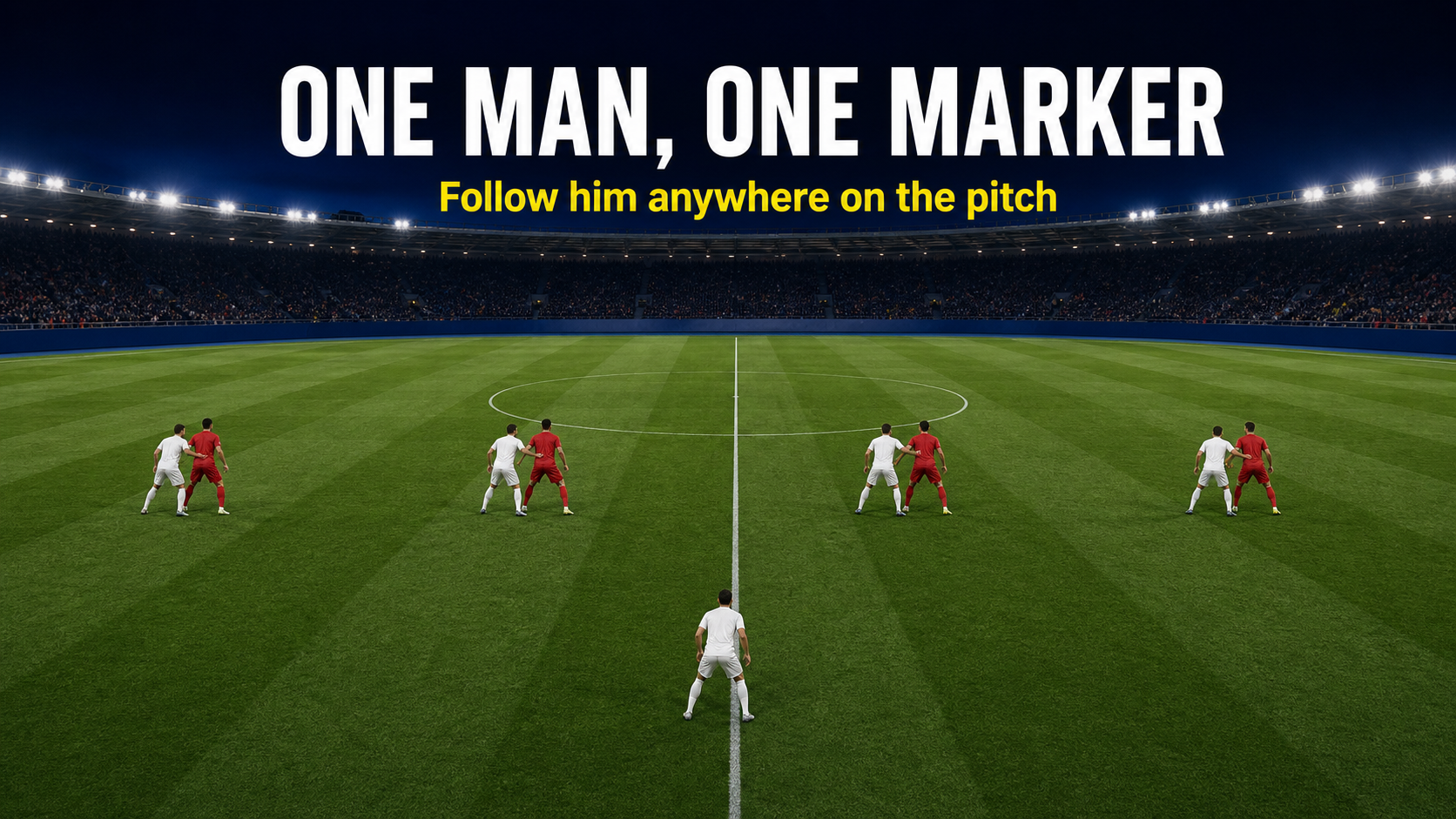
The reference point is the difference. A zonal defender reads the ball and his space, while a Bielsa defender reads his man and follows him into midfield, out to the touchline, or deep into his own box. This is closer to pure man to man marking than anything else in the elite game.
Diego Simeone and Jurgen Klopp borrow pieces of this idea, but Bielsa applies it without compromise, which is what supporters christened Bielsa ball. The system only holds because of the defender left behind the markers.
That free man turns ten individual duels into a structure rather than a gamble. Take him away and the scheme becomes ten foot races with no safety net.
The All-Pitch Commitment: Following Your Man Everywhere
The defining feature of the system is that the assignment never ends at a zone boundary. A Leeds full-back would follow an opposition winger inside, a midfielder would chase a dropping striker into his own third, and nobody passed responsibility to a teammate. Every player owned one opponent for ninety minutes.
This is why Bielsa ball looks chaotic and feels suffocating at the same time. The opponent rarely finds a free man in his usual passing lane, because that man already has a shadow. Bielsa described the goal as denying the opposition the time to think.
The risk is obvious and deliberate. Dragging markers everywhere stretches the shape and opens space, but Bielsa accepts that trade because the marker travels with the danger. Wherever the ball goes, a defender is already there.
The +1 Rule: Why One Defender Always Stays Free
The +1 rule is what stops the method from turning reckless. Bielsa keeps one extra defender at the back, two centre-backs against one striker or three against two, so a spare man is always free of any marking duty. Analysis from Coaches’ Voice on Bielsa’s defending calls this free defender the libero who covers wherever trouble appears.
To create that spare man at the back, Bielsa runs a -1 in attack. His striker presses two centre-backs alone, sacrificing a body high up so the extra man exists low down. It is a numbers trade, accepted shortage in attack to guarantee a surplus in defence.
At Leeds, Kalvin Phillips often became the free midfielder once Bielsa pushed his centre-backs onto their men. That cushion let Phillips step out and delay attacks, knowing the spare centre-back could cover behind.
Squeezing the Pitch: The Press That Powers the Marking
The system only works because it is welded to a suffocating press. Every time the opponent plays a slow sideways ball or a backpass, the marker jumps forward and the whole team climbs with him to stay compact. The Bielsa pressing engine and the marking scheme are the same action seen from two angles.
This is the part of Bielsa ball that exhausts opponents. There is no safe square pass to reset, because each ball invites a fresh wave from a marker who is already touch-tight. It is the mirror image of teams that defend without the ball in a passive block.
The press also turns defence into attack instantly. Win the ball with everyone marked and the opponent is, by definition, marked out of the counter too, so Leeds could swarm forward without fear. The press was a recovery tool as much as a containment one.
Inside the Leeds United Engine: The Data Behind Bielsa Ball
The cost of Bielsa man marking shows up most clearly in the running data from his Leeds United tactics. Marking the man instead of the space means a defender accelerates every time his opponent moves, and those metres accumulate across ninety minutes. Leeds led the entire Premier League in physical output during 2020-21.
Per Opta data published by Sky Sports, Leeds covered 113.1km per game and produced 169 sprints per game, both the highest figures in the division. Their pressing intensity was equally extreme, sitting among the league’s most aggressive PPDA marks.
| Metric (2020-21) | Bielsa’s Leeds United | Why It Matters |
|---|---|---|
| Distance per game | 113.1 km (most in the PL) | Every marker chases his man, never a fixed zone |
| Sprints per game | 169 (most in the PL) | Marking the man means repeated explosive tracking |
| PPDA | Among the league’s lowest | Marks double as pressing triggers high up the pitch |
| Squad used | 23 players, fewest changes | The system demands drilled, repeatable partnerships |
Data reflects Opta-tracked metrics across Leeds United’s 2020-21 Premier League season. Individual match and season variance applies.

That workload is not a side effect, it is the system. Bielsa ball asks players to run more than anyone else because marking a person is more expensive than guarding a patch of grass. When the legs go, so does the structure.
From Newell’s to Uruguay: The Bielsa Lineage
The method is not a Leeds invention, it is the latest version of an idea Marcelo Bielsa has carried for over three decades. His path, traced from Newell’s Old Boys onward, runs through the Chile national team, Athletic Bilbao, Marseille, Leeds United, and now Uruguay, where he remains head coach into the 2026 World Cup.
The influence runs deeper than results. Pep Guardiola once travelled thousands of miles to meet Bielsa before becoming a manager and still calls him the coach he admires most, while Mauricio Pochettino credits Bielsa with planting the seed of his career. Diego Simeone and Jorge Sampaoli sit on the same family tree.
What they borrowed was rarely the pure marking, which few dare to copy wholesale. They took the intensity, the courage, and the belief that a team can dictate through aggression rather than possession. Bielsa kept the most extreme version for himself.
The Weakness: One Beaten Man Breaks the Whole Chain
The fatal flaw of Bielsa’s man-marking is simple, you are only as strong as your weakest individual duel. The moment one attacker beats his direct marker, no covering defender waits in that zone, because everyone else is occupied with their own man. One win turns instantly into a clean run at the spare defender.

Opponents counter Bielsa ball by manufacturing exactly that mismatch. A quick winger isolated against a slower full-back, a false nine dropping to drag a centre-back out, or a sharp one-two to spin a marker, each is designed to win a single duel and expose the space behind. Pep Guardiola’s teams repeatedly used rotations to bait Leeds markers out of position.
The high line the system demands makes the punishment severe. With defenders pushed up onto their men, one pass in behind becomes a foot race toward goal, which is why sound rest defence structures hurt these teams so badly on the turnover.
Bielsa’s answer was always more aggression, not less, trusting that winning the ball back faster mattered more than covering the gaps. Against elite attackers, that bet did not always pay.
The Bigger Picture
Bielsa man marking is the most honest system in modern football, and that honesty is both its glory and its ceiling. It refuses the safety of the zone and stakes everything on whether each defender wins his duel, which makes it thrilling to watch and brutal to sustain. Few squads have the legs or the nerve to run it for a full season.
My view is that Bielsa ball will always be a cult method rather than a dominant one, because the elite game punishes single mistakes too efficiently. But its fingerprints are everywhere, in every coach who presses man-to-man in midfield or trusts a defender to follow his runner. Bielsa proved the extreme is possible, even when it is not optimal.
What Do You Think?
Leeds covered a league-high 113.1km a game under Bielsa’s man-marking system and still slid out of the Premier League two seasons later. Was it a noble dead end, or would it work today with a deeper, fitter squad and five substitutions to manage the load? Make your case below.
Want to read any match like this?
The framework behind these breakdowns, in one place. The four phases, a 15-minute method for diagnosing both teams before the drinks break, a printable match-watching worksheet, and 51 terms defined. 40 pages.
Get the pack$9, instant downloadRelated Tactical Breakdowns

Zonal Marking vs Man-to-Man Defending: Which System Actually Wins?
Why it connects: Bielsa’s all-pitch method is the extreme end of the man-to-man tradition this guide weighs against zonal systems.

What Is Counter-Pressing? 7 Principles That Win the Ball Back
Why it connects: The instant swarm Bielsa launches on winning the ball is the same recovery logic that drives elite counter-pressing.
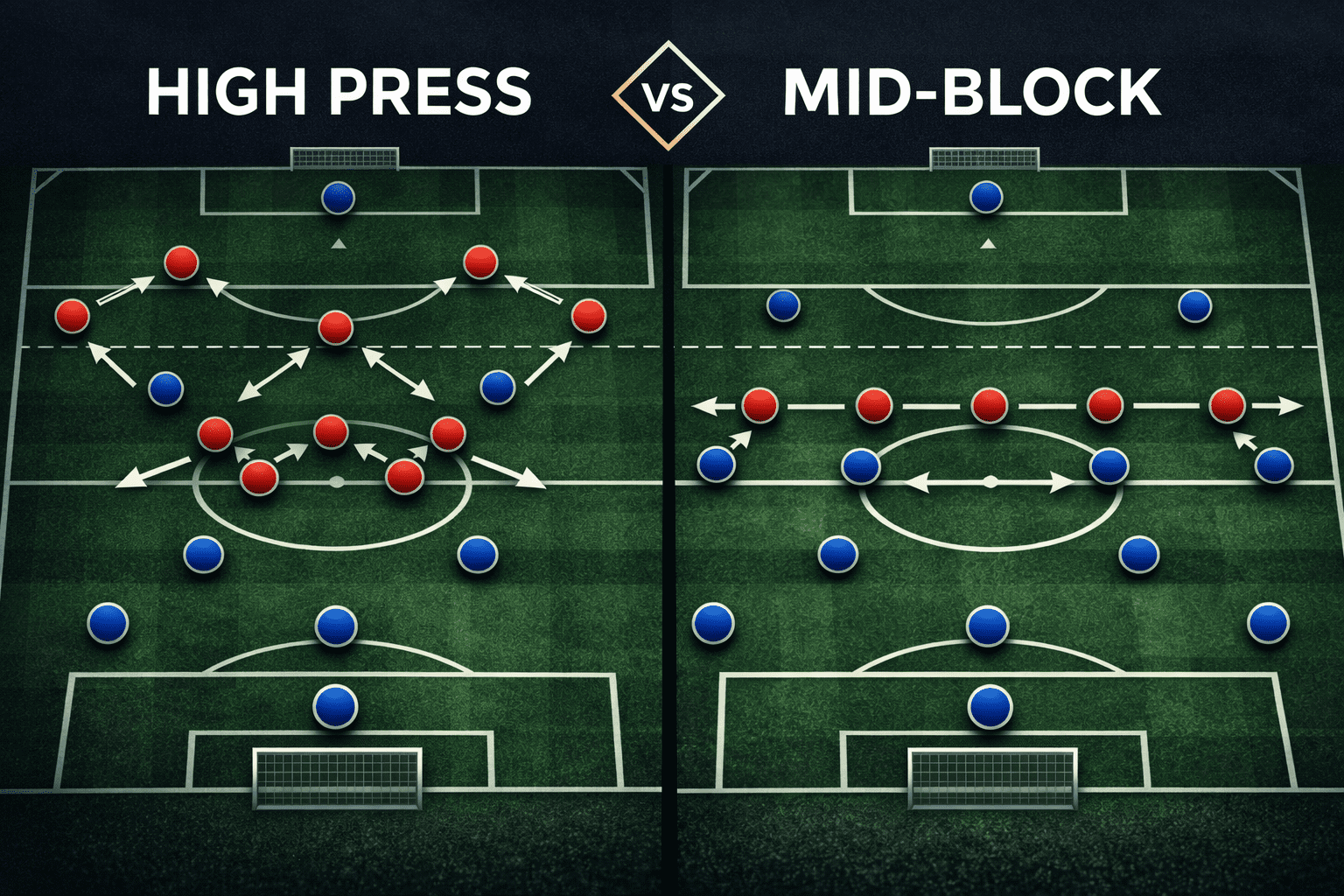
High Press vs Mid-Block: 7 Tactical Differences That Define Modern Football
Why it connects: Bielsa sits at the most aggressive edge of the high-press spectrum this breakdown maps against the mid-block.
Speak the language of the game
Get the free 47-term tactical glossary. Gegenpress, half-space, xT, low block, each defined in plain language and linked to a full breakdown. It is yours for an email.
Frequently Asked Questions
What is Bielsa man marking in football?
Bielsa’s man-marking is a system where every outfield player tracks one assigned opponent across the whole pitch. Marcelo Bielsa keeps a single spare defender behind the markers and welds the scheme to a relentless press. It trades positional safety for constant aggression and the denial of time on the ball.
Why does the Bielsa system require so much running?
Marking the man instead of a zone forces every defender to chase his opponent wherever he goes, which demands elite fitness. Bielsa’s Leeds covered 113.1km per game in 2020-21, the most in the Premier League per Opta. The metres pile up because the reference point is a moving player, not a fixed space.
How do teams beat Bielsa’s man-marking system?
Teams beat it by winning a single one-versus-one duel and attacking the space behind. Isolating a quick attacker on a slower defender, dropping a striker to drag a centre-back out, or playing in behind the high line all exploit the lack of zonal cover. One beaten marker is enough to open a direct route to goal.
Is Bielsa’s marking the same as zonal marking?
No, Bielsa’s approach is the opposite of zonal marking. Zonal defenders guard areas and pass attackers between them, while Bielsa’s players guard people and follow them everywhere. The two sit at opposite ends of the defensive spectrum, with most modern teams blending them rather than committing fully to either.