

Last updated: October 27, 2026
Dominic Solanke’s stoppage-time header at Old Trafford on 10 October was Tottenham’s third Premier League goal of the season, and it earned their third point. Roberto De Zerbi’s side had ten men after Rodrigo Bentancur’s red card, yet Opta Analyst still had them ahead on chances, 1.56 expected goals (xG) to Manchester United’s 0.77.
That gap between control and reward is the story of the Tottenham tactics under De Zerbi so far. De Zerbi has rebuilt how Tottenham Hotspur keep the ball, press and build from the back, and the football tactics behind it hang together, but Opta Analyst records that Spurs failed to win their opening six league games for only the fourth time in the club’s history.
In simple terms: Tottenham under De Zerbi build patiently from the goalkeeper, press high after losing the ball, and still struggle to turn possession into goals.
Six league games is a small sample, so every trend below carries that warning.
Key Takeaways
- The ball now belongs to Spurs: 58.9% possession after six league games, fourth in the division (FotMob), up from 49.6% in 2025-26 (Opta).
- The goals were slow to arrive: Spurs scored three league goals in their first six games, the fewest in the league at that point (FotMob), before beating Coventry 3-1.
- The set-piece crutch is gone: Set plays produced 39.6% of Tottenham’s league goals last season, the division’s highest share (Opta).
- The press survived the rebuild: Spurs win the ball in the final third 4.8 times a game, fifth in the league (FotMob).
- The sample is still tiny: De Zerbi made 12 starting-XI changes in the first four league games, the most Spurs have ever made at that stage of a Premier League season (Opta).
Table of Contents
What Are the Tottenham Tactics Under De Zerbi?
The Tottenham tactics under De Zerbi are a possession game built from the goalkeeper outward: short goal kicks, centre-backs who break lines with passes, a double pivot that receives under pressure, and an immediate press when the ball is lost. On the team sheet Spurs have lined up with a back four this season, listed as a 4-2-3-1 for the draw at Manchester United, with Conor Gallagher as the 10 there and at Brentford, per the club and Sky Sports.
De Zerbi’s Brighton & Hove Albion side is the template. Opta Analyst found Brighton played 159.8 passes a game that finished in their own defensive third between September 2022 and the end of 2023-24, at least 12 more than any other side, while still pressing hard enough for a 10.5 PPDA, second-lowest in the league. The Brighton mechanics, from the studs-on-ball pause to the 4-2-4 pin, are covered in our breakdown of the De Zerbi baiting press structure.
The Spurs version differs in three ways. The personnel was bought for the system rather than coached into it, the set-piece goals that kept Tottenham up have gone, and every opponent now knows the bait is coming.
The Survival Version: How De Zerbi Kept Spurs Up
De Zerbi’s first seven games were a pressing rescue, not a possession project. He arrived on 31 March with Spurs one point above the relegation zone, swapped Igor Tudor’s 4-4-2 for a 4-3-3, and finished 17th, two points clear of relegated West Ham United.
The engine was an industrious midfield. After a 1-0 defeat at Sunderland, Gallagher, Bentancur and João Palhinha started the final four games, per Sky Sports, and Opta figures published by the club showed Spurs winning possession in the final third 5.3 times a game in De Zerbi’s first four matches, up from 3.7 under Thomas Frank and 3.8 under Igor Tudor.
The defence improved faster than the attack. Sky Sports measured 0.79 xG conceded per game under De Zerbi against 1.51 before.
Survival came from a press and a corner, not from De Zerbi-ball. Spurs took 11 points from those seven games (Sky Sports), and Palhinha’s goal from a corner beat Everton 1-0 on the final day.
The Rebuild: Signings Chosen for De Zerbi’s Build-Up
Tottenham’s summer spending was a direct order for De Zerbi’s style: well over £300 million on new players, per Reuters, concentrated in the two lines that start possession. Jan Paul van Hecke arrived from Brighton, Sandro Tonali from Newcastle United and Mateus Fernandes from West Ham, a trio costing a combined £237 million, while Marcos Senesi and Andy Robertson came on free transfers.
Each signing answers a build-up question. Opta Analyst’s numbers show Van Hecke made 459 line-breaking passes last season and Senesi 420, the kind of progression De Zerbi’s first phase is built on.
De Zerbi’s attack was added late and the old spine left. Sávio joined from Manchester City for an initial £75 million and Omar Marmoush followed on a season-long loan, per Al Jazeera, while Cristian Romero and Palhinha departed and Antonín Kinský became first-choice goalkeeper, according to Opta Analyst.
De Zerbi Tottenham Formation: How the Build-Up Hunts a Free Man
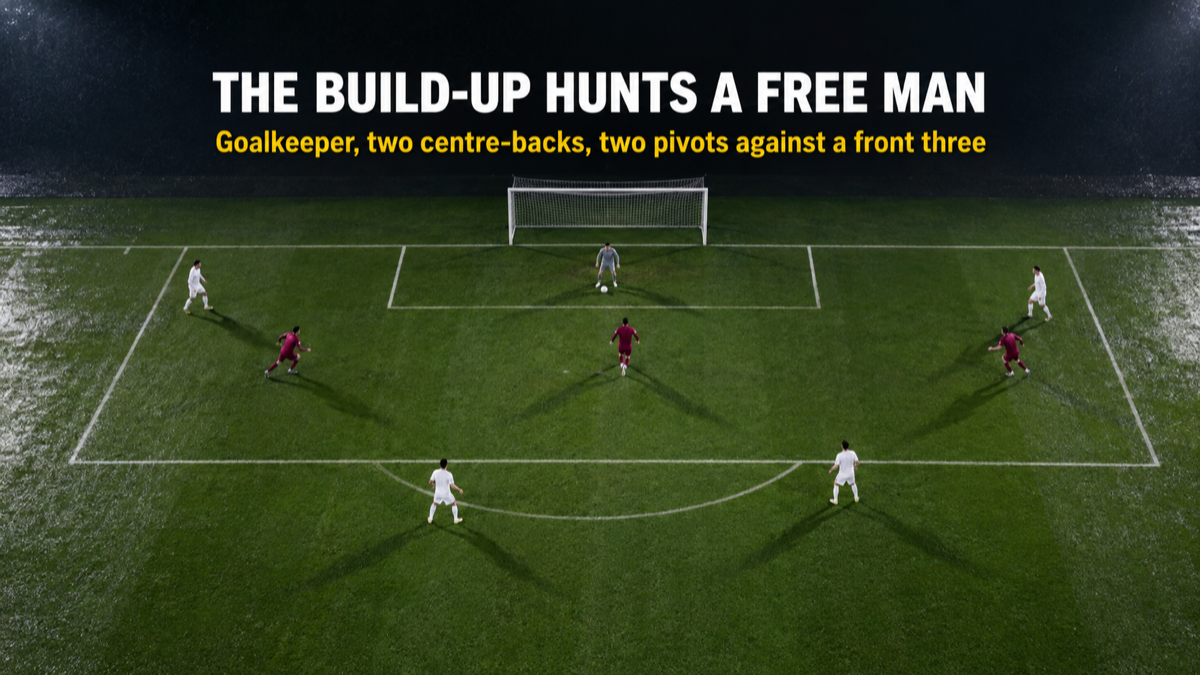
The De Zerbi Tottenham formation matters less than the first phase it produces: Kinský, two centre-backs and two pivots form a five-man base built to outnumber the opponent’s first line of pressure. If a side presses with three, one Spurs player is free, and De Zerbi’s whole build-up exists to find him before the press resets.
Spurs build-up play now avoids the long exit almost completely. Tottenham complete 466.5 passes a game, third in the league, and the fewest accurate long balls of any side at 15.8 a game, per FotMob, a striking reversal for a back line that includes Senesi, who attempted more long balls (477) than any Premier League outfielder last season, according to Opta Analyst.
The front four hold the width and height that pin a back four, giving the pivots room to turn. Sávio has been the main supplier, with 11 chances created, the most in the squad per FotMob, while Robertson, Destiny Udogie and Archie Gray have all started at full-back.
Tottenham Possession Stats: The Paradox in Numbers
Tottenham possession stats under De Zerbi describe a team that has taken the ball off opponents without yet taking the game off them. The table compares the 2025-26 side De Zerbi inherited with the first six league games of 2026/27, and the territory has shifted far more than the threat.
| Metric | Spurs 2025-26 | Spurs 2026/27 (6 PL games) | What it tells you |
|---|---|---|---|
| Average possession | 49.6%, 11th (Opta, first 31 games) | 58.9%, 4th (FotMob) | Control has moved decisively to Spurs |
| Long balls | 12.2% of passes, 11th-highest (Opta) | 15.8 accurate per game, fewest in the league (FotMob) | The direct exit has been closed on purpose |
| Final-third possession wins | 3.7 under Frank and 3.8 under Tudor, 5.3 in De Zerbi’s first four games (Opta) | 4.8 per game, 5th (FotMob) | The press survived the rebuild |
| Set-piece output | 39.6% of goals, highest share in the league (Opta) | 1 set-piece goal from the league’s most corners, 42 (FotMob) | The old safety net has gone |
| Goals per game | 1.26, 48 in 38 games (Opta) | 0.5, 3 in 6 games, fewest (FotMob) | Territory has not yet become threat |
Sources: Opta figures published by Opta Analyst and Tottenham Hotspur for 2025-26, and FotMob team statistics after six 2026/27 Premier League games.

The pattern is the sterile-possession trap that Field Tilt was built to expose. Spurs rank fourth for touches in the opposition box (182) but 19th for total xG (6.6), per FotMob, so the ball reaches the area without turning into clear chances.
Why Spurs Set Pieces No Longer Bail Them Out
Spurs set pieces were the hidden engine of 2025-26, and the rebuild removed the men who finished them. Set plays produced 36.9% of Tottenham’s xG and 39.6% of their goals last season, the highest shares in the Premier League per Opta Analyst, with Palhinha scoring five set-piece goals, Romero four and Micky van de Ven four.
Palhinha and Romero have both gone, and the threat went with them. FotMob now counts one set-piece goal from the most corners in the league.
A possession side can live without a corner routine if it scores freely from open play, and De Zerbi’s Spurs are not yet that side. Elite set-piece tactics are coached routines rather than a by-product of tall defenders, and Spurs need a new one built around Van Hecke and Van de Ven.
The Last 25 Metres: Where De Zerbi’s Spurs Stall
The final third is where De Zerbi’s model currently breaks, and he said so himself. After the 0-0 with Everton he told reporters, per NBC Sports: “We went into the goal area 74 times but we didn’t create the chances to meet our quality of play,” adding, “We have to focus on the last 25 meters.”
Opta Analyst’s match data backs the diagnosis. Spurs took 14 shots against Everton but put only two on target for 0.64 xG, while Everton generated 1.17 xG from 12 attempts, and Tottenham’s first league goal of the season came with their 67th shot, ending a 492-minute drought.
Personnel explains part of De Zerbi’s problem. Solanke, Dejan Kulusevski, Mohammed Kudus, Xavi Simons and Wilson Odobert were all injured before the opener, per Opta Analyst, and the front line has barely played together. Old Trafford showed the chances can catch up with the control, with Tonali and Sávio supplying the deliveries.
The Weakness: Man-to-Man Pressure and the Counter Behind the Build-Up
The weakness of De Zerbi’s Tottenham is the trade his Brighton made: a build-up that invites pressure also invites punishment when a pass is loose or the counter-press arrives late. Opta Analyst found De Zerbi’s Brighton conceded 15 goals from counter-attacks, the most in the league, and lost the ball within 40 metres of their own goal 288 times, with 48 of those turnovers leading to an opposition shot.

Keith Andrews’ Brentford showed the Spurs version on the opening day. Brentford won 3-0 with 3.96 xG to Tottenham’s 0.47, per Sky Sports, and their second goal followed a Spurs turnover, with De Zerbi admitting afterwards that “we made a lot of mistakes in the timing of the pressure.”
The second counter is refusal. Everton let Spurs keep the ball at the Tottenham Hotspur Stadium, defended resolutely in Opta Analyst’s description, and still finished ahead on xG, an opponent the bait cannot solve on its own.
Both responses aim at the same pressure point in De Zerbi’s model. Teams that will not press leave Spurs needing final-third craft they currently lack, and every extra player sent forward to find it thins the rest defence structure behind the ball when possession is lost.
Final Thoughts
The process numbers argue for patience and the table argues for urgency, and De Zerbi needs to answer both at once. Possession, box entries and the press point to a coherent system, while three goals in the first six games, and a first win only at the seventh attempt, point to a system still learning to finish.
The verdict here is that Spurs should keep the build-up and stop being pure about everything else. A coached set-piece routine and a willingness to go long when Everton-style pressure arrives would cost De Zerbi nothing philosophically, and both could buy the weeks his model needs.
Brighton finished sixth in De Zerbi’s first season after he took over with no pre-season, per Opta Analyst. Spurs have had a full pre-season and well over £300 million, so are the Tottenham tactics under De Zerbi a slow build, or an expensive mistake in the making?
What Do You Think?
Spurs had 58.9% possession and three goals after six league games, before a 3-1 win over Coventry. Is that proof the Tottenham tactics under De Zerbi just need time, or should he trade some control for a more direct route before the table decides for him? Drop your take below.
Related Tactical Breakdowns
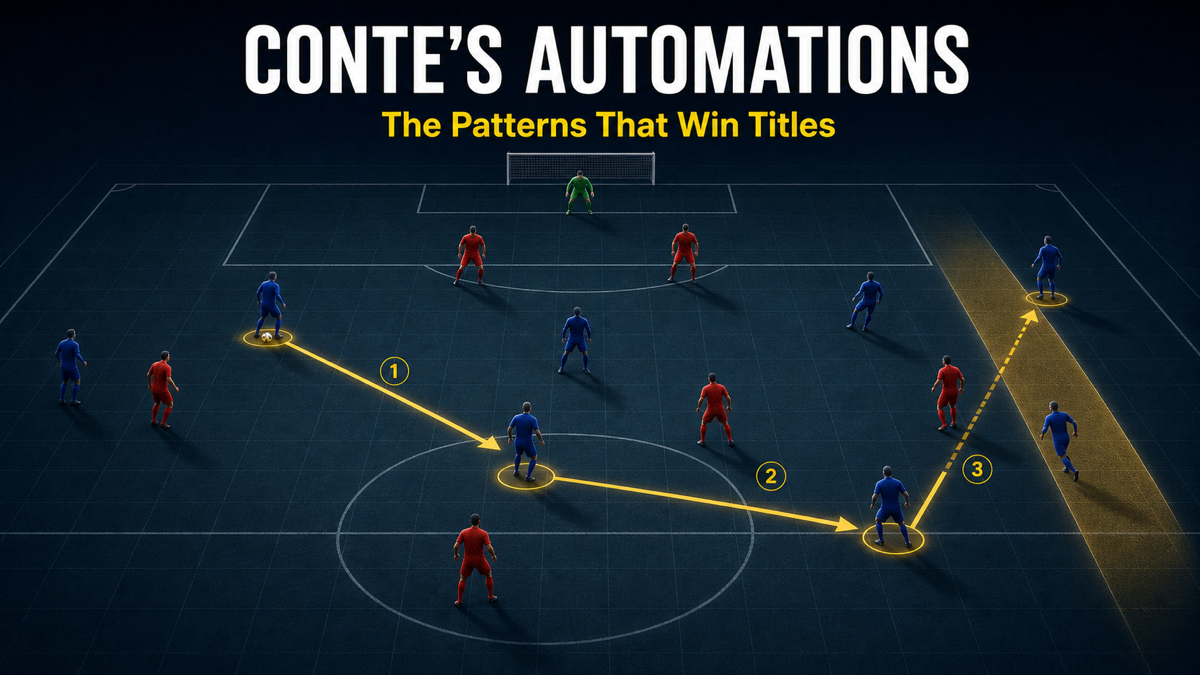
Conte’s Automations: How Patterns of Play Win Titles
Why it connects: Conte’s rehearsed patterns show why 12 line-up changes in four games cost De Zerbi the repetition that automations need.

Game Models in Football: Why Elite Teams Pick Transition or Possession First
Why it connects: Spurs have swapped a transition-and-set-piece game model for a possession-first one, the exact choice this piece maps out.
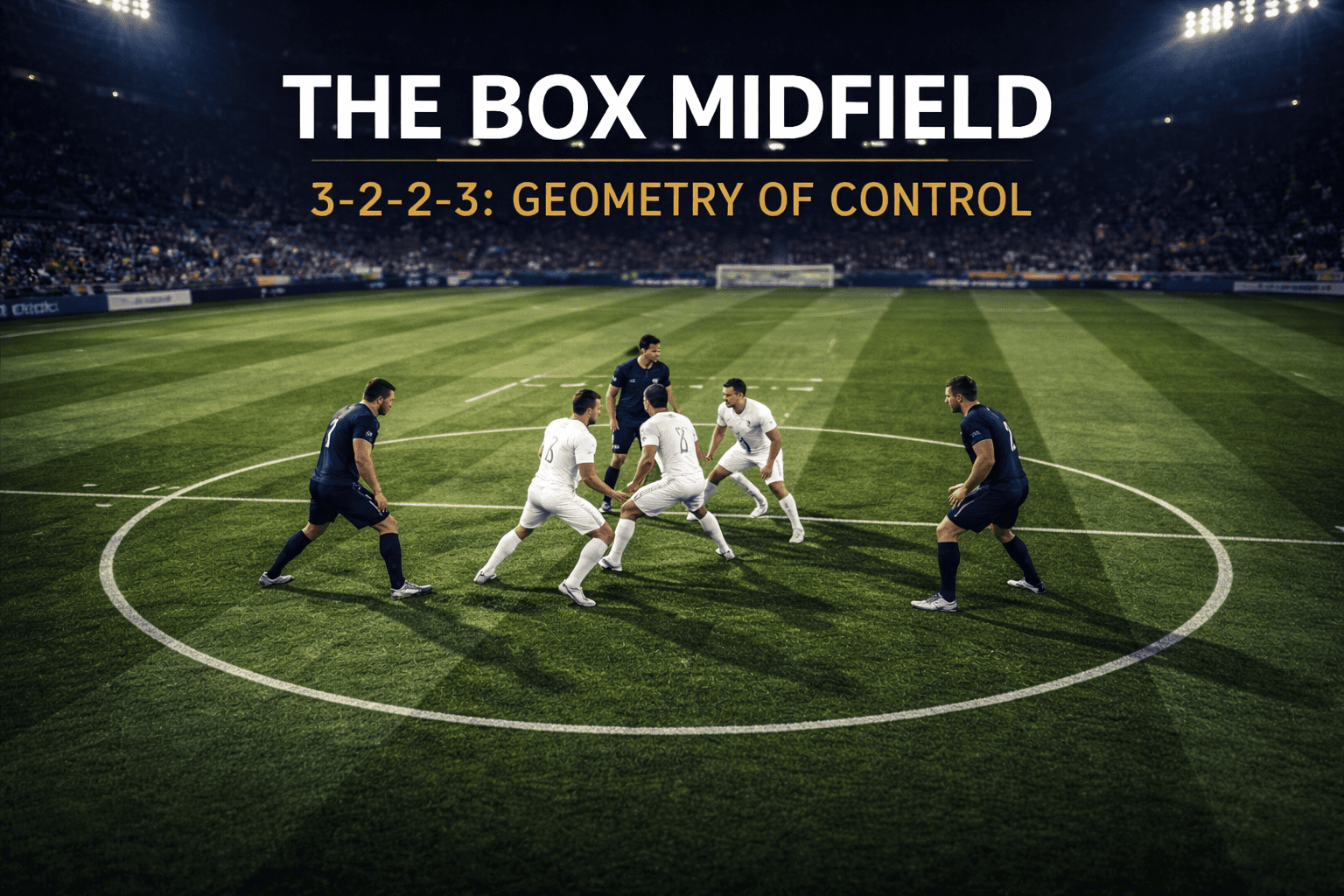
Box Midfield Tactics (3-2-2-3): How Elite Teams Dominate Possession
Why it connects: The two-pivot, two-centre-back base De Zerbi builds from is a close cousin of the box midfield’s central four.
Learn to read a match like an analyst
Get the free 33-page Starter Pack, How to Read a Football Match (the Four Phases, a 15-minute match read, a printable worksheet), plus the 70+ term tactical glossary. Both are yours for an email.
Frequently Asked Questions
What formation does De Zerbi use at Tottenham?
De Zerbi uses a back four at Tottenham, listed as a 4-2-3-1 for the 1-1 draw at Manchester United. He switched Spurs from Igor Tudor’s 4-4-2 to a 4-3-3 in April 2026. In possession the goalkeeper, two centre-backs and two pivots form the base while the front four supply width and height.
Why are Tottenham struggling under De Zerbi this season?
Tottenham are struggling because their possession is not yet producing goals. Spurs average 58.9% of the ball, fourth in the league per FotMob, but scored three times in their first six league games. Injuries in attack, 12 line-up changes in four games (Opta) and the loss of last season’s set-piece threat explain most of the gap.
Who did Tottenham sign for De Zerbi in summer 2026?
Tottenham signed Sandro Tonali, Mateus Fernandes, Jan Paul van Hecke, Marcos Senesi, Andy Robertson and Sávio, and took Omar Marmoush on loan. Reuters put the spending on new players at well over £300 million. Most of it went on the defence and midfield, the two lines that start De Zerbi’s Spurs build-up play.
Is De Zerbi’s Tottenham the same as his Brighton team?
De Zerbi’s Tottenham share his Brighton principles but are far less developed. Both build short from the goalkeeper and press high, and Brighton finished sixth in his first season, per Opta Analyst. Spurs have bigger-money signings, but the attacking rotations and final-third combinations Brighton produced have not yet appeared at Tottenham.