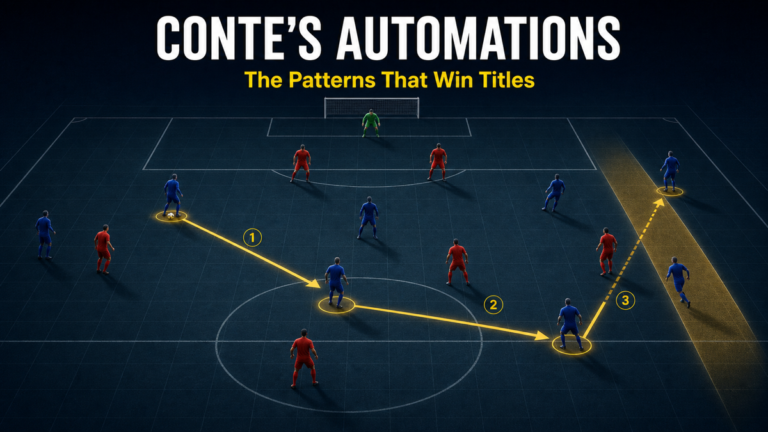


Kylian Mbappé timed his run, burst past the Barcelona back line, and the flag went up. Then it happened again. By full time in the October 2024 Clásico, Mbappé had been flagged offside eight times, the most by any player in Europe’s top five leagues since 2010, according to The Analyst. None of those runs were errors. They were the product of a back line that had turned the offside trap into a weapon.
A high defensive line is the most aggressive bet a defence can make. Push the back four up, squeeze the pitch, and an attack can be strangled thirty metres from goal. Misjudge the step by half a second and a striker has a clear run through. This sits at the heart of modern defensive tactics.
In simple terms: An offside trap is a defensive move where the back line steps up together to leave an attacker behind the play and offside.
This is the real risk calculation behind the high line: what it buys, what it costs, and the moment the whole bet collapses.
Key Takeaways
- The high line is a bet, not a trick: A high defensive line trades space behind for compression up the pitch, and stepping the defence up is how a team collects on that bet.
- Barcelona proved the upside: Barcelona’s opponents were caught offside 77 times in 2024-25, 7.0 per game, far ahead of any rival, per The Analyst.
- Defensive line height is the dial: The higher the line, the more offsides a team provokes and the more grass it leaves behind for a single runner.
- One mistake erases ninety minutes: The offside trap fails the instant a single defender steps late, turning a routine flag into a one-on-one with the goalkeeper.
- The counter is timing, not power: Teams beat the line with a curved run and a through ball, not with strength, which is why the tactic is so unforgiving to coach.
Table of Contents
What Is an Offside Trap?
An offside trap is a coordinated defensive movement where the back line steps forward at the moment an attacker is about to receive the ball, leaving that attacker offside. It works by exploiting the offside rule itself. Under Law 11 of the Laws of the Game, a player is offside if any part of the head, body, or feet is nearer the opponents’ goal line than both the ball and the second-last defender when a team-mate plays the ball.

The trap turns that rule into a trigger. If the defence steps up a fraction before the pass is played, the runner is stranded the wrong side of the line. The flag goes up, possession changes hands, and the attack resets forty metres from goal.
What makes the step-up a tactical choice rather than a reflex is its link to the high line. A deep block has no need for it because there is no space behind to protect. A high defensive line creates that space deliberately, then dares the opposition to run into it.
The trap is the safety net stretched across that space. It only holds if all four defenders move as one.
The Risk and the Reward: Why Teams Push the Line Up
Pushing the defensive line up buys compression, and compression is the most valuable currency in modern defending. When the back four sits thirty metres from its own goal, the gap between defence and attack shrinks, passing lanes close, and the press has somewhere to push the ball toward. A team that defends high can win the ball back in dangerous areas instead of clearing it from its own box.
That reward is why the high line travels with the high press. The two are the same idea seen from opposite ends of the pitch, which is why a high line rarely works without the aggressive pressing covered in our breakdown of the high press versus the mid-block. Squeeze from the front, step up from the back, and the playing area collapses to forty metres.
The cost is written into the same move. Every metre the line climbs is a metre of grass left undefended behind it, and that grass is where games are decided.
| Defensive Setup | Space Compressed | Offsides Won per Game | The Main Risk |
|---|---|---|---|
| High line with an offside trap | High | 7.0 (Barcelona 2024-25, The Analyst) | A single runner in behind |
| Mid-block | Moderate | Around 1 to 2 | Entries into the half-spaces |
| Low block | Minimal | Rare | Sustained pressure and crosses |
Data reflects benchmark and example metrics across the 2024-25 and 2025-26 seasons. Individual team and season variance applies.
The table shows the trade in one row. The step-up converts that undefended grass from a liability into a weapon, but only while the timing holds.
Defensive Line Height: Measuring the Bet
Defensive line height is the metric that measures how high a team is willing to make this bet. The Analyst defines it as the average distance from a team’s goal line to its deepest outfield defender when the team is out of possession. A higher number means a braver line, more offsides provoked, and more space gambled behind.
Barcelona pushed that number to an extreme in 2024-25. Their opponents were caught offside 77 times across the season, an average of 7.0 per game, a figure that dwarfed every rival in Europe, per The Analyst. Aston Villa under Unai Emery had led the way the year before at 4.4 per game, and Barcelona nearly doubled it.

Those numbers are the visible half of defensive line height. Each flag is a possession won forty metres from goal, a counter snuffed out before it started, an opponent forced to reset. On the surface, a team running a high defensive line that provokes seven offsides a game looks like it has solved defending.
It has not. It has simply moved the risk somewhere harder to see, into the handful of moments when the line steps late and the same metric that won 77 flags becomes the open door behind the defence.
Coordination: Why the Line Springs in Unison
The offside trap works only when four defenders act as one body, and that synchronisation is the hardest thing to coach in football. The line must step forward at the same instant, triggered by the same cue, usually the moment the passer’s head drops to strike the ball. One defender reading it late keeps the runner onside and unlocks the entire defence.
This is why the step-up is a discipline, not a trick. Defenders rehearse it until it becomes reflex, with one organiser, often a central defender, calling the line forward with a raised arm or a shout. The communication has to survive noise, fatigue, and the panic of a fast break.
It also has to survive the referee and the assistant. A line sprung a fraction too early plays the attacker onside, and VAR now measures those margins in centimetres. The same technology that confirms a clean trap also punishes a sloppy one, which has made the modern high line a far finer instrument than it was a decade ago.
When it is drilled properly, the result is the Barcelona pattern: a back line stepping up in a straight wave, arms raised, a striker frozen behind them. When it is not, the result is a goalkeeper sprinting to the edge of his box to meet a striker who was never offside at all.
The Weakness: How Attackers Beat the High Line
Beating the high line comes down to timing the run, not winning a foot race. The offside trap is defeated by an attacker who starts behind the ball and accelerates onto a pass at the exact moment it is struck, staying onside by half a step. Pace helps, but the decisive variable is the synchronisation between passer and runner.

The cleanest counter is the disguised through ball. A midfielder who can slide a pass between two stepping defenders, the way Kylian Mbappé is fed at Real Madrid, turns the line inside out. The runner is gone before the defence can reset, and one pass has eliminated four players.
Curved runs are the second answer. By starting wide and bending the run infield, an attacker keeps the second-last defender in peripheral vision and delays the offside moment until the ball is played. Direct, vertical runs are easy to flag, but a bent run is a coin toss for the assistant.
Game state changes the maths too. A team protecting a lead will often drop its line and abandon the step-up entirely, a decision tied to the patterns in our analysis of game state and tactical shifts. The trap is a tactic for chasing control, rarely for defending a one-goal lead in the final ten minutes.
The Final Word
The offside trap is not a defensive system. It is a bet placed on the timing of four players, and the size of the bet scales with the height of the line. Barcelona’s 77 flags in a season show how much it can pay, and Kylian Mbappé’s eight offsides in a single Clásico show how completely it can dominate a world-class attacker.
The honest verdict is that the high line is neither brave nor reckless on its own. It is a calculated trade of safety for control, and the teams that run it best are not the fastest but the most synchronised. The moment that synchronisation slips, the same line that suffocated an attack becomes the widest open door in football.
That is the real risk calculation, and every defence that steps up is making it, whether it has done the math or not.
What Do You Think?
Barcelona provoked 7.0 offsides a game in 2024-25, yet a single mistimed step can hand a striker a clear run on goal. Is a defensive line that aggressive a sign of elite coaching, or a gamble that eventually costs you a season? Make your case below.
Want to read any match like this?
The framework behind these breakdowns, in one place. The four phases, a 15-minute method for diagnosing both teams before the drinks break, a printable match-watching worksheet, and 51 terms defined. 40 pages.
Get the pack$9, instant downloadRelated Tactical Breakdowns

Defending the Half-Space: How Elite Teams Kill the Most Dangerous Zone on the Pitch
Why it connects: The space behind a high line is usually attacked through the half-spaces, the exact zones this breakdown shows elite teams fighting to control.

How Elite Teams Defend Without the Ball: A Complete Tactical Guide
Why it connects: Stepping the line up is one tool inside the larger art of defending without the ball, where structure matters more than tackling.
Low Block Defense in Football: What It Means & How It Works
Why it connects: The low block is the high line’s opposite bet, trading compression up the pitch for safety behind, and the contrast sharpens both ideas.
Speak the language of the game
Get the free 47-term tactical glossary. Gegenpress, half-space, xT, low block, each defined in plain language and linked to a full breakdown. It is yours for an email.
Frequently Asked Questions
What is an offside trap in football?
An offside trap is a defensive tactic where the back line steps forward together to leave an attacker offside as the ball is played. It exploits the offside rule by removing the second-last defender from behind the runner at the decisive moment. Done in unison, it turns possession over without a tackle.
Why do teams play a high defensive line?
Teams play a high defensive line to compress space and win the ball closer to the opponent’s goal. A higher line shortens the pitch, supports an aggressive press, and forces opponents to play through tight gaps. The trade-off is the open space left behind for runners to attack.
How do attackers beat a high defensive line?
Attackers beat a high defensive line by timing runs to start onside and accelerate as the pass is struck. Disguised through balls and curved runs are the most reliable counters, since they delay the offside moment and keep the runner level with the last defender. Raw pace helps, but precise timing matters more.
Is the offside trap a risky tactic?
The offside trap is a high-risk, high-reward tactic that depends entirely on coordination. When all four defenders step as one, it provokes turnovers in dangerous areas, as Barcelona’s 77 offsides won in 2024-25 showed. When one defender steps late, it leaves a striker clean through on goal.
What is defensive line height?
Defensive line height measures the average distance from a team’s goal line to its deepest defender when out of possession. The Analyst uses it to show how high and how aggressively a team defends. A higher figure means more offsides provoked and more space gambled behind the line.