


Last updated: October 9, 2026
A fast-break shot in the 2024-25 Premier League carried 0.17 expected goals, per The Analyst. A shot from settled open play carried just 0.12. That gap is the entire case for the counter-attack, and the up-back-through is how elite teams turn a regained ball into the cleaner look.
Most counters die for a simple reason. The runner sprints, the pass goes long and early, and a recovering defender reads it the whole way. The up-back-through solves that by adding one disguised touch that freezes the last defender before the ball ever travels forward. It is the difference between a hopeful punt and a surgical strike, and it sits at the centre of modern attacking football tactics.
In simple terms: The up-back-through is a three-pass move where a forward ball is set back first, then released in behind for a runner attacking the space the defence leaves.
This breakdown covers each phase of the up-back-through, the data that explains why it punishes transition moments, and the defensive structure built to shut it down.
Key Takeaways
- Three passes, one purpose: The up-back-through uses a forward pass, a first-time set, and a disguised release to free a runner the defence cannot track.
- Transition is the multiplier: Fast-break shots averaged 0.17 xG in 2024-25, per The Analyst, against 0.12 for open play, because the defence has not yet set.
- The set is the trick: The backward pass commits the last defender forward and opens the lane the final ball exploits.
- Liverpool proved the volume: Arne Slot’s Liverpool generated 179 shots in transition and 31 transition goals in 2024-25, the most in the division, per The Analyst.
- It has a clear counter: Disciplined rest defence and a delayed press strip the up-back-through of the space it depends on.
Table of Contents
What Is the Up-Back-Through Combination?
The up-back-through is a three-pass combination that releases a runner behind the defensive line by sending the ball up, back, and beyond. A forward pass goes into a striker or a player between the lines. That player sets it back first time to a supporting teammate, who slides the third pass into the gap for a runner attacking the space in behind.

The up-back-through works because it manipulates the defender, not just the ball. When the forward receives with his back to goal, his marker steps in to press, certain the danger is in front of him. The instant the ball is set back, that defender is facing the wrong way, and the lane behind him is the one the move is designed to attack.
This is the up-back-through expression of the third-man principle, the idea that the player who finishes a move is rarely the one the defence is watching. Pep Guardiola’s Manchester City drill it constantly, using a dropping forward to bait a centre-back before releasing a midfielder beyond him. You can see the same logic mapped in detail by the third-man principle that elite academies teach.
Up: The Pass That Commits the Last Defender
The first pass exists to provoke a reaction, not to progress the ball. A vertical ball into the forward invites the nearest defender to jump, because a striker receiving with time is a threat every back line is coached to deny. That jump is the entire point of the up pass in the up-back-through.
Speed and disguise matter more than distance here. The best version arrives firm into the forward’s feet, so he can set it back in a single touch before the defender adjusts. Andoni Iraola’s AFC Bournemouth built a season around this instinct, with Iraola telling Sky Sports their first thought on winning the ball is to play to the number nine.
When the up pass is too soft or too slow, the defender holds his position and reads the next pass. The up-back-through only springs when the forward pass is convincing enough to pull a defender out of the line. Winning the ball high with counter-pressing makes that first pass shorter and far more dangerous.
Back: The Set That Springs the Trap
The backward pass is the up-back-through’s hidden trigger, the touch that turns a defender into a liability. As the forward cushions the ball back first time, the defender who stepped up is suddenly ahead of the play and facing his own goal. He cannot see the runner, and he cannot recover the line in time.
This is where the combination separates from a simple long ball. A direct pass asks the runner to beat a set defender to the bounce. The set-back asks nothing of the runner except timing, because the defence has already broken itself by its own movement.
The supporting player who receives the set is the decision-maker. He has a half-second with the ball facing forward, the clearest picture on the pitch, and a runner already moving beyond the line. Good teams rehearse this exchange until the back pass and the final ball feel like a single motion.
Through: Releasing the Runner Behind the Line
The through ball is the only pass of the three that actually attacks the goal. It is slid into the space the defender vacated when he stepped up, weighted so the runner meets it in stride. Timing beats power, because an early ball plays the runner offside and a late ball lets the cover recover.
The runner is the third man, and a well-timed third man run is almost impossible to mark because nobody is watching him. Two defenders were already occupied by the up pass and the set, which is how the sequence manufactures a free attacker in the most valuable area of the pitch. The same spatial logic underpins how elite teams create overloads and isolations to guarantee a spare man.
In transition the runner often arrives from deep, which makes him even harder to track. A recovering defender is racing toward his own goal while the third man attacks from behind his shoulder at full speed.
Why the Up-Back-Through Devastates a Team in Transition
Transition is when the up-back-through is at its most lethal, because the defence has not yet set. A regained ball invites the combination before defenders can screen the passing lanes or recover their shape. On the break, the midfielder who would normally intercept the set-back is still goal-side, sprinting the wrong way.
Arne Slot’s Liverpool turned this into volume in 2024-25. They generated 179 shots in transition and 31 transition goals, the most in the division, per The Analyst. The combination thrives precisely when the opponent is least organised.
The table below compares the value of a shot by where it comes from, and the gap is the entire argument for hunting the fast break.
| Shot Origin (2024-25 PL) | Average xG per Shot | Share of All Shots | What It Signals |
|---|---|---|---|
| Fast break | 0.17 | 10.2% (record high) | An unset defence concedes higher-value chances |
| Settled open play | 0.12 | Largest share | Organised blocks suppress shot quality |
| Set piece | 0.09 | Smallest share | Dead-ball chances are the lowest value of the three |
Data reflects average metrics across the 2024-25 Premier League season, per The Analyst. Individual team and season variance applies.

Pace alone does not explain the edge. A counter that is fast and direct, with the up-back-through layered on top, is what separates a clean look from a frantic one. The speed of attacking transitions only pays off when the final pass is rehearsed.
The Weakness: How Defences Survive the Up-Back-Through
The up-back-through has one fatal dependency: it needs the first defender to take the bait. Disciplined back lines beat the up-back-through by refusing to jump, holding their shape, and forcing the forward to receive with no runner committed beyond him. Diego Simeone’s Atlético Madrid built a decade of success on exactly this restraint.

Rest defence is the structural answer. Teams that keep two or three players behind the ball during their own attack, in the shapes that rest defence is built around, leave no vacated lane for the final ball to find. The set-back then runs into a spare defender already screening the space.
Delaying the press is the individual answer. A defender who jockeys the forward instead of lunging keeps his body open, sees the set coming, and tracks the runner. The up-back-through dies the moment the last line treats the up pass as a decoy rather than a threat.
The Bigger Picture
The up-back-through is not a trick play, it is a test of whether a team trusts its rehearsal under pressure. Any side can launch a runner and hit a long ball; very few can set the ball back when every instinct in transition screams to go forward. That restraint, the willingness to add a touch when the goal is in sight, is what turns a 0.12 chance into a 0.17 one.
The teams that master it are not the fastest, they are the most coordinated. Liverpool’s transition volume and Bournemouth’s relentless directness in 2024-25 came from drilled patterns, not improvisation. The up-back-through rewards sides who treat the counter-attack as a designed sequence rather than a hopeful sprint, and that is where the modern game is heading.
What Do You Think?
Liverpool generated 179 transition shots in 2024-25 by hunting moments like the up-back-through, but Diego Simeone’s Atlético Madrid have won trophies by refusing to chase the same spaces. Is a designed counter-attack combination more valuable than the defensive discipline that smothers it, or does one only exist because of the other? Drop your take below.
Want to read any match like this?
The framework behind these breakdowns, in one place. The four phases, a 15-minute method for diagnosing both teams before the drinks break, a printable match-watching worksheet, and 51 terms defined. 40 pages.
Get the pack$9, instant downloadRelated Tactical Breakdowns

The Third Man Run: 3 Secrets Elite Teams Use to Shatter Defensive Lines
Why it connects: The off-ball run the up-back-through is built to release, broken down as a movement in its own right.
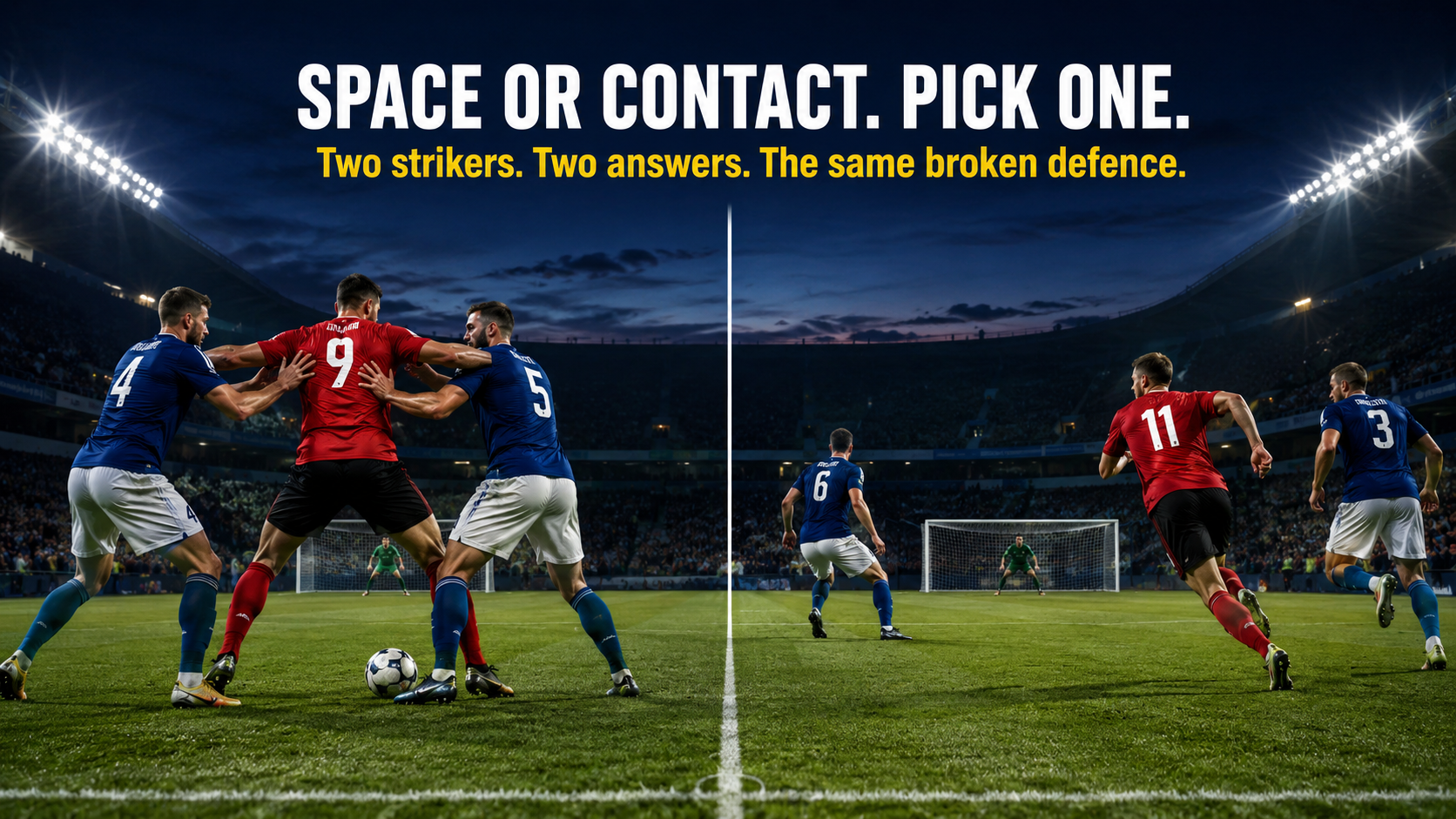
False 9 vs Target Man: How Two Strikers Break a Defence Differently
Why it connects: Whether a false nine or a target man receives the up pass changes how the set-back trap is sprung.

Zone 14 in Football: What It Is, Why It Matters, and How Teams Exploit It
Why it connects: The final ball usually targets Zone 14, the exact space this combination is designed to attack.
Speak the language of the game
Get the free 47-term tactical glossary. Gegenpress, half-space, xT, low block, each defined in plain language and linked to a full breakdown. It is yours for an email.
Frequently Asked Questions
What is the up-back-through combination in football?
The up-back-through is a three-pass combination that releases a runner behind the defence. A forward pass goes up to a striker, who sets it back to a supporting teammate, who then releases it in behind for the runner. It breaks the line vertically without needing to shift the defence sideways.
Why is the up-back-through so effective on the counter-attack?
The up-back-through is effective on the counter-attack because the defence is unset and cannot screen the passing lanes. Fast-break shots averaged 0.17 xG in the 2024-25 Premier League, per The Analyst, against 0.12 in open play. A recovering defender chasing his own goal cannot track the third man arriving from deep.
How do defenders stop an up-back-through combination?
Defenders stop the up-back-through by refusing to jump at the first pass and holding their line. Rest defence keeps two or three players screening the space behind, so the final ball finds no lane. Jockeying instead of lunging lets the last defender see the set-back and track the runner.
Is the up-back-through the same as a third man run?
The up-back-through is the passing combination, while a third man run is the off-ball movement it creates. The combination describes the three passes, up, back, and through. The third man run describes the runner who arrives unseen to receive the final ball, so the two work together rather than being identical.