
March 25, 2014. Bayern Munich seal the Bundesliga with seven games to spare, the earliest title in the league’s history, and the captain lifting the trophy is not a striker or a playmaker but a right-back who spent the season living in central midfield. Philipp Lahm’s conversion under Pep Guardiola was the moment the false fullback stopped being an experiment and became a blueprint. Twelve years on, the false fullback sits at the heart of how elite teams build attacks, from Riccardo Calafiori at Arsenal to Trent Alexander-Arnold at Real Madrid, and it remains one of the most misread ideas in modern football tactics. In simple terms: a false fullback is a defender who leaves his flank in possession and plays as a genuine central midfielder. This breakdown covers where the role came from, what it actually asks of the player, and exactly where it breaks.
Key Takeaways
- Born at Bayern: Pep Guardiola moved Philipp Lahm into midfield in 2013-14 and, per Wikipedia’s match record, won the Bundesliga with seven games to spare, the earliest title in league history.
- A conversion, not a tuck: The false fullback joins the midfield line as a genuine pivot player, a full step beyond the shallow central drift of standard fullback inversion.
- Structure follows the swap: The move turns a back four into a 3-2 base, adding a spare passer against the first line of pressure and a ready-made counter-press screen.
- The modern test case: Trent Alexander-Arnold, now at Real Madrid under José Mourinho, is the player most often cast in the role.
- Punishable at the flank: Every false fullback leaves grass behind him, and elite counter-attacking teams aim their first pass straight at that vacated channel.
Table of Contents
What Is a False Fullback?
A false fullback is a nominal fullback who steps into central midfield when his team has the ball, playing the possession phase as a genuine midfielder rather than as a wide defender. The team sheet says defender. The game says pivot.
Arsenal’s 2025-26 title season is the cleanest current example of the role in practice. Riccardo Calafiori and Myles Lewis-Skelly started at left-back on paper, then spent the build-up phase as the left half of a double pivot, turning Mikel Arteta’s back four into a three-man line behind a 3-2 base.
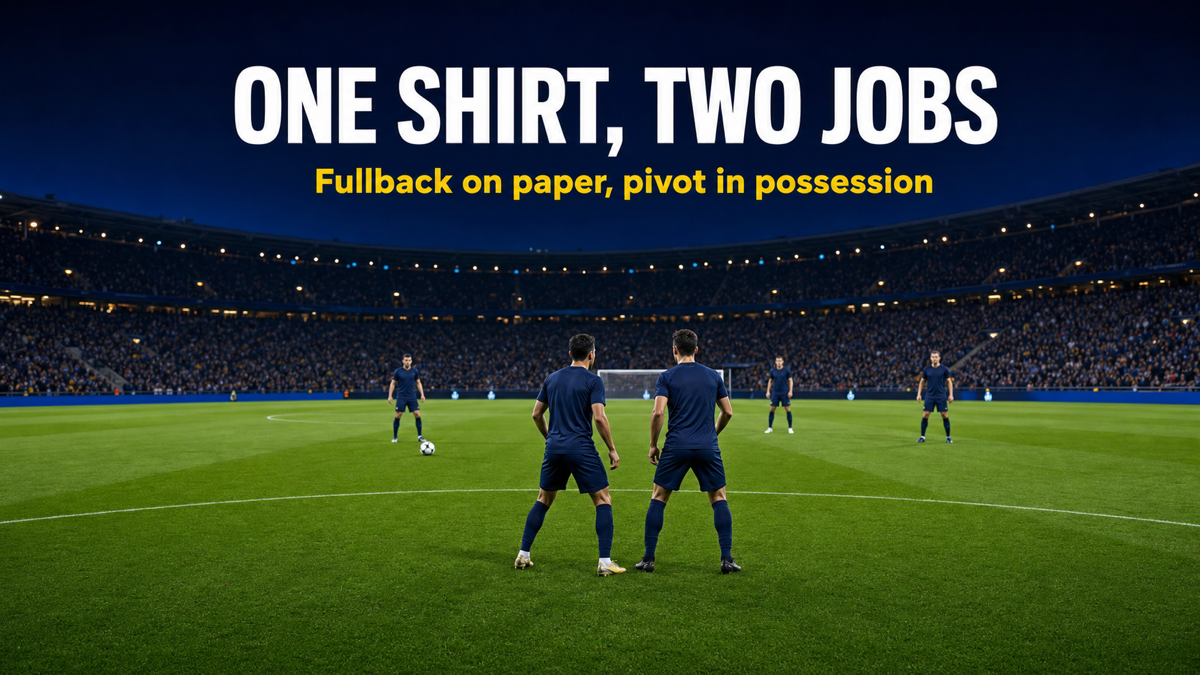
The “false” prefix works exactly as it does for the false nine. The position printed on the team sheet is a decoy, and the player’s real address in possession is a line higher and thirty metres more central. A false nine is a striker who lives in midfield; a false fullback is a defender who does the same thing from the opposite direction.
What separates the false fullback from a simple positional tweak is the job description. He does not drift infield to offer a safe sideways pass. He inherits a midfielder’s full decision load: receiving on the half-turn, breaking the first line, and organising the counter-press when the ball is lost.
From Lahm to Cancelo: How Guardiola Manufactured a Midfielder
Pep Guardiola built the modern false fullback at Bayern Munich in 2013-14, and he built it around Philipp Lahm. From the start of that season Lahm was used as a defensive midfielder, and Guardiola called him “perhaps the most intelligent player I have ever trained”. Bayern retained the title with a record seven games to spare.
The idea travelled with Guardiola to Manchester City and evolved on the way. Fabian Delph played the role in the 2017-18 centurion season, and Joao Cancelo later became its definitive reference, a fullback so comfortable in midfield that City’s build-up shape bent around him.
The lineage is now a coaching orthodoxy rather than a curiosity. The family tree runs from Lahm through Cancelo to Trent Alexander-Arnold, with Oleksandr Zinchenko’s Arsenal years as the bridge into the Premier League mainstream.
Guardiola’s insight was never about the fullback position itself. He needed more passers in central midfield than opponents could mark, and the fullback was simply the player whose defensive-phase job left him closest to the spare space.
False Fullback vs Inverted Fullback: Where the Line Actually Sits
The difference between a false fullback and an inverted fullback is the depth of the conversion: inversion is a positional drift into central areas, while the false fullback undergoes a full role change into the midfield line. One adjusts where the player stands. The other changes what the player is.
Not every fullback moving into midfield qualifies as a false fullback. Plenty of teams ask their wide defenders to tuck into the half-space and recycle possession, and our full breakdown of inverted fullbacks and the structures they create covers that broader family, including the 3-2 and 2-3 build-up shapes and the rest-defense logic behind them.
The false fullback passes a harder test. He takes up the pivot’s station beside or ahead of the number six, receives between opposition lines rather than behind them, and carries playmaking responsibility, not just circulation duty.
Fullback inversion, in other words, is a spectrum. The false version is its extreme end, the point at which the defender’s in-possession game becomes indistinguishable from a career midfielder’s.
The Three Jobs a False Fullback Does in Possession
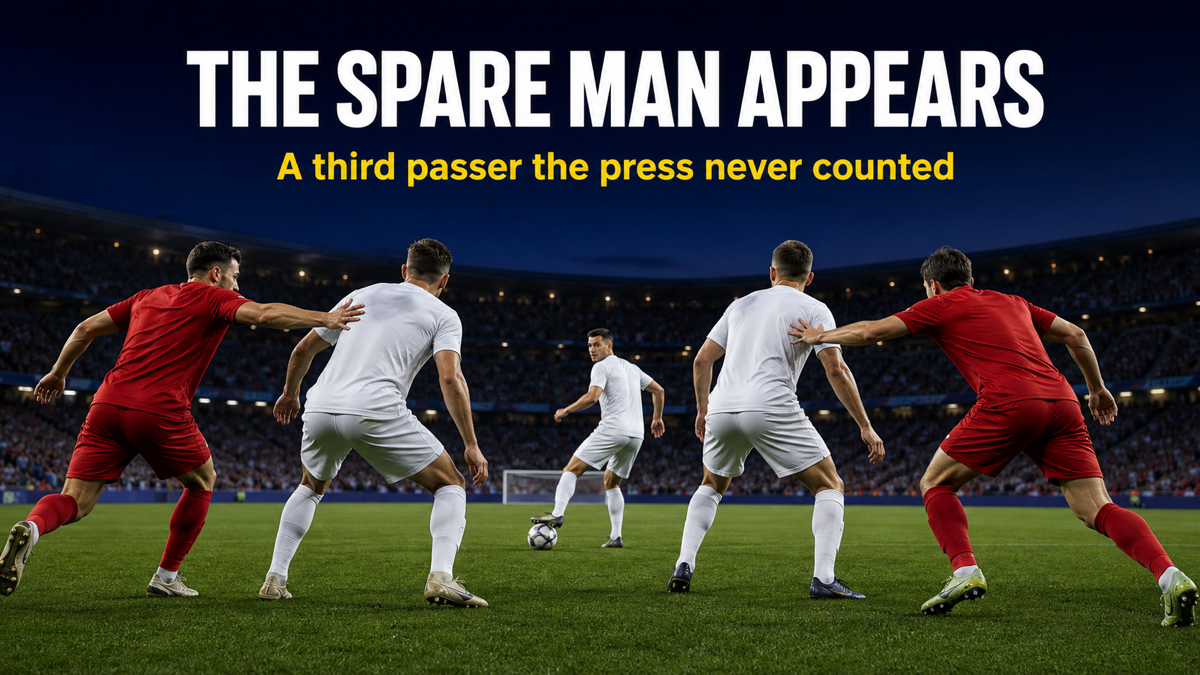
In possession the false fullback does three jobs: he adds a spare passer beside the pivot, he screens the transition at the point of loss, and he releases the eights to live between the lines. Each job attacks a different weakness in a modern press.
The spare passer matters first. A pressing structure that assigns markers to two central midfielders collapses when a third arrives from fullback, because the press must either leave him free or pull a winger inside and surrender the flank.
The screening job is quieter but just as valuable. Standing in the 3-2 base when the ball is lost, the converted defender becomes the first line of the counter-press, the same structural insurance we broke down in the box midfield’s 3-2-2-3 possession shape.
The comparison below shows how the role rewrites a traditional fullback’s job in the build-up phase.
| Build-up job | Overlapping fullback | False fullback | Tactical implication |
|---|---|---|---|
| First-phase position | Wide, on the touchline | Second line, beside the pivot | Extra central passer against the first line of pressure |
| Rest-defense shape | Back four stretched wide | Compact 3-2 base | Counter-attacks meet a set screen, not a scramble |
| Primary pass | Vertical to the winger, then cross | Line-breaking pass through midfield | Progression through the centre rather than around it |
| Space vacated | Inside half-space | The entire wide channel | The winger holds width alone |
A qualitative comparison of the two roles, not measured data.
The third job, releasing the eights, is the one supporters see. With the false fullback holding the pivot line, both central midfielders push into the pockets, which is why Arsenal’s and City’s attacking midfielders so often receive within shooting range instead of in front of the opposition block.
Trent Alexander-Arnold: The Role’s Sternest Test
Real Madrid are where the false fullback faces its highest stakes. Trent Alexander-Arnold, signed from Liverpool in 2025, arrived with a midfielder’s range at right-back; Xabi Alonso’s spell in charge ended in January 2026, and José Mourinho now decides how far to push the swap.
Alexander-Arnold arrived pre-trained for the conversion. Jurgen Klopp inverted him at Liverpool from 2022-23, and England experimented with him as a starting midfielder, so any Madrid brief only formalises what his passing range always suggested.
The tactical logic is simple: the swap floods central midfield with passers without sacrificing a forward, keeping Madrid’s front line intact while the build-up gains a body.
The risk is equally clear. Madrid’s league rivals press the vacated right channel on every turnover, betting that a defender playing midfield by instruction recovers ground more slowly than one who never left home.
The Weakness: Where the False Fullback Gets Punished
The false fullback’s weakness is the space he leaves behind: a full wide channel defended by nobody, reachable with one diagonal ball the moment possession turns over. No amount of structure erases that trade. The role bets that control of the ball outweighs the exposure, and elite counter-attacking teams exist to win that bet in the other direction.
Mikel Arteta’s answer to the exposure behind Oleksandr Zinchenko was to move towards more defensively complete profiles like Calafiori, signed in 2024. The lesson was not that the false fullback fails. It was that the player profile, not the shape, decides whether it survives contact.

The counter-plan is standard among transition-first coaches: pin the winger high against the inverting side, win the ball in midfield, and play the first pass into the empty channel before the 3-2 base can slide across. A sound rest-defense structure narrows the window, but it never closes it.
Managers also punish the role with the press itself. If the marking scheme tracks the false fullback all the way into midfield, the spare man disappears and the team is left building with a back three and no width on one side.
Final Thoughts
The false fullback is elite football’s most honest admission that positions are costumes. Guardiola did not discover a new spot on the pitch in 2013-14; he discovered that a great midfielder had been hiding at right-back, and every serious coaching staff has been auditing its defenders for hidden midfielders since.
That is also the verdict on the role’s limits. The conversion works when the player is genuinely a midfielder, as Lahm was, as Alexander-Arnold is, and it collapses when a team copies the shape without the profile, inheriting the vacated flank with none of the control that justifies it.
The next frontier is already visible: if the fullback can be false, so can anyone. Watch how quickly the same conversion spreads through the back line.
What Do You Think?
Trent Alexander-Arnold is the obvious false fullback for Real Madrid, but knockout football pays counter-attacks in full. Would you keep the midfield swap in a Champions League semi-final, or park him at orthodox right-back and protect the channel? Drop your take below.
Related Tactical Breakdowns

Hybrid Centre-Back Explained: How the John Stones Role Redefined Modern Defense
Why it connects: John Stones ran the same defender-to-midfielder conversion from centre-back, one position further inside than the false fullback.
The Regista: Football’s Most Misunderstood – and Most Essential – Midfielder
Why it connects: The regista’s job description, deep playmaking and tempo control, is exactly what the false fullback borrows for the possession phase.
Underlap vs Overlap: How Elite Teams Break Low Blocks
Why it connects: Underlaps and overlaps are what the same fullback offers when his team wants width and penetration instead of a midfield swap.
Learn to read a match like an analyst
Get the free 33-page Starter Pack, How to Read a Football Match (the Four Phases, a 15-minute match read, a printable worksheet), plus the 70+ term tactical glossary. Both are yours for an email.
Frequently Asked Questions
What is a false fullback in football?
A false fullback is a defender who moves into central midfield when his team has possession, playing as a genuine midfielder rather than holding a wide position. The role was popularised by Pep Guardiola with Philipp Lahm at Bayern Munich in 2013-14. Out of possession the player returns to a conventional back-four station.
Why do fullbacks move into midfield?
Fullbacks move into midfield to add a spare passer in build-up, screen against counter-attacks, and free the central midfielders to push higher. The extra body creates a numerical advantage against the opposition’s first line of pressure. It also forms a compact 3-2 rest-defense base behind the ball.
Is a false fullback the same as an inverted fullback?
No, the false fullback is the extreme end of fullback inversion, not a synonym for it. An inverted fullback drifts into central areas to support circulation, while a false fullback fully joins the midfield line and takes on a midfielder’s playmaking duties. Every false fullback inverts, but most inverting fullbacks stop well short of the full conversion.
Which teams use a false fullback in 2026?
Real Madrid, Arsenal and Manchester City all use versions of the false fullback in 2026. At Madrid, Trent Alexander-Arnold is the obvious candidate under José Mourinho, while Arsenal’s title defence continues to run through Riccardo Calafiori’s moves into midfield. Joshua Kimmich, once Bayern’s right-back, now anchors their midfield, though Germany still used him at right-back at the 2026 World Cup.