
Between Rodri’s debut in 2019 and his injury in September 2024, Manchester City won 74% of their Premier League games with him on the pitch and only 61.9% without him, a swing that turned the most dominant team of the era into a side that lost a third of the matches he missed. That gap had almost nothing to do with goals or assists. It was about the quiet work a defensive midfielder does in front of the back four, the work nobody chants about.
Screening the defense is the oldest job in the book, and it sits at the centre of the most important of the modern midfield roles. A team can survive a misfiring striker. It rarely survives an unprotected back line, which is why every elite manager treats the defensive midfielder as non-negotiable.
In simple terms: a defensive midfielder screens the defense by occupying the space in front of the centre-backs and cutting off central passes.
This breakdown explains what screening is, how the best players execute it, and why the number 6 in football decides matches without ever touching the highlight reel.
Key Takeaways
- The screen is a results multiplier: Up to his September 2024 injury, Manchester City averaged 2.37 points per game with Rodri and 1.90 without him, a defensive midfielder’s value that never shows in a box score.
- Screening beats tackling: The best defensive midfielders win the ball by standing in the right place, cutting the central pass before it is played rather than lunging after it.
- Zone 14 is the prize: A defensive midfielder’s first task is blocking access to Zone 14, the central pocket just outside the box where chances are manufactured.
- The destroyer is not the regista: Screening the defense and building play from deep are different jobs, and elite teams rarely ask one holding midfielder to master both at once.
- Cover shadow is the weapon: By angling his body, an anchor midfielder uses his cover shadow to take a passing lane out of the game without making a single tackle.
Table of Contents
What Is a Defensive Midfielder in Football?
A defensive midfielder is the player who sits at the base of midfield, in front of the centre-backs, to protect the defense and break up attacks before they arrive. Think of Sergio Busquets in Pep Guardiola’s Barcelona: rarely sprinting, rarely tackling, yet somehow standing exactly where the dangerous pass wanted to go. That is the role in one image.
The position is shorthanded by its traditional shirt number, which is why the number 6 in football and “defensive midfielder” mean the same thing. As Coaches’ Voice puts it, this player is the first line of defence on transition, tasked with stopping, slowing, or breaking up the counter before the back four is ever exposed.
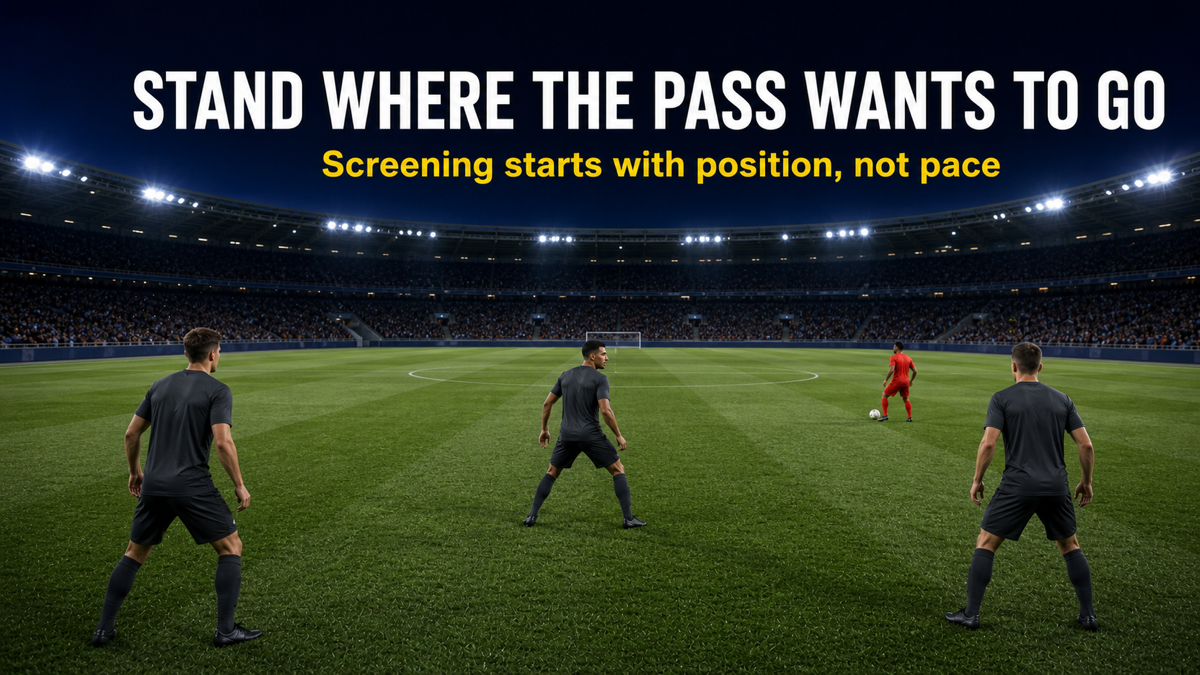
A defensive midfielder does this less through athleticism than through reading. The elite ones diagnose where the ball is going a beat early, step across the lane, and turn a promising attack into a recycled sideways pass. A good holding midfielder makes the game look boring, and that is the entire point.
Screening the Defense: The Number 6’s First Responsibility
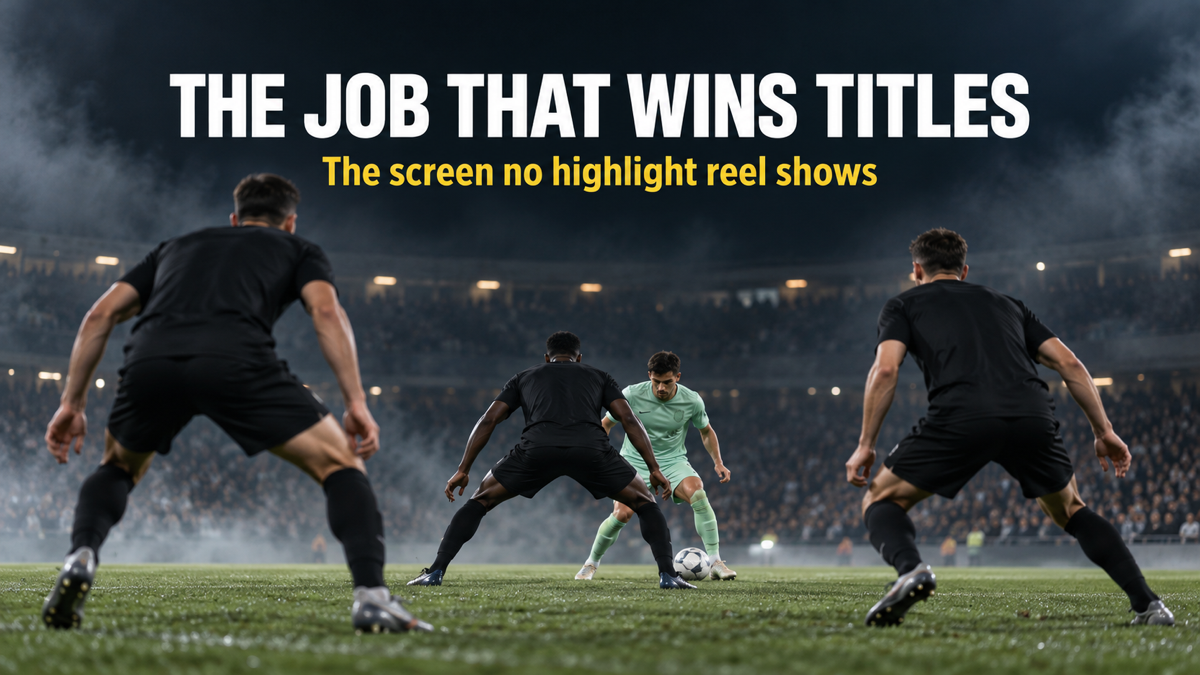
Screening the defense means positioning your body between the ball and your own goal so the most dangerous pass, the one into a forward’s feet in Zone 14, is never on. A defensive midfielder who screens well removes the opponent’s best option before anyone has to make a tackle. Managers obsess over the role precisely because it produces no obvious numbers.
The screen protects a specific area. Coaches’ Voice describes the number 6 blocking access to Zone 14, the central strip just outside the penalty box where most high-value chances are created. Force the play wide, away from that strip, and dangerous attacks become harmless crosses.
This is the same principle behind how elite teams defend without the ball as a unit. The defensive midfielder is the hinge: hold the centre and the centre-backs can stay home, lose it and everything behind collapses. A disciplined holding midfielder is worth more than a flashy one here.
A screen works through the cover shadow, the strip of pitch a defensive midfielder takes away simply by standing in the passing lane with the right body angle. If the defensive midfielder opens his stance toward the ball, he can track both the ball and the runner behind him and shuffle to keep the lane shut. Tackling is the last resort, not the plan.
Body shape decides the rest. An anchor midfielder who points his hips toward one touchline funnels the opponent that way, killing half the pitch as an option. The best practitioners barely move, because every step out of position opens a lane they were paid to close.
Timing turns a good screen into a great one. A defensive midfielder reads the passer’s eyes and shifts a fraction before the ball is struck, intercepting in the mind before intercepting with the foot. That is why elite screening looks like luck and is actually rehearsed reading.
The Rodri Effect: What Manchester City Lost Without a Screen
Manchester City stopped functioning as champions the moment Rodri’s screen disappeared, and the data is brutal. After Rodri suffered a season-ending knee injury in September 2024, City went seven straight games without a win, an unthinkable run for a side that had just won four titles in a row. The defensive midfielder they lost was not a goalscorer, he was the structure.
The numbers tell the story cleanly. From his 2019 debut to his September 2024 injury, City won 74.1% of Premier League games with Rodri and 61.9% without him, worth 2.37 points per game against 1.90, and The Analyst put the win-rate gap at more than 12 percentage points. In the 2023-24 Premier League he also averaged 103 successful passes per game and 126 touches per 90 minutes, more of the ball than any teammate, the metronome that let the screen reset after every attack.
The table below shows how a single defensive midfielder reshapes a champion’s output. It remains the clearest public case of one screening role swinging a title race.
| Manchester City metric | With Rodri | Without Rodri |
|---|---|---|
| Win rate (Premier League) | 74.1% | 61.9% |
| Points per game | 2.37 | 1.90 |
| Average goal difference | +1.70 | +1.29 |
Data covers Premier League matches from Rodri’s Manchester City debut in August 2019 to his injury in September 2024. Goal difference per The Analyst; win rate and points per game as reported by The Week for the same period.
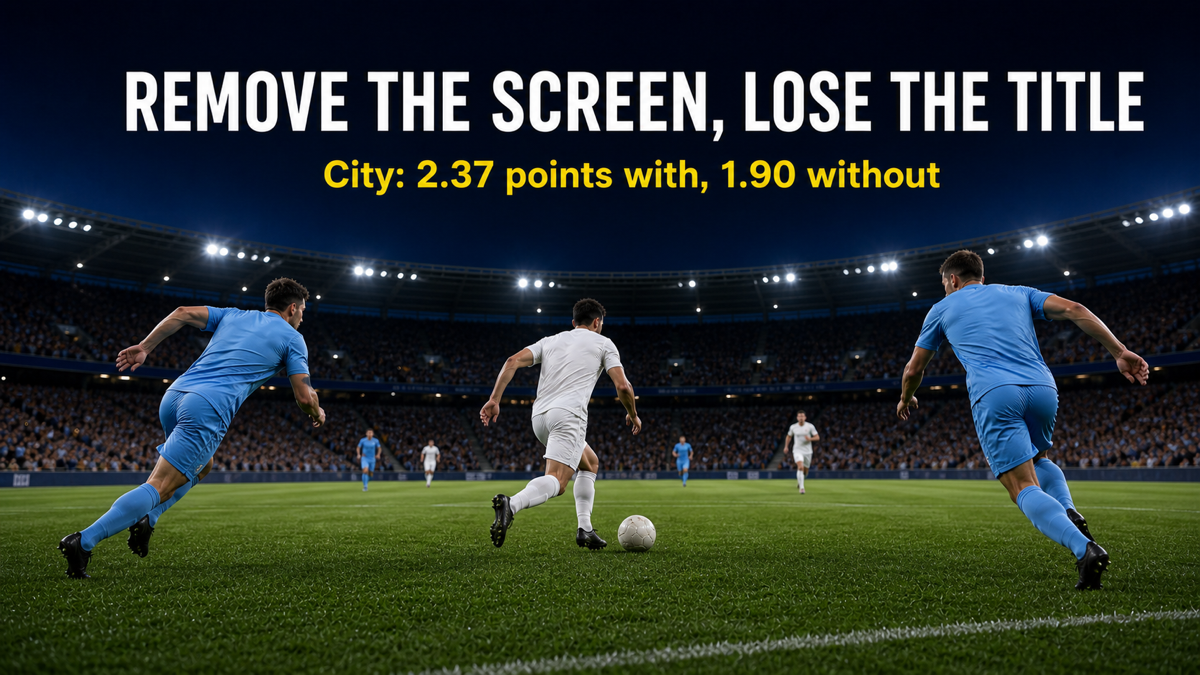
The lesson is not that Manchester City missed a star. They missed a screen, and no stand-in defensive midfielder could rebuild it overnight.
Screening Is Not Playmaking: The Destroyer vs the Regista
Screening the defense and dictating play from deep are two different jobs, and confusing them is how teams end up unprotected. The pure screener, the destroyer, exists to win the ball and give it simply. The deep playmaker exists to receive under pressure and unlock the press with a pass.
Claude Makélélé defined the first archetype so completely that the position is still called the Makélélé role. At Real Madrid and then Chelsea, Makélélé rarely crossed halfway, yet his screening let the talent ahead of him attack without fear. A defensive midfielder in that mould is judged on what does not happen behind him.
The deep playmaker is a different animal, closer to the regista. That role prizes passing range and tempo over pure protection, which is why few teams ask one holding midfielder to screen and create at the highest level at once. When they try, the screen usually suffers.
A defensive midfielder who chases the game upfield leaves the exact space he was built to guard. That is the risk every time a coach asks a single defensive midfielder to both protect and create.
The Modern Screen: Zubimendi, Jumping, and When to Step Up
The modern defensive midfielder does not just sit, he picks precise moments to jump out of the screen and kill an attack at its source. Martín Zubimendi is the current template. In 2025-26 he started almost every Premier League match as Arsenal won the title under Mikel Arteta, anchoring a side built on controlling the central lanes.
Jumping is the high-risk half of the job. When a teammate presses high, the defensive midfielder steps onto the opposing midfielder receiving the ball, snapping the line forward. Time it right and the press traps the opponent, time it wrong and the screen sits empty behind you.
Zubimendi reads that trade-off as well as anyone in Europe. He knows when to hold the screen and when to spring it, the judgement that separates a title-winning anchor midfielder from a merely tidy defensive midfielder.
A defensive midfielder who only sits is predictable, one who only jumps is reckless. Mastery is knowing which minute calls for which.
The Weakness: When the Screen Gets Pulled Apart
A single screen breaks when an opponent puts two players in the space one defensive midfielder is asked to guard. The simplest counter is an extra body in Zone 14, a second 10 or a striker dropping in, which forces the screener to pick one threat and abandon the other. The lane he closed reopens behind him.
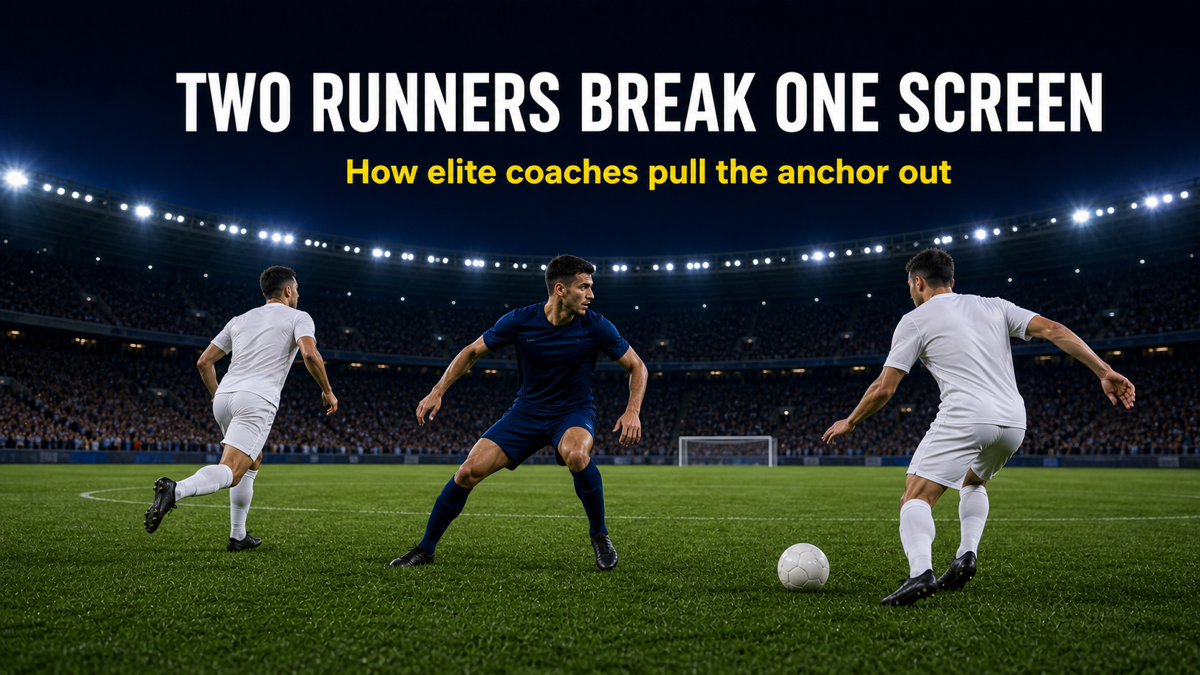
Dragging the screen sideways works just as well. Pep Guardiola’s teams routinely pull a defensive midfielder toward the touchline with a wide rotation, then attack the vacated centre with a late runner. Once the anchor is dragged five yards from his post, the protection is gone.
This is why elite sides rarely lean on one screen alone. Many pair the defensive midfielder with a disciplined partner or build a rest defense structure behind the ball, so one player being pulled out does not expose the whole back line. The lone screener is a single point of failure, and the best coaches hunt for it.
Pulling It All Together
The defensive midfielder is the most undervalued player on most team sheets, and the market is finally catching up. For a decade, screening was treated as a chore handed to whoever could not pass well enough to play higher. Rodri’s Ballon d’Or and Arsenal’s title built on Zubimendi’s screen have ended that argument.
Here is the verdict: a side can buy goals, but it cannot win anything lasting without someone to guard the space in front of the back four. The defensive midfielder does the work that lets everyone else take the credit, and ignoring it is the fastest way to look brilliant in October and broken by March. Stop judging the screen by the highlight reel, and start judging it by what never reaches your goal.
What Do You Think?
Manchester City fell from 2.37 to 1.90 points per game without Rodri between 2019 and 2024, yet Arsenal won a title built on Martín Zubimendi’s screen rather than a marquee scorer. So which is the smarter build: spend big on a destroyer who protects everything behind him, or trust a cheaper, disciplined screen and pour the money into the attack? Drop your take below.
Want to read any match like this?
The framework behind these breakdowns, in one place. The four phases, a 15-minute method for diagnosing both teams before the drinks break, a printable match-watching worksheet, and 51 terms defined. 33 pages, free.
Get it freeFree PDF, sent to your inboxRelated Tactical Breakdowns
The Modern Maestro: Mastering The “Free 8” Role
Why it connects: If the six screens, the eight roams, and the Free 8 is the attacking foil the anchor’s discipline exists to protect.
Defending the Half-Space: How Elite Teams Kill the Most Dangerous Zone on the Pitch
Why it connects: The central lanes a defensive midfielder screens feed straight into the half-spaces, the next zone elite teams have to lock down.
Hybrid Centre-Back Explained: How the John Stones Role Redefined Modern Defense
Why it connects: When the screen steps up, a centre-back often inverts into the John Stones role to fill the space the holding midfielder vacates.
Learn to read a match like an analyst
Get the free 33-page Starter Pack, How to Read a Football Match (the Four Phases, a 15-minute match read, a printable worksheet), plus the 70+ term tactical glossary. Both are yours for an email.
Frequently Asked Questions
What is a defensive midfielder’s main job?
A defensive midfielder’s main job is screening the defense, sitting in front of the centre-backs to block central passes and break up attacks early. They protect the space ahead of the back four, force play wide, and recover the ball before it reaches a dangerous zone. Goals and assists are a bonus for a defensive midfielder, never the purpose.
Why is the number 6 so important in football?
The number 6 is important because it protects the most dangerous space on the pitch, the central area in front of the defense. Manchester City won 12 percentage points more of their league games with Rodri screening that zone, per The Analyst. A weak number 6 leaves the entire back line exposed.
How does a defensive midfielder screen the defense?
A defensive midfielder screens the defense by standing in the passing lane and using his cover shadow, the strip of pitch he blocks just through body position. He angles his hips to force play wide, reads the passer early, and intercepts before a tackle is ever needed. Position beats athleticism for the defensive midfielder in this role.
Is a defensive midfielder the same as a deep-lying playmaker?
No, a defensive midfielder and a deep-lying playmaker are different roles, even though both start from deep. The screener, or destroyer, prioritises winning the ball and protecting the defense. The playmaker, closer to a regista, prioritises passing range and dictating tempo. Very few players truly master both at once.
Which players are the best modern examples of a screening number 6?
Rodri and Martín Zubimendi are the best modern examples of a screening number 6. Manchester City lost a third of the Premier League games Rodri missed between 2019 and 2024, per The Analyst, while Zubimendi anchored Arsenal’s 2025-26 title win. Both prove a defensive midfielder can decide trophies.