

Last updated: October 9, 2026
On any matchday at the Metropolitano, you can watch Atlético Madrid’s block compress between phases. The forward line drops a step, the midfield bank tucks in, and the back four glues itself to within twenty-five metres of the front. The ball still moves. The pitch does not. That is compactness in football working at its most engineered.
Most defensive shapes ignore the geometry that produces them. This property is not one variable; it is two. The vertical squeeze measures the distance between the deepest defender and the highest presser, while the horizontal squeeze measures the width between the widest defenders when the ball sits on a flank.
In simple terms: Compactness in football denies space along two independent axes: vertically between the lines and horizontally across the pitch.
This breakdown decodes how the two axes operate, which managers prioritise which squeeze, and where every compact defensive block breaks. It sits inside our broader football tactics archive, which threads every principle this concept touches.
Key Takeaways
- Two Independent Axes: The discipline operates on two planes: vertical, between the deepest defender and the highest presser, and horizontal, between the widest defenders when the ball is on a flank.
- The Vertical Range: Elite defensive blocks compress to roughly 25 to 35 metres between back line and front line. Atlético Madrid sit at the floor of that range, per Opta tracking.
- The Horizontal Range: Ball-side compact teams narrow horizontal width to around 30 to 35 metres on the strong side, ceding the far flank to the switch.
- The Trade-off: The vertical squeeze usually requires sitting deeper. The horizontal squeeze requires elite midfield mobility. No defensive shape buys either for free.
- Where Blocks Die: Every compact defensive block fails on the axis it refuses to defend, and the half-space is where most of them break.
Table of Contents
What Is Compactness in Football?
Compactness in football is the deliberate compression of defensive space along two independent axes, vertical and horizontal, to deny attackers room to receive, turn, or progress. The vertical axis runs from the deepest defender to the highest presser. The horizontal axis runs from the widest defender on the strong side to the widest defender on the weak side.
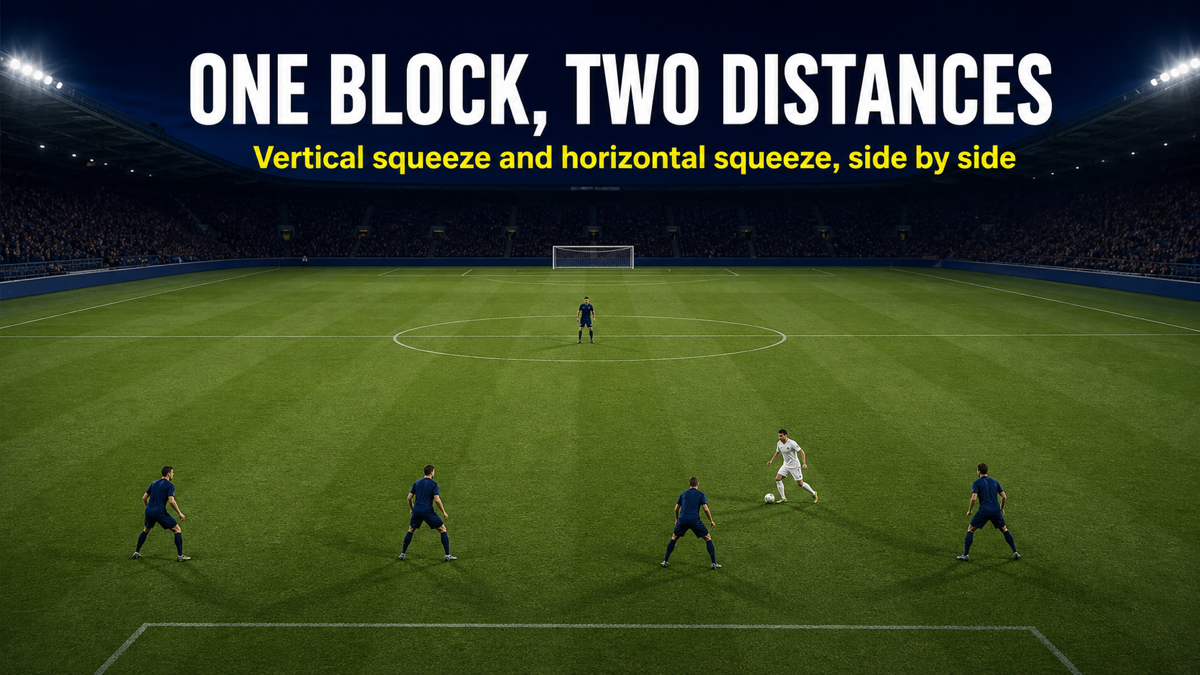
Both squeezes shrink the canvas, both punish attackers with smaller passing windows, and both demand a different kind of discipline to maintain. Diego Simeone built an entire managerial career on the vertical axis of this concept. His 4-4-2 at Atlético Madrid sits between 25 and 28 metres top-to-bottom for long stretches of every match, per Opta tracking data.
Antonio Conte pulled the other lever. His 3-5-2 at Inter Milan in 2020-21 slid the ball-side wing-back nearly to the box on every defensive transition, narrowing horizontal width to under 30 metres while the opposite wing-back tucked into the back three. The Italian league recorded Inter’s npxG conceded that season among the lowest figures in Europe, per FBref’s Serie A tracking.
Both managers built a compact defensive block, but neither chose both axes equally, and that distinction is the heart of this article’s argument.
The Vertical Squeeze: Compressing Between the Lines
The vertical squeeze is the act of holding the back line and the front line within a narrow vertical range of roughly 25 to 35 metres to suffocate the space attackers most want to receive in. The space between the lines, between full-backs and centre-halves, is where every modern attacking system tries to find its number eight or its false nine. When a defensive shape compresses vertically, that space disappears.
Receivers in midfield arrive on the ball already pressed. Half-turns that work against a stretched block get cut off before the ball arrives. The vertical squeeze also kills the third-man combination, the pattern Pep Guardiola built at Manchester City; we covered the mechanics in our third man run breakdown.
Diego Simeone’s Atlético Madrid is the cleanest example of a vertical-first system. The 4-4-2 deliberately sits deeper than most La Liga rivals, accepting territorial loss in exchange for two banks of four that stay locked vertically. Their defensive line height has consistently registered below the league average across the last five seasons, per FBref.
The cost is territory. A team sitting at a 25-metre vertical block usually does so because it has accepted a deeper defensive line and a lower forward line. That is why a pure vertical version lives most often inside the low and mid blocks, the territory we mapped in our low block defence breakdown.
The Horizontal Squeeze: Sliding to the Strong Side
The horizontal squeeze slides the block toward the ball-side of the pitch and narrows the distance between the widest defenders to around 30 to 35 metres while ceding the far flank. Ball-side compactness lets a four-man midfield behave like a five-man one on the strong side. The far winger tucks in, the far full-back narrows, and the two centre-halves shift across by five to seven metres each.
The result is a numerical overload on the side of the pitch where the ball actually is. Two recent sides built league seasons on this horizontal version. Antonio Conte’s Inter in 2020-21 ran a 3-5-2 with ball-side wing-back compression as the entire defensive premise.
Xabi Alonso’s Bayer Leverkusen in 2023-24 ran an unbeaten Bundesliga campaign with a 3-4-2-1 that slid the same way, narrowing into a sustained ball-side overload. The compact defensive block forced opponents into one of two losing patterns. They either played through the overload, losing the ball into a counter, or they switched the play across the pitch and arrived on the weak side just as the block had finished re-sliding.
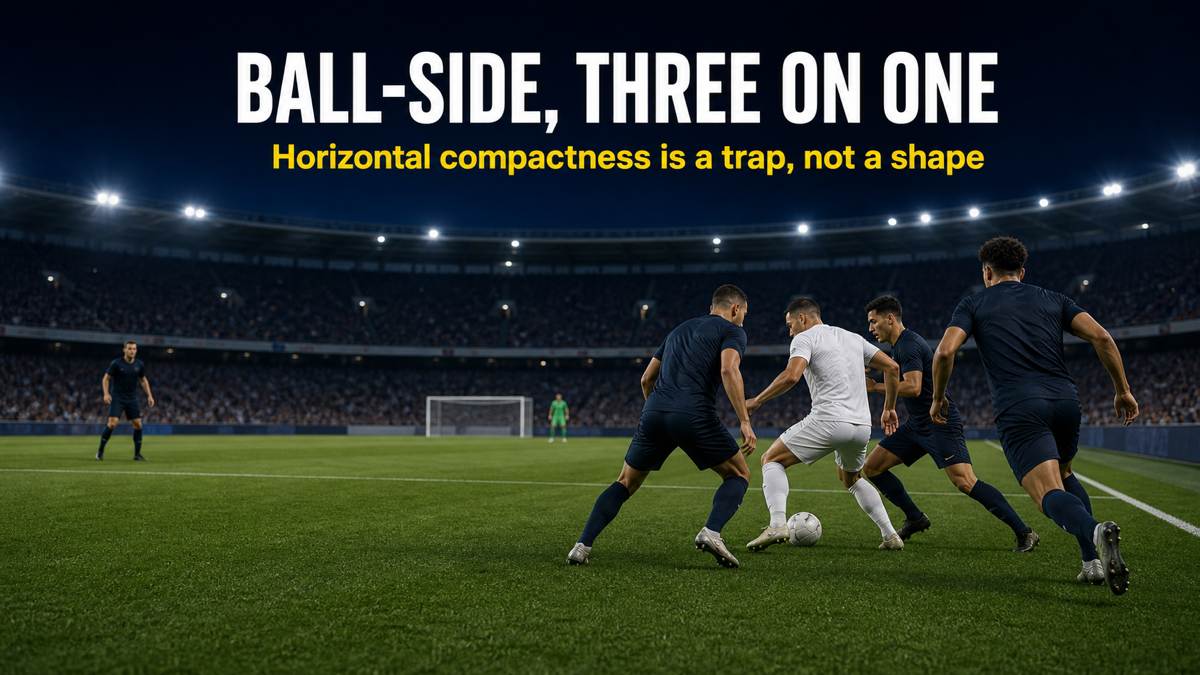
By the time the ball lands on the far winger, the block has reformed around it. The horizontal squeeze sits naturally inside mid-block systems where the line is high enough that the back four can rotate without being pinned to its own area. That is the territory of mid-block pressing, where ball-side compression is the most reliable tool a coach has for forcing the opposition to play backwards.
Why Most Teams Sacrifice One Axis
Most teams sacrifice one defensive axis because the physical demands of maintaining both at full intensity for ninety minutes exceed what most squads can deliver. A vertical squeeze without a horizontal one produces a deep, narrow block. Atlético Madrid under Diego Simeone is the archetype: the far flank is left fully open, but the block stays so tight vertically that the opposition cannot find a receiver between the lines to switch the play through.
A horizontal squeeze without a vertical one produces a high, sliding block. Brighton under Roberto De Zerbi during 2022-23 ran one. The horizontal slide locked down ball-side options, but the vertical gap between the press and the high last line stayed open, which is why their FBref-recorded npxG conceded ran higher than the table position suggested.
Carrying both axes at full intensity requires the squad to recover ground at sprint pace every defensive transition, every set-piece reset, every counter-press. Most teams cannot do it. Manchester City under Pep Guardiola try, and even they trade vertical compression on possession loss for a rest-defence structure rather than holding the full block.
The half-space is the seam where the two axes meet. When one axis loosens, the half-space opens, which is why we made it the subject of our half-space defending breakdown.
How Elite Coaches Engineer Both Squeezes Simultaneously
Elite coaches engineer the dual squeeze dynamically, using ball-position triggers to re-shape the defensive block instead of holding one geometric shape for the full match. When the ball sits centrally, the block stays vertically compact, with the back line stepping up to twelve or fifteen metres beyond the box. When the ball moves to a flank, the block stretches vertically to maintain horizontal slide, with the back line dropping while the ball-side full-back jumps.
Pep Guardiola’s Manchester City built this dynamic version around positional triggers. The cue is not “where is my opponent” but “where is the ball, and which axis matters right now.” A vertical squeeze when the opposition has the ball centrally, a horizontal squeeze when the ball is wide, and a rest-defence rotation when City have the ball themselves.
Mikel Arteta’s Arsenal have adopted a similar logic but in a higher block. The press steps up vertically against goal-kicks and central build-up phases, then drops into a horizontal slide as soon as the opposition completes its third progression pass. The team practises the switch between the two squeeze modes more than it practises any individual press trigger, per tactical reporting from The Athletic’s football section.
The principle is not published in standard match reports, but optical tracking from Opta, StatsBomb, and Second Spectrum exposes the ranges elite blocks live in. The table below summarises typical defensive-block profiles across four identities. The figures are season averages drawn from public-facing tracking reports and tactical analysis, not single-match snapshots.
| Block Type | Vertical Squeeze (avg m) | Horizontal Squeeze (avg m) | Representative Side |
|---|---|---|---|
| Deep low block, 4-4-2 | 24 to 28 | 38 to 44 | Atlético Madrid under Diego Simeone |
| Ball-side sliding mid-block, 3-4-2-1 | 30 to 34 | 28 to 32 | Bayer Leverkusen 2023-24 under Xabi Alonso |
| High dynamic press, 4-3-3 | 28 to 32 centred | 34 to 38 ball-side | Manchester City under Pep Guardiola |
| Reactive deep block, 5-3-2 | 22 to 26 | 32 to 36 | Inter Milan 2020-21 under Antonio Conte |
Data reflects average metrics across each side’s representative season. Individual team and season variance applies.
The pattern in the numbers tracks the article’s argument. Low blocks live at the floor of the vertical squeeze and the ceiling of the horizontal one, because they cannot slide and stay deep at once. High dynamic blocks stay near the middle of both, because they switch modes rather than holding one shape.
The Weakness: Where Every Compact Block Eventually Breaks
Every compact block fails on the axis it refuses to defend, which is why the half-space is the most reliable solvent for any compact defensive block. A block that locks vertically but stretches horizontally fails to the switch. A block that slides horizontally but stretches vertically fails to the runner in behind.

A block that compresses both axes fails to a player who is fast enough to leave the compressed zone before the geometry catches up to him. The most consistent break is the half-space pocket, the space between centre-half and full-back fifteen to twenty metres inside the touchline. The half-space is where the horizontal squeeze and the vertical squeeze contradict each other directly.
Slide ball-side, and the far half-space opens; step up vertically, and the half-space behind the press opens. This is why Kevin De Bruyne built a generational career on receiving in the half-space pocket. The pocket is unmarkable by design.
A defender who closes it has either left a vertical seam open above or a horizontal seam open beside it. A passer who can find that receiver consistently breaks the geometry of any compact defensive block. The fix is not denial; it is hand-off, and elite blocks accept that one half-space is always open while managing which one is exposed by ball position.
Final Thoughts
Compactness in football is the single most under-appreciated tactical property in modern coverage, because it is not visible in highlight reels and not extracted by mainstream stat trackers. Every defensive identity, from Diego Simeone’s vertical obsession to Pep Guardiola’s dual-axis dynamic block, lives or dies on geometric discipline that does not photograph well. The next time a side looks “organised” on a Saturday afternoon, look at the distance from back line to forward line, then the distance from one full-back to the other.
The numbers will tell you which axis the manager has committed to and which he has ceded. The argument here is that the two-axis frame should become the default lens for defensive analysis. Single-axis vocabulary, like “low block” or “high press,” captures one dimension and ignores the other.
Football’s most interesting tactical innovations happen in the seam between the vertical squeeze and the horizontal one. If the next decade of tactical evolution is about anything, it is about coaches who learn to compress both axes for ninety minutes without dropping either.
What Do You Think?
Diego Simeone’s Atlético Madrid has built a decade of league-and-Champions-League results on a pure vertical squeeze while ceding horizontal width, but Xabi Alonso’s unbeaten Bayer Leverkusen flipped the formula entirely. Which axis would you actually want your team’s defensive identity built on, knowing the other will always be sacrificed?
Want to read any match like this?
The framework behind these breakdowns, in one place. The four phases, a 15-minute method for diagnosing both teams before the drinks break, a printable match-watching worksheet, and 51 terms defined. 40 pages.
Get the pack$9, instant downloadRelated Tactical Breakdowns

How Elite Teams Defend Without the Ball: A Complete Tactical Guide
Why it connects: This concept is the structural property that lets a team defend without the ball, and this companion piece maps the broader frame across the systems it enables.
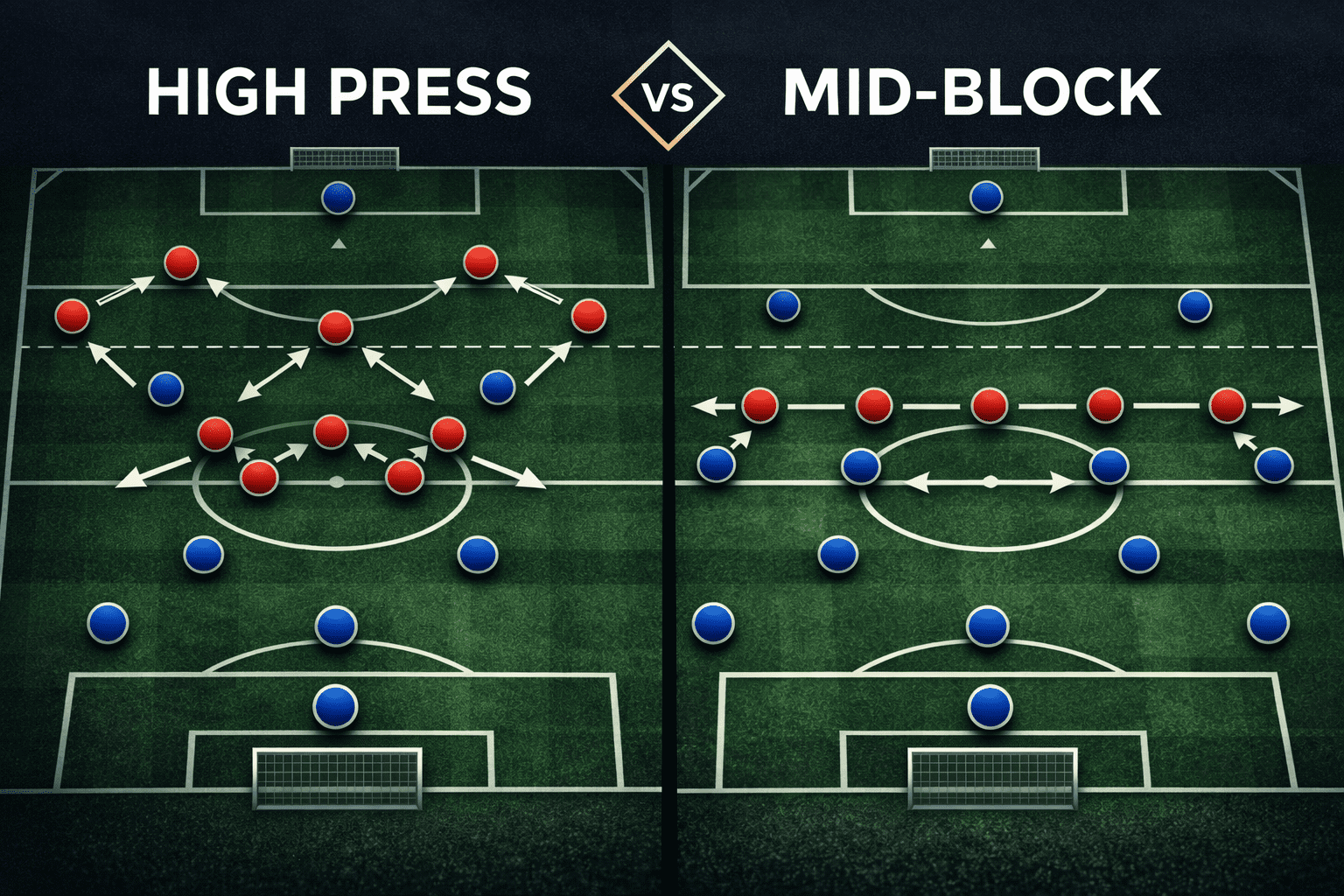
High Press vs Mid-Block: 7 Tactical Differences That Define Modern Football
Why it connects: The vertical squeeze and the horizontal squeeze sit at the heart of the choice between a high press and a mid-block, and that breakdown tracks the trade-off in formation terms.
Pressing Triggers: The Decision Behind Every Elite High Press
Why it connects: Dynamic dual-axis blocks rely on pressing triggers to switch between vertical compression and horizontal slide, and this companion piece breaks down the trigger logic.
Speak the language of the game
Get the free 47-term tactical glossary. Gegenpress, half-space, xT, low block, each defined in plain language and linked to a full breakdown. It is yours for an email.
Frequently Asked Questions
What is compactness in football?
Compactness in football is the deliberate compression of defensive space along two axes: vertical, between the deepest defender and highest presser, and horizontal, between the widest defenders. The vertical squeeze denies space between the lines. The horizontal squeeze overloads the ball-side. Elite compact defensive blocks engineer both axes dynamically based on ball position.
How is vertical compactness different from horizontal compactness?
Vertical compactness measures the distance from the deepest defender to the highest presser, usually 25 to 35 metres in elite blocks. Horizontal compactness measures the distance between the widest defenders when the ball is on a flank. Most coaches prioritise one because maintaining both for ninety minutes requires elite physical depth across the entire squad.
Which teams are the best examples of compactness in football?
Diego Simeone’s Atlético Madrid is the best example of the vertical squeeze, sitting between 25 and 28 metres top-to-bottom for long ninety-minute stretches. Antonio Conte’s Inter 2020-21 and Xabi Alonso’s Bayer Leverkusen 2023-24 are the best examples of the horizontal squeeze, sliding ball-side into sustained overloads. Manchester City under Pep Guardiola show the dynamic dual-axis version.
Why does the half-space break compact blocks?
The half-space breaks compact blocks because it sits at the intersection of the vertical squeeze and the horizontal squeeze, where the two axes contradict each other. A block that slides ball-side opens the far half-space. A block that steps up vertically opens the half-space behind the press. Defending the half-space requires the block to manage the seam, not eliminate it.