

Last updated: October 27, 2026
Chelsea were 2-0 up on Bournemouth before the third minute was out on 10 October. Cole Palmer cut the ball back for Jordan Henderson, and Morgan Rogers added a deflected second moments later, taking Chelsea to five goals inside the opening five minutes of league games this season, per The Analyst.
That fast start is the quickest way into Xabi Alonso’s Chelsea tactics: hit early, then let the other team have the ball. Seven league games into his first season, the coach whose Leverkusen side smothered opponents with possession has built one of the most direct teams in England, and one of the most open. It is a very different branch of football tactics from the one that made his name.
In simple terms: Alonso’s Chelsea tactics pair a 3-4-2-1 with low possession, fast breaks through a central front three and wing-backs supplying all the width.
Key Takeaways
- Possession is optional: Alonso’s Chelsea tactics accept less of the ball, averaging 47.1% possession over the first five matchdays, a club low on Opta’s Premier League record, per The Analyst.
- Fast breaks carry the attack: No side produced more fast breaks (14), fast-break shots (11) or fast-break goals (3) in that window, per the same Opta data.
- Width belongs to the wing-backs: Pedro Neto and Pep Chavarría hold the touchlines so Palmer, Rogers and João Pedro can attack centrally.
- Control is the missing piece: The same Chelsea tactics stall with the ball, drawing 2-2 with Hull City on 68.3% possession and losing 3-0 at Brentford on 59.8%, per Opta.
- The defence pays the bill: Chelsea conceded 13 goals in their first six league games, before a first clean sheet in 23 league matches at Everton.
Table of Contents
What Are Xabi Alonso’s Chelsea Tactics in 2026/27?
Alonso’s Chelsea tactics start from a 3-4-2-1 that defends deep and compact, then breaks quickly through three central attackers while two wing-backs stretch the pitch. The closest club reference is Antonio Conte’s 2016-17 title side, which also won with a back three and wing-backs.
Chelsea announced on 17 May 2026 that Alonso had agreed a four-year contract from 1 July, replacing Liam Rosenior, who was dismissed in April. He arrived after a short spell at Real Madrid that ended in January 2026.
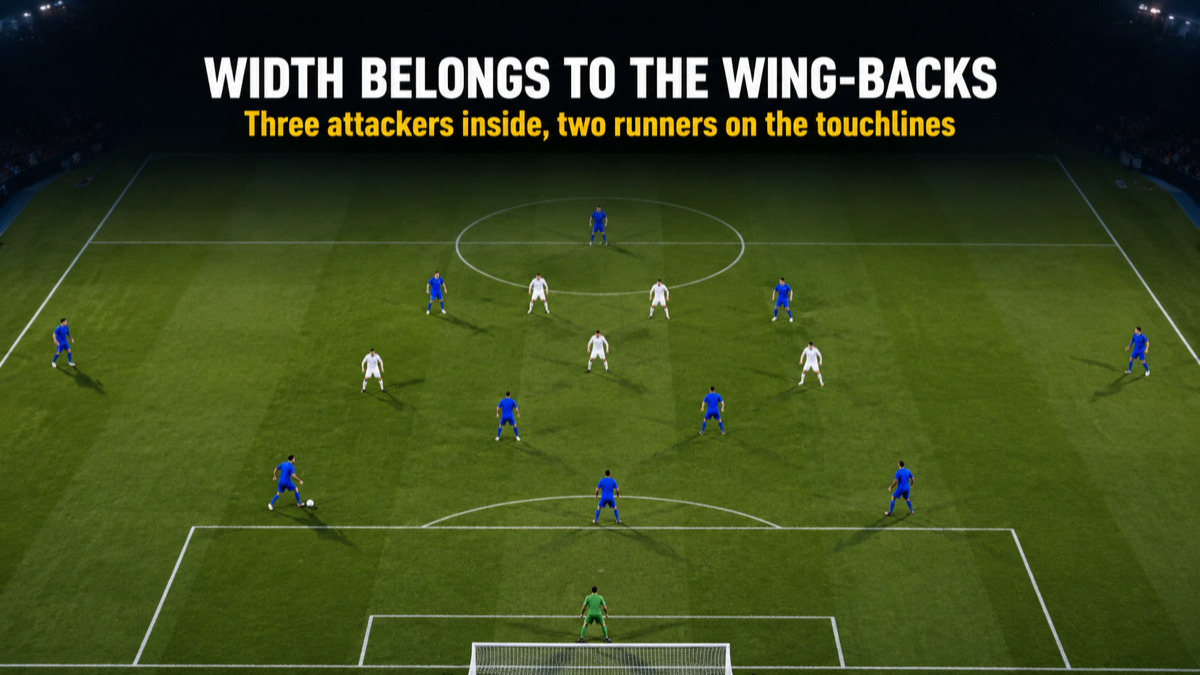
The Chelsea tactics he has installed rest on three ideas. Score early so the opponent has to open up, attack the space that opening creates, and let the wing-backs provide every yard of width. Through seven league games those Chelsea tactics have produced 17 goals scored, 13 conceded and a record of four wins, one draw and two defeats.
The Chelsea Formation: A 3-4-2-1 That Drops Into a Back Five
The Chelsea formation under Alonso is a 3-4-2-1 in possession and a back five without the ball. The Analyst confirmed the 3-4-2-1 in the opening game at Fulham, the same shape Alonso used to win the Bundesliga with Bayer Leverkusen.
The side expected for the trip to Everton on 17 October, which Chelsea won 2-0 through two Pedro Neto goals, shows the full-strength Chelsea tactics. Emiliano Martínez, signed from Aston Villa in August, sits behind Josh Acheampong, Maxence Lacroix and Levi Colwill. Neto and Chavarría are the wing-backs, Moisés Caicedo and Henderson the midfield pair, and Palmer and Rogers play as twin number 10s behind João Pedro.
Without the ball the wing-backs drop level with the centre-backs and the block sits deep and compact. The point of this 3-4-2-1 formation is a stable back line that releases three runners the moment possession turns over, which is the core of Chelsea tactics under Alonso so far.
Why Alonso’s Chelsea Tactics Look Best Without the Ball
Alonso’s Chelsea tactics have looked most dangerous when the opponent has the ball and least convincing when Chelsea have it. Over the first five matchdays they averaged 47.1% possession, which The Analyst lists as their lowest figure for a Premier League campaign on Opta’s record.
The split by result is stark. Chelsea beat Brighton & Hove Albion 4-3 with barely a quarter of the ball and won 3-2 at Fulham on 38.1%, yet drew 2-2 with Hull City on 68.3% and lost 3-0 at Brentford on 59.8%, per Opta figures. After three games, ESPN’s analysis ranked Chelsea 17th of 20 for field tilt, a sign of how rarely these Chelsea tactics camp in the final third.
Early goals explain part of it. A side that leads after five minutes invites the opponent forward, a textbook game state effect, and Chelsea led Brighton 3-0 inside 32 minutes before holding on. Alonso admitted afterwards that his team then played too much with the result, and he has refused to set any fixed possession target.
The Fast-Break Engine: Palmer, Rogers and João Pedro
Fast breaks are the main source of chances in Alonso’s Chelsea tactics. The Analyst defines a fast break as a quick counter that starts in a team’s own half against a defence that is at least partly unsorted, and no side recorded more of them than Chelsea in the first five matchdays.
The three attackers make these Chelsea tactics work because none of them has to stay wide. Palmer drops and roams to receive, Rogers carries and runs beyond, and João Pedro links play and finishes, with five league goals in the first six games. Rogers, a British-record £117m signing from Aston Villa in July, scored on his debut at Fulham.
This is the logic of attacking transitions turned into a full game plan. These Chelsea tactics depend on all three forwards being fit, and João Pedro missed the 3-0 loss at Brentford through injury.
Wing-Backs Who Own the Touchline
Neto and Chavarría provide almost all of the width in Alonso’s Chelsea tactics, because the three attackers ahead of them play inside. Neto is a winger first and foremost, but Alonso has asked him to defend the whole flank as well as attack it.
Chavarría arrived from Rayo Vallecano in August to replace Marc Cucurella, who joined Real Madrid. Both wing-backs were decisive against Bournemouth: Neto cut the ball back for João Pedro’s first goal, and Chavarría’s first-time cross from a Rogers pass set up the second, per Sky Sports’ match report.
The cost is that each wing-back owns a whole touchline. When both are high at once, the outside centre-backs cover the channels alone, and that is where the weakness in these Chelsea tactics begins.
The Midfield Pair and the Pressing Question
The midfield pair is the unfinished part of the Chelsea tactics, and it decides how much control the team can have. Enzo Fernández and Andrey Santos left in the summer and Caicedo missed most of the opening weeks injured, so Henderson, a free transfer from Brentford, has stepped in at 36.
Henderson scored twice against Bournemouth. Caicedo’s return beside him matters because the midfield has to cover the space the wing-backs leave behind.
Chelsea do not press high. Through three games ESPN measured them at 18.89 opposition passes per defensive action, the highest PPDA in the league against an average of 12.20, so these Chelsea tactics wait for the counter rather than hunt the ball.
What Changed From Alonso’s Leverkusen
The formation is the same as in Germany, but the game model has flipped from control to transition. Alonso’s Leverkusen system was built on long possession spells and a box midfield, and it produced the first unbeaten season in Bundesliga history in 2023-24, per Bundesliga.com.
A full season against six games is a lopsided comparison, so read the table’s gaps as direction rather than verdict on the new Chelsea tactics.
| Measure | Leverkusen 2023-24 (Bundesliga) | Chelsea 2026/27 (Premier League, early) | What it tells you |
|---|---|---|---|
| Base formation | 3-4-2-1 | 3-4-2-1 | Same shape, different job |
| Possession | 62.1% (Opta, via TNT Sports) | 47.1% (Opta, first five matchdays) | Control traded for transition |
| Goals conceded | 24 in 34 games | 13 in the first 6 games | A far higher defensive bill |
| Width | Wing-backs Jeremie Frimpong and Alejandro Grimaldo | Wing-backs Neto and Chavarría | Still the wing-backs’ job |
Leverkusen: the full 2023-24 Bundesliga season. Chelsea: the first five or six 2026/27 Premier League games, as labelled.

Leverkusen used the ball to rest and to suffocate opponents. Alonso’s Chelsea tactics use it sparingly and spend the team’s energy on the break, because Palmer, Rogers and João Pedro are at their best running into open space behind a defence.
The trade also fits the league this season. Teams with at least 60% possession won only 36.4% of their games in the opening weeks, the third-lowest rate on record, per The Analyst, so Chelsea tactics built on the counter are swimming with the current.
The other change is defensive. Leverkusen conceded 24 league goals in that whole season, a club record per Bundesliga.com, while Chelsea conceded 13 in their first six games, and that gap is the real measure of what Alonso still has to fix.
The Weakness in Alonso’s Chelsea Tactics: Empty Channels and Set Pieces
The weakness in Alonso’s Chelsea tactics is the space left behind when both wing-backs and a midfielder push on at once, and opponents have attacked it on the counter and from set pieces. Chelsea conceded 13 goals in their first six games and conceded in 22 league matches in a row, a run that stretched back into last season, before keeping a clean sheet at Everton on 17 October.

Brentford showed the full menu in their 3-0 win on 18 September. Their opener came from a corner, and Colwill said afterwards that Chelsea had at times been bullied at set pieces and had overexposed themselves chasing the game, inviting Brentford’s counters.
Hull City found another route, letting Chelsea have 68.3% of the ball and still scoring twice in a 2-2 draw, and Arsenal came from behind to win 2-1. Alonso said that, for now, his side were not ready to compete for a whole game.
The fix is structural rather than personal. A disciplined rest defence, with one wing-back holding while the other attacks and Caicedo screening the channel, would cost Chelsea a runner but buy the cover a back three needs.
Recreate Alonso’s Chelsea in EA FC 27
This section is for EA FC 27 players, separate from the match analysis above. The game launched worldwide on 25 September 2026, and its formation list includes a 3-4-2-1 with two wide midfield slots rather than wing-back positions.
- Back three: three centre-backs on the Defender role.
- Wide midfielders: players who hold the touchline and track back, the jobs Neto and Chavarría do.
- Central pair: a Holding midfielder for the Caicedo role and a Box-to-Box partner for Henderson.
- Number 10s: Playmaker for Palmer and Shadow Striker for Rogers.
- Striker: Advanced Forward, for João Pedro’s runs in behind.
Set up the defensive depth and build-up style in game for a deeper block and quick counters. These FC 27 tactics translate the real Chelsea tactics into roles, not sliders.
Final Thoughts
Alonso has not rebuilt Leverkusen in west London. He has built a counter-attacking team that shares its formation, and that is the right call for a front three worth more running at a retreating back line than passing around a settled one. Six games are too few to say whether Caicedo’s return and a calmer rest defence can cut the bill at the other end.
History is the real challenge for Chelsea tactics built this way. Per Opta data cited by TNT Sports, only two Premier League sides with under 50% average possession have finished in the top four since 2003-04: Everton in 2004-05 and Leicester City in 2015-16. Can Alonso’s side make it three, or will he have to take the ball back to stop conceding?
What Do You Think?
Chelsea under Alonso have won with barely a quarter of the ball and dropped points with almost 70% of it. Should these Chelsea tactics commit fully to the counter, or is Leverkusen-style control the only way to fix a defence that conceded 13 in the first six games? Drop your take below.
Related Tactical Breakdowns
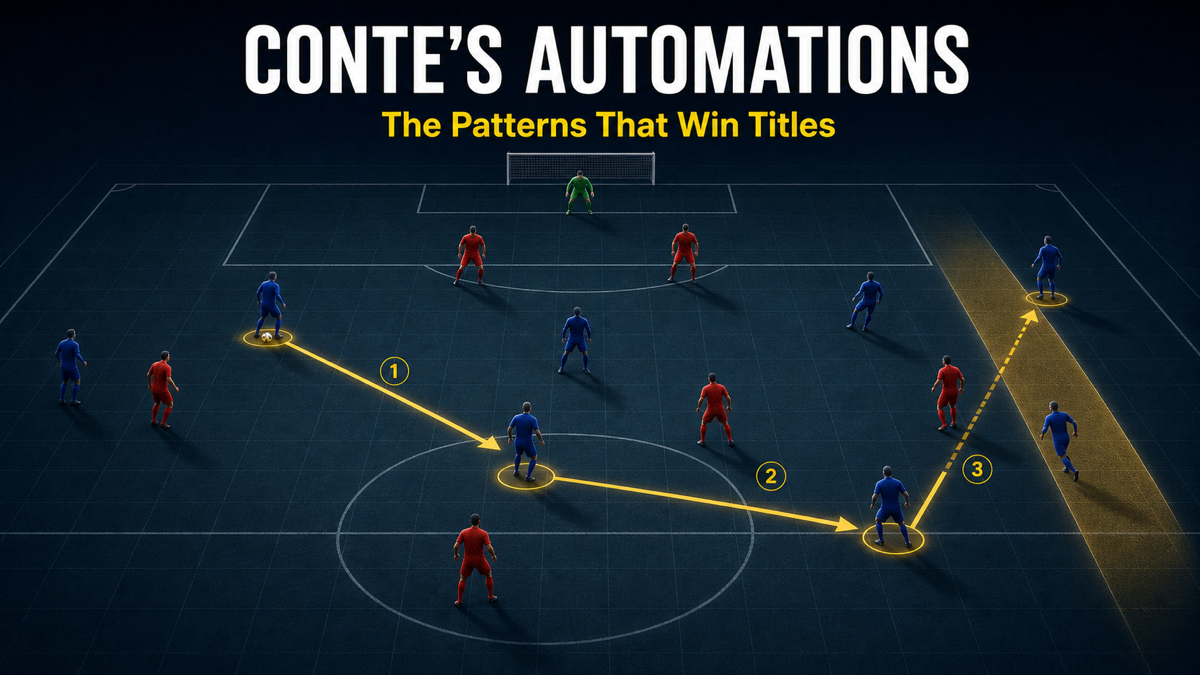
Conte’s Automations: How Patterns of Play Win Titles
Why it connects: Conte’s 2016-17 Chelsea won the title with a back three and wing-backs, the closest club template for Alonso’s side.

Game Models in Football: Why Elite Teams Pick Transition or Possession First
Why it connects: The shift from Leverkusen’s possession to fast-break Chelsea tactics is a live case of choosing a transition-first game model.

Field Tilt: The Metric That Exposes Sterile Possession
Why it connects: Field tilt shows how rarely Chelsea camp in the final third, even in the games they win.
Learn to read a match like an analyst
Get the free 33-page Starter Pack, How to Read a Football Match (the Four Phases, a 15-minute match read, a printable worksheet), plus the 70+ term tactical glossary. Both are yours for an email.
Frequently Asked Questions
What formation does Xabi Alonso use at Chelsea?
Xabi Alonso uses a 3-4-2-1 at Chelsea, the same base shape he used at Bayer Leverkusen. Pedro Neto and Pep Chavarría play as wing-backs, with Cole Palmer and Morgan Rogers behind João Pedro. Without the ball the wing-backs drop, so the back three becomes a back five.
Why do Chelsea have less possession under Alonso?
Chelsea have less possession because Alonso’s Chelsea tactics are built to score early and then counter. They averaged 47.1% possession over the first five matchdays, a club low on Opta’s Premier League record, per The Analyst. They also led the league for fast breaks, so the low share is a choice more than a failure.
Who are the key players in Alonso’s Chelsea tactics?
The key players in Alonso’s Chelsea tactics are Cole Palmer, Morgan Rogers, João Pedro and the two wing-backs. Rogers joined from Aston Villa for a British-record £117m, Palmer roams as the creative 10, and João Pedro scored five league goals in the first six games. Moisés Caicedo is the midfield screen.
How are Alonso’s Chelsea tactics different from his Leverkusen team?
Alonso’s Chelsea tactics share Leverkusen’s 3-4-2-1 but not its control of the ball. Leverkusen kept 62.1% possession in their unbeaten 2023-24 Bundesliga season, while Chelsea averaged 47.1% over the first five matchdays. Chelsea attack faster and concede far more: 13 goals in their first six league games against Leverkusen’s 24 in 34.
Can you copy Xabi Alonso’s Chelsea tactics in EA FC 27?
Yes, EA FC 27 includes a 3-4-2-1 formation you can adapt for Alonso’s Chelsea. Use three Defender centre-backs, a Holding and a Box-to-Box midfielder, Playmaker and Shadow Striker as the two 10s, and an Advanced Forward. Set the defensive depth in game for a deeper block and quick counters.